
The Revival of the “Green Fairy”
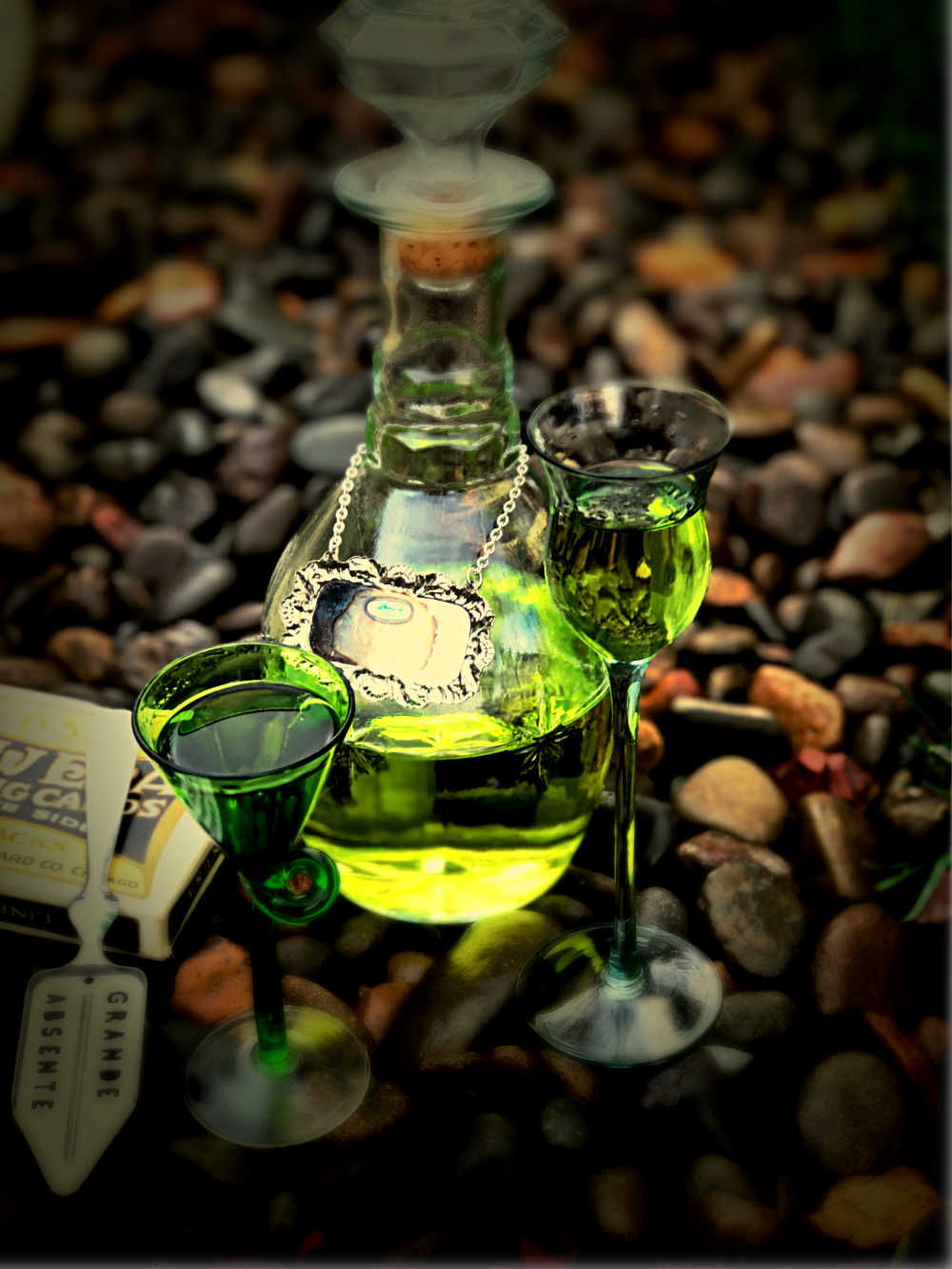
Are you familiar with Absinthe – the “Green Fairy”? A now legalized liquor that has long been rumored to cause madness. No other drink has inspired so much fear, so much awe, and allure as absinthe!
In French, the word “absinthe” means “wormwood.” It was also known as the “green fairy” during its heyday in France in the 1800s. The Green Fairy is the English translation of La Fee Verte, the French nickname given to absinthe in the 19th century. The nickname stuck, and over a century later, “absinthe” and “Green Fairy” continue to be used.
Absinthe is an anise-flavored liquor or spirit that is made by steeping wormwood (wormwood has been defined as the quinine of the poor) and other aromatic herbs (hyssop, lemon balm, and angelica) in alcohol.
The drink is distinguished by its dazzling emerald blue-green clarity, due to its chlorophyll content. When mixed with water, the liquor changes to cloudy white.
Pernod was the original absinthe. It is still distilled today, only without the wormwood. Other liqueurs used today as a substitute for wormwood are Ricard, Hersaint, Anisette, Ouzo, and Sambuca.
Definition of Wormwood: Wormwood is a derivation of the German word “wermut” or the Anglo-Saxon word “wermod,” and has a lineage to the word “vermouth.” Wormwood has also come to mean a bitter or mortifying experience.
Any of 250 strong-smelling plants with white or yellow flowers that are generally classed as weed. It is specifically the Eurasian perennial (Artemisia absinthium) that is so notorious in the cocktail world. It produces a bitter, dark-green oil once used in making absinthe, vermouth, and other bitters. Wormwood had been used medicinally since the Middle Ages to exterminate tapeworms in the abdomen while leaving the human host uninjured and even rejuvenated by the experience.
Absinthe – the “Green Fairy” is traditionally served with water and a cube of sugar. The sugar cube was place on an absinthe spoon (a small slotted spoon), and the liquor was drizzled over the sugar into the glass of cold water until the sugar was dissolved and the desired dilution was obtained. The sugar helped take the bitter edge away from the absinthe, and when poured into water, the liquor turned a milky white. The spoons themselves were often works of art, covered with filigree flowers and stars, or shaped like sea shells.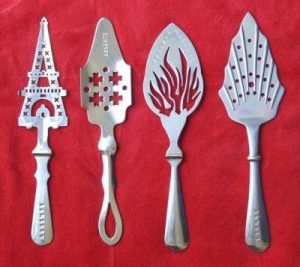
The effect of this drink was related to the degree of dilution, the amount imbibed, and the frequency of drinking. Physical effects of nausea, disorientation, hallucination and seizure were noted by the drinkers of absinthe. Of course, these effects can be noticed by anyone who drinks too much!
The popularity of absinthe lasted just over 100 years.
Absinthe History and Legends
15th Century B.C.
Accounts in ancient texts dating as far as 1500 B.C. mention that wormwood’s medicinal as well as religious significance, and even a drink that was fortified with extract of wormwood. We will likely never know the exact origins of the very first absinthe ever distilled or the name of its original inventor.
1st Century A.D.
The first written detailed description of absinthe’s use and therapeutic properties was written by Gaius Plinius Cecilius Secundus (23 A.D.-79 A.D.), better known as Pliny the Elder’s. He was an Roman scholar, author, naturalist, and naval and military commander. He is known for his great compendium of the knowledge of the ancient world called Naturalis Historia (Latin for Natural History):
“There are several kinds of absinthe: that called Santonic from a city of Gaul, the Pontic from Pontus, where cattle grow fat on it and because of it are found without gall; there is none finer than this. The Italian is far more bitter, while the pith of the Pontic is sweet. About its use all agree, for it is a plant very easy to find and among the most useful; moreover it is honored uniquely in the rites of the Roman people in that at the Latin festival when four-horsed chariots race on the Capitol the victor drinks absinthe, because, I believe, our ancestors thought that it was an honouable reward to be given health….”
18th Century A.D.
1789 – 1792 – According to history or legend (not sure which it is), absinthe was originally developed by Dr. Pierre Ordinaire. He was a French doctor in self-exile due to political reasons, who was living in the Swiss town of Couvet. It was said that he discovered the plant wormwood while traveling in the Val-de-Travers. He mixed wormwood and other herbs with alcohol to create his 136 proof elixir. He used this elixir in his treatment of the sick. After many claims of miracuous healing powers, it became a cure-all. It was eventually nicknamed “la Fee Verte,” which means the Green Fairy.
It is also believed that Dr. Ordinaire either gave or sold his recipe to Mademoiselle Grand-Pierre, who then sold it to two sisters named Henrod in Couvet. Some historical information suggest that the Henroid sisters were making the elixir before Dr. Ordinaire even arrived in the area, and his is credited with being one of the first people to promote it. The Henrod sisters promoted the elixir commercially by offering sample of the elixir to be sold in nearby pharmacies.
1794 – Abram-Louis Perrenoud (1776-1851), a distiller by trade, living in Couvet in the Val de Travers region of Switzerland. Somewhere around the year 1794, Abram-Louis actually scribbled his recipe for absinthe in his diary.
1797 – A Frenchman named Major Daniel-Henri Dubied, a lace merchant, recognized the commercial potential of the formula and purchased the recipe from Perrenoud. Since he had to distilling experience, he employed Abram-Louis’ son, Henri-Louis Perrenoud, who had learned the distilling trade from his father. It is also said that the Major’s daughter, Emile, married Henri-Louis in 1797. In 1798, along with Dubied’s sons, they began producing absinthe under the name of Dubied Pe et Fils.
1805 – In 1805, after several permutations of partnership, Henri-Louis changed his surname from Perrenoud to Pernod and he established a distillery of his own in Pontarlier, France called Maison Pernod Fils.
19th Century A.D.
1847 – Absinthe’s progress from medicine to social poison started with the military. It is said that the demand for absinthe rose dramatically after the Algerian War (1844-1847) when the soldiers were given rations of absinthe along with their drinking water as a bacterial deterrent. The soldiers, now hooked on absinthe, began drinking it in peace time France, thus starting the first surge in absinthe popularity.
1870 – 1900 – Grape Phylloxera (a tiny aphid-like insect that attacks the roots of grapevines) attacked the root stock of vineyard all over the France and Europe. The epidemic devastated most of the European wine growing industry. Within 25 years, grape phylloxera had destroyed two-thirds of the vineyards in Europe. The price of wine skyrocketed and became scarce and very expense. The aristocrats bought and consumed what wine was available. The middle class (the artisans and tradesmen) began looking for a cheaper alternative to wine. As absinthe was already growing in popularity, it became the perfect alternative.
1880 – From the 1880s to the turn of the century, drinking absinthe during the cocktail hour in France became so popular that people begin calling it the I’heure verte (the green hour) for the liquor’s bright green color. Generally, from 5:00 p.m. to 7:00 p.m., the cafes in Paris would be crowded with people drinking absinthe. At cafes, one could find policemen, laborers, bankers, and artists, all enjoying the elaborate absinthe ritual and all getting “loaded.”
Absinthe was the “beaverage du jour” for artists, writers, and poets in Europe. It was known as the drink of the Bohemians. The bohemians were self-impoverished artists, writers, musicians, free-thinkers, and counter-culture types. Manet, Toulouse-Lautrec, Degas, Picasso, de Maupassant, and especially Vincent Van Gogh are associated with absinthe. The “green fairy,” as absinthe came to be called for purportedly causing hallucinations, is thought to have encouraged Van Gogh to cut off part of his left ear. They believed absinthe stimulated creativity. Absinthe was believed to raise the drinkers consciousness, insights, and emotional experience to another level. It seemed that everyone indulged themselves enthusiastically; so enthusiastically in fact that alcoholism began to be a serious problem in France.
Men and women became enthralled with the ritual of presentation as well as with the appearance, taste, and excitement of the liqueur. Absinthe was one of the few drinks considered ladylike and women freely enjoyed drinking it in the dance halls and coffee houses where it was most commonly served. Picasso painted several haunting images featuring absinthe women drinkers.
Absinthe drinking was exported to New Orleans and its French Quarter, where the Old Absinthe House have been a tourist attraction for more than a century. Absinthe appeared in New Orleans liquor advertisements as early as 1837, but its popularity didn’t take off until the latter half of the 19th century with the opening of the barroom that would become the Old Absinthe House in 1874.
20th Century A.D.
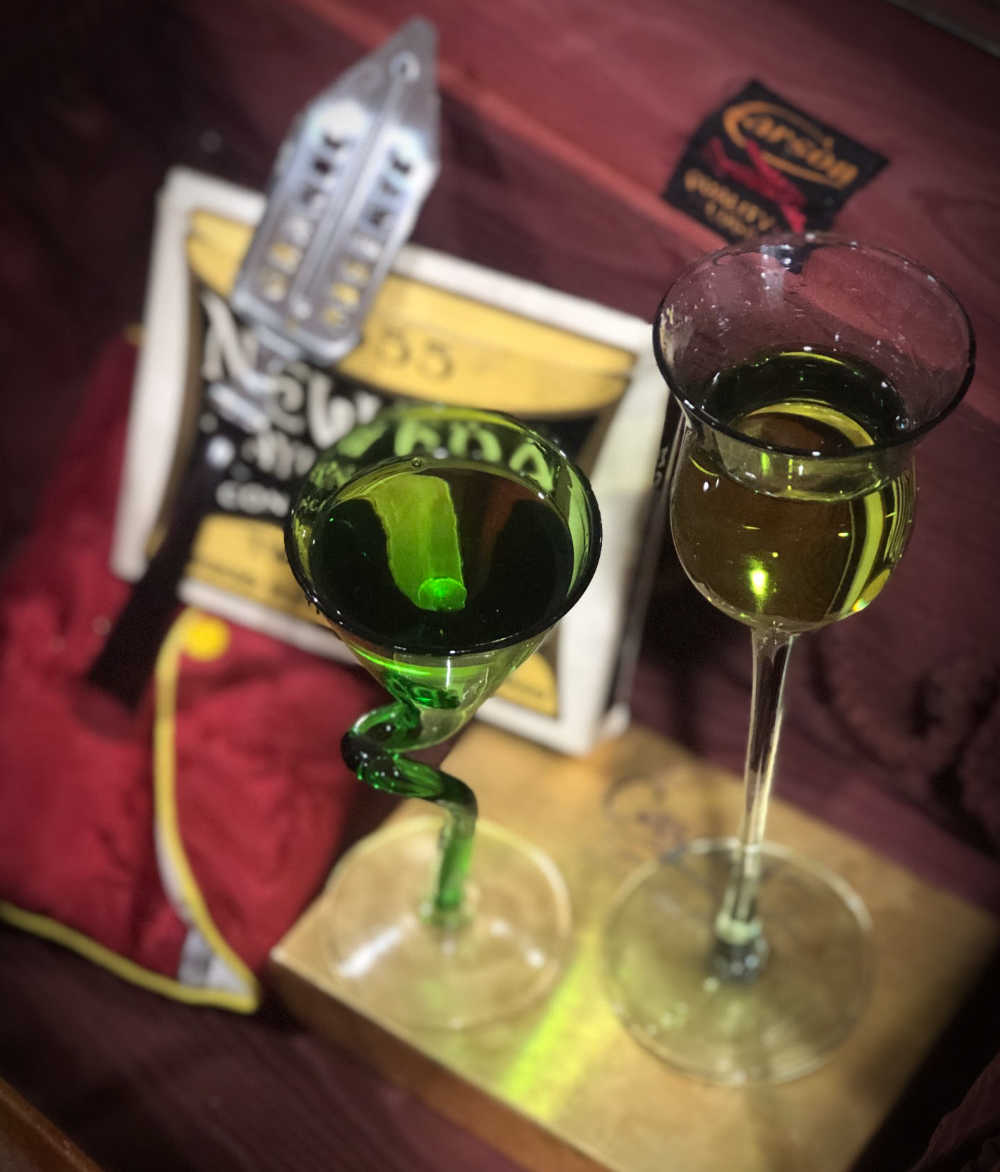
At the turn of the 20th century, much of France (and parts of the rest of Europe and the United States) were on an absinthe binge. This wide spread popularity led to an attempt at its prohibition. Backed by the French wine growers, the temperance movement targeted absinthe as responsible for alcoholism, racial degeneration, and social instability.
1910 – Absinthe was banned in Switzerland
1912 – When the prohibition movements were underway, on July 25, 1912, the Department of Agriculture banned absinthe in America. One of the reasons it is banned in the U.S. is that it was thought to have caused insanity and hallucinations that drove drinkers to commit criminal acts. In other words, it was pretty much like any other alcoholic drink.
1915 – At the outbreak of the First World War, the drink was seen as a threat to the nation, and the National Assembly voted for the bill to ban absinthe as an act of national defense. The France banned absinthe use in 1915.
1990 – A revival of absinthe began in the 1990s, when countries in Europe began to reauthorize its manufacture and sale.
21st Century A.D.
Absinthe is once again legal in most of the world!
2007 – In 2007, after 95 years of prohibition, absinthe was finally authorized again for sale in the United States in bars and liquor stores. U.S. re-evaluation came after European distillers pressured American officials to conduct real research and approve authorization of selling absinthe.
March 5th was declared to be the unofficial National Absinthe Day in the United States. Absinthe Day is another way to celebrate the fact that the popularity of this drink has resurfaced in recent times.
How To Drink Absinthe – Chasing The Green Fairy
My daughters, Nancy and Brenda, and my granddaughter, Tabitha, spent several days in Las Vegas celebrating Tabitha’s 21st birthday. I still ca not believe that I am old enough to have a 21-year old granddaughter. The years just slipped away!
One of the things that I have wanted to do (my bucket list), was to taste absinthe. I had researched this drink for my web site in the past, and wanted to taste it. Now that it is legal again, this was my chance. My daughters have also wanted to taste absinthe. What a better time than on my granddaughter’s 21st birthday! I guess that gives me several excuses and reasons to partake and “Chase The Green Fairy.” Below are photos that I took while our drinks were being made and instructions for you to make your own absinthe drinks.
Traditional Method – Absinthe Drip (Traditional French Method):
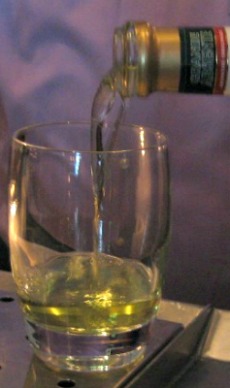 Pour the Absinthe into a glass. Place an Absinthe spoon (flat-slotted absinthe spoon) on the top of the glass and set a single sugar cube on top of the spoon. The sugar is traditionally used to balance the bitter taste of the absinthe. NOTE: If you don’t have an absinthe spoon or sugar cubes, you can just use granulated sugar, mixing it in any glass of your choice.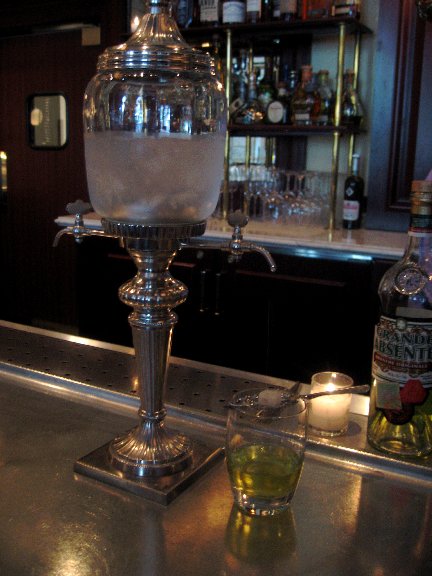
Very slowly drip 3 to 5 parts of iced water onto the sugar cube to dissolve the sugar into the absinthe using an Absinthe Fountain (see above photo) or slowly pouring from a carafe or pitcher. It is important to do this drop-by-drop.
The water added to the absinthe must always be iced, as cold as possible. The advantage of using an Absinthe Fountain is that you could add ice cubes to the water to keep it cold.
The usual ratio for absinthe to water is either 1:3 or 1:5. A traditional 2 ounces of absinthe with 6 ounces water will equal an 8 ounce drink and fill most of the glass
The amount of water added to your absinthe drink is entirely at the customer’s discretion and taste.
The sugar cube will slowly start to collapse and drip into the glass, eventually leaving only a few drops of sugared water on the spoon. As water is slowly poured water into the absinthe, it slowly turns a milky white (opaqueness). This is known as the “louche” effect. According to the brand of absinthe you use in your drink, there is a 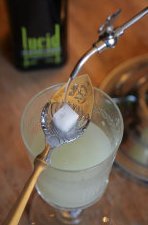 considerable variety both in color and in the opacity of the louche.
As you pour in the water, watch the as it mixes with the absinthe. When the water-to-absinthe ratio reaches a certain level, the essential oils which are dissolved in the absinthe during distillation will emulsify with the water and create the opalescent and cloudy effect known as the “louche.” Seeing the absinthe drink gradually change color was considered a part of its ritualistic attraction.
When the sugar cube has almost completely dissolved, add the rest of the iced water needed (your choice) in a thin stream. Now mix it all together (this is called muddling) with your absinthe spoon.
Your absinthe is now ready to drink. Sip your drink and enjoy.
Option: Some people will add 2 or 3 ice cubes to the finished drink. You may do this, but it may be frowned upon by absinthe purists.
Non-Traditional Method – Bohemian-Style Absinthe (Czech method):
The Czech method is more dramatic, but burning absinthe is not traditional, but it makes an impressive exhibition. This method or gimmick was introduced by the producers of Czech Absinthe (considered a fake absinthe) in the 1990s. It is not recommended because it can be dangerous due to the high alcohol content in absinthe.
To do this method, drip some absinthe onto the sugar cube, sitting on the absinthe spoon, and light it on fire for approximately 1 minute. The fire will caramelize the sugar as it drips down into the absinthe in the glass (the caramelized sugar adds a little additional flavor, This unusual method uses 1/2 the water of the French method, and thus makes a stronger drink.
Favorite Absinthe Cocktail Recipes:
Sazerac Cocktail:
This drink is considered by historians as the first cocktail ever invented. It was originally created by a New Orleans pharmacy in the early 19th century to ward off tropical malaise.
Ingredients:
1 1/2 ounces absinthe
2 ounces Cognac
3 dashes Peychaud’s Bitters
1/2 teaspoon granulated sugar
Instructions:
Shake with ice and strain into an old-fashion glass (or an egg-cup, garnish with lemon peel.
Absinthe Suissesse:
This cocktail is a staple at The Old Absinthe House in New Orleans. There are many variations of this drink. It is also one of the finest “morning after” remedies you will ever taste.
Ingredients:
1 1/2 ounces absinthe
1/2 ounce Orgeat Syrup*
1 egg white
1/2 ounce cream
4 ounces shaved or crushed ice
* Orgeat Syrup is a sweet syrup made from almonds, sugar, and either rose water or orange-flower water.
Instructions:
Combine all ingredients in a blender, blend for 5 seconds and serve in a chilled cocktail glass.
Ernest Hemingway’s Death in the Afternoon Cocktail:
A recipe verified in the 1935 humoristic celebrities’ cocktail book titled, So Red the Nose, or Breath in the Afternoon. Hemingway wrote: “This was arrived at by the author and three officers of the H.M.S. Danae after having spent seven hours overboard trying to get Capt. Bra Saunders’ fishing boat off a bank where she had gone with us in a N.W. gale.”
Ingredients:
Pour one (1) jigger absinthe into a Champagne glass.
Instructions:
Add iced Champagne until it attains the proper opalescent milkiness.
Drink three to five of these slowly.
Absinthe Martini – European style:
The mixture below was created around the beginning of the 20th century, when it became fashionable in France to drink American-style’ cocktails.
Ingredients:
1 1/2 ounces dry vermouth
1 dash absinthe
1 dash orange bitters
Instructions:
Shake with ice and strain into a cocktail glass.
Green Fairy Cocktail:
1 ounce absinthe
1 ounce water
Juice of 1 lemon
2 teaspoons egg white
1 dash Angostura bitters
Shake thoroughly with ice and strain into a cocktail glass.
2 Responses to “Absinthe – the “Green Fairy” Returns”
Pete
In an episode of the Andy Griffith Show Andy’s girlfriend, Peg takes him to a fancy restaurant and orders a Sazerac, which she describes as “kind of a New Orleans drink”. Now that I know Absinthe was illegal in the United States when that episode was filmed, I find it very interesting that mention of Sazerac was allowed. Perhaps they didn’t know the ingredients in it.
Artemisia A.
I can’t believe that you wrote an article about Absinthe without mentioning Thujone. That’s the mildly psychoactive chemical in Wormwood. Absinthe was banned in the US due to Thujone. Now that it’s legal, many commercial Absinthe products have very little Thujone, if any. For real Absinthe, you need the highest level of Thujone you can find. Otherwise it’s just green liqueur. While Wormwood doesn’t cause hallucinations, it does make every thing around you look crisp and sharp. Your peripheral vision is in front of you- it’s hard to explain. I grow Wormwood, and drink the tea at times. Thujone pools in the Liver and doesn’t process through it well, according to the Merck Index. 3.5 ounces makes a good cup of tea. That’s about 3 or 4 stalks. It tastes like crap!!! I think when Absinthe was in style, all the artists who were hallucinating had Liver disease. High ammonia levels is a sign of Liver failure. And causes hallucinations. Anyway, buy Absinthe with the highest Thujone level you can find! Cheers! 💚