
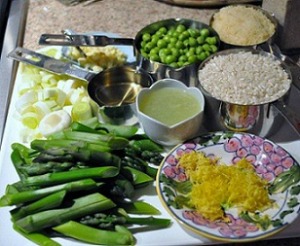
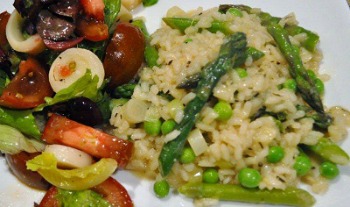
This a delicious and wonderful Lemon Risotto with Spring Vegetables to serve when the spring asparagus and peas are available. The ingredients list is long, so have everything read to go (Mise en Place) and then all it takes is about 20 to 25 minutes from stove to table.
This delicious lemon risotto recipe, comments, and photos were shared with me by Karen Calanchini, Food Stylist and Photographer, of Redding, CA.
Learn How To Make Risotto Ahead of Time – With this technique, that is used by restaurant chefs, you never have to stand at the stove, stirring, for 20 minutes while your guests wonder where you have gone. You can make any kind of risotto you want using this method.
Before making risotto, please read Making Perfect Risotto. Lots of hints and tips to help you.
- 1 pound asparagus, trimmed and cut into 1 inch pieces
- 1 teaspoon salt
- 5 1/2 cups chicken stock or broth (reduced-sodium)
- 1 tablespoon olive oil, extra-virgin
- 2 medium leeks, cleaned and chopped
- 3 garlic cloves, minced
- 1 teaspoon thyme,qchopped
- 1 1/2 cups Arborio Rice
- 1/3 cup white wine
- 1 cup frozen green peas, thawed
- 1 teaspoon lemon zest, grated
- 3 tablespoons lemon juice, fresh-squeezed
- 1/2 cup parmesan cheese, freshly-grated
- 1/4 teaspoon black pepper, freshly-ground
-
In a large pot, cook the prepared fresh asparagus in a small amount of boiling water until they are a bright green. Remove from heat, drain, and rinse in a colander under cold running water to stop the cooking process; set aside.
-
Trim and clean leeks:
-
Thinly slice the white portion. You need to thoroughly clean a leek because dirt can become trapped in its many layers. Trim the root portion right above the base (cutting too far up the stalk will remove the part that holds the layers together). Slice off the fibrous green tops, leaving only the white-to-light green stalk. Discard greens. Cut the leek in half lengthwise, then cut according to your recipe (slice, chop or dice).
-
Heating the broth or liquid:
-
All the flavors that the cooking liquid starts out with become more concentrated and intense as it evaporates. Bearing that in mind, when the recipe requires broth, you will use a fine, mild beef or chicken broth. It is always better to use homemade broth or stock, but if you do not have the time (like most of us), do not worry! Swanson's Organic Chicken and Beef broths are great for making risotto.
-
In a large saucepan over medium-low heat, bring chicken broth to a slow, steady simmer (the liquid should stay hot but not simmer). Place this pot on a burner, over low heat, next to the burner you will be using to make the risotto. Keep the broth simmering slowly.
-
Toasting the rice:
-
Cooking the rice in hot butter or oil before adding liquid helps the rice to absorb the liquids slowly without becoming soggy. This is called "Toasting the Rice."
-
In a large heavy 4-quart pan (or non-stick pan) over medium heat, heat the olive oil; add leeks, garlic, and thyme. Saute approximately 3 minutes or until soft (be careful not to brown the leeks).
-
Add the rice and cook, stirring approximately 1 to 2 minutes, making sure all the grains are well coated (toasting the rice in hot oil keeps it from getting mushy). Toasting the rice also quickly heats up the grain's exterior (toast until the rice is hot to the touch and the color should remain pearly white and translucent, but not turn brown).
-
Add the wine and stir until completely absorbed, approximately 2 to 3 minutes.
-
Add liquid in increments:
-
The quantity of liquid suggested in the recipes is always approximate. In actual cooking, you should be prepared to use more, or sometimes less, as the risotto itself requires. All the flavors that the cooking liquid starts out with become more concentrated and intense as it evaporates.
-
Add the hot chicken broth (1 cup at a time), stirring frequently. Add liquid slowly and stirring frequently are the keys to making perfect risotto. Run your wooden spoon across the bottom of the pot to determine when each addition of broth is almost completely absorbed. Wait until each addition is almost completely absorbed before adding the next cup of hot chicken broth, reserving about 1/2 cup chicken broth to add at the end. Stir frequently to prevent sticking.
-
Risotto does not need constant attention during its 18 minute cooking time. You will just need to check on the pan every few minutes, give the rice a stir to keep it from sticking, and add more chicken stock.
-
Finishing the risotto:
-
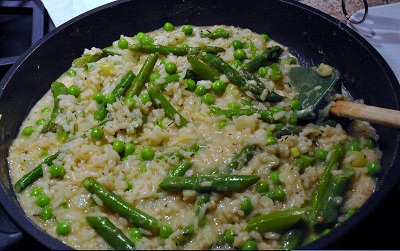
After approximately 18 minutes, when the rice is tender but still firm, add the asparagus, peas, lemon zest, lemon juice, and the 1/2 cup reserved hot chicken broth. When cooking with broth, if you have used up the broth before the rice is fully cooked, continue with simmering water.
-
The rice is done when it is tender, but firm to the bite. The total amount of cooking time may vary within 2 to 3 minutes. The total cooking time from the first addition of chicken broth should be approximately 22 minutes.
-
Turn off the heat and immediately add the parmesan cheese and pepper, stirring vigorously to combine with the rice. Serve immediately.
-
Makes 4 to 6 servings as a main dish.

Source: Recipe adapted from the cookbook, Weight Watches Greatest Hits: 250 Classic Recipes from the Sixties to Today.