
Dealing with Kitchen Downsizing
Simple Tips for Going Smaller
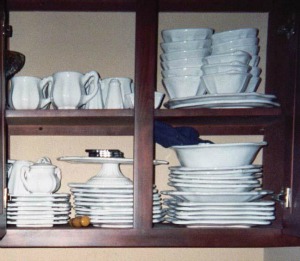 Moving to a smaller kitchen can be a large task. Sometimes, just looking at the quantities of kitchen cabinets, appliances, and dishes will make you think downsizing is not possible.
It is quite possible to move to a smaller home and a small kitchen and still have everything you need. I speak from experience. I have downsized my own home, relative’s homes and, as a professional organizer, those of my client’s. In this economy, it is not just seniors moving into senior communities that downsize, so you are in good company.
Begin with Encouragement:
At some point in your life, you most likely lived in a smaller space. Nearly all of us spent time in a dorm room, a shared apartment, a newlywed bungalow, or a tiny starter home. Since you are reading this, it is a good guess you did not starve during those years. You managed just fine in less space and with less kitchen gadgets and you can do so now.
Get Real with your Sorting – Ask yourself if you need it:
Ask yourself if you need some of it but not all of it – For example, let us say you have 8 coffee cups with your dish set, 4 favorite mugs with nice fat handles, several souvenir mugs, and other mugs from mysterious origins. When was the last time you served coffee to 32 people? Pare it down!
Do not be afraid to break sets – Used dishes have little resale value. You will not lose much, if anything at all, if you keep half of a set and sell or donate half of a set. Someone else with a tiny space will be happy to have half. So if you have 24 drinking glasses in your set, with 12 tumblers and 12 shorter glasses, then keep half of each. If you have a dish set with service for 12 or for 8 people, then keep only service for 6 or for 4 people. Indeed, if you are like me and never use the cups that came with the dishes, then let those cups go.
Keep only one way to cook something – Think of all the ways someone can cook a hotdog. You could pan grill it, boil it, microwave it, put it on the George Foreman, use the outdoor barbeque, and/or broil it or stick it on a coat hanger in a fire. So why would you need a hotdog cooker? You do not need both a 4-cup and an 8-cup coffee maker. You do not need both an electric skillet, a 20-inch cook top skillet, and a wok.
Check your decisions – Ask yourself, “If I did not own this, what would I use instead?” If you can’t think of anything, keep it. If you can not come up with a reason, let it go!
Keep only one – Many common kitchen items often have duplicates. Purge down to one colander, one set of measuring cups, one spatula, one set of tongs, and so forth.
Make Good Use of Space Available:
You will need every inch of space in a small kitchen. Below are some great ideas for organizing your kitchen storage spaces:
Use plate stackers:
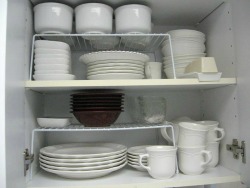
You’ll be able to use all of the cabinet space by stacking plates, bowls, cups, and canned goods on stackers.
Use turntables:
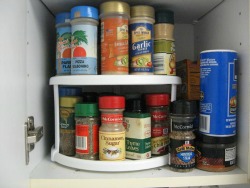
You can get a lot of bottles and spices into one cabinet with these turntables.
Use the inside of cabinet doors:
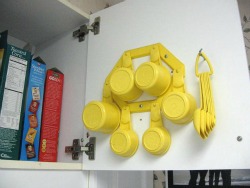
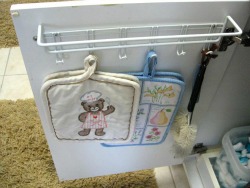
Add organizing products to the inside of your cabinet doors. Some common ones are designed to hold foil, wraps, hand towels, and/or pot lids. Add hooks inside of doors for measuring cups or anything with a loop or hole for hanging.
Add pullout baskets:
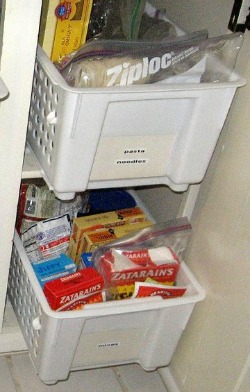
Baskets installed in lower cabinets allow you to use every inch of space. Even the use of a plastic tub that you can slide out is helpful.
Use a ladder:
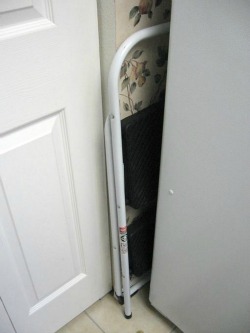
In a big kitchen, we put seldom used things on top shelves. In a small kitchen, you have let go of seldom used things and everything
you have is used. This means you will need access to top cabinets. A one-inch wide step ladder can slide in between the wall and refrigerator.
Use space in the laundry room:
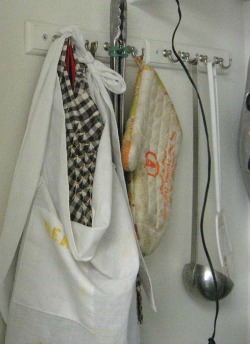
In a small home, laundry facilities are often in an adjacent closet. Use the wall space next to the washer for hooks to hold items like aprons, barbecue tools and other odd items.
 Author Lea Schneider, a columnist for What’s Cooking America, is a freelance writer and organizational expert whose organizing ideas have been published in many magazines including Woman’s Day, Better Homes and Gardens Kitchen and Bath Ideas, Family Circle, Parents Magazine, as well as numerous newspapers and websites. She is a member of the Association of Food Journalists.
Getting organized is all about living simpler and making things easier. The bonus is it often leads to saving money. Lea Schneider’s kitchen organizing columns tell you how to organize the many things that relate to kitchens, menus, meals, and special food events.
Check out all of Lea Schneider’s helpful home and kitchen columns at Organizing Kitchens, Pantries, Menus and Meals.
Categories:
Kitchen Organization