
My food bill continues to rise – How about yours?
The food budget in our household is the largest of our variable expenses. There are so many other kinds of bills that I have no control over. This makes me want to work even harder to save at the grocery. With rising grocery prices, your resolve to save is probably not enough. You need a plan.
Break out your organizing skills and use them to hunt for a bargain. To get the most bang for your buck, you can no longer just go to the closest market and picking up everything you need. It may be efficient but it might also be costly.
Think of stores, outside your normal grocery chains, which may offer better prices. This time of year, you will find fresher and better priced produce at local farm stands or farmer’s markets. In addition, we buy a ton of things with our food money that we do not eat, from hairspray to laundry detergent. Many of those things are cheaper in dollar or discount stores.
Here are some tips to help organize for savings:
 Do not stick to one store. Choose two or more near-by stores. It generally does not pay to burn gas to drive across town to save 10 cents a pound on something.
Lay out the competing newspaper ads or look at them at the store’s website. Grab a sheet of paper. Make a list, by store, of the really great deals. Those include:
Buy one and get one free items.
Ten for $10 items.
Produce on sale that is also in season.
Meat specials
Use the list you have made of sale items from the newspaper ads to develop the meal ideas. Concentrate on making meals out of the items featured on the front and back cover of the advertising circular. Those featured items, such as chicken quarters or watermelon, are the biggest price break.
The more times you run into a store, the more you spend. Make a menu and then shop for two weeks of meals. My money saving ideas involve stopping at several spots. It really will not impact your schedule much when you get a lot of groceries at one time. Then you will not be heading out for several weeks and will have more free time.
Avoid pre-packaged or already prepared foods, even if the buy one-get one free types. This is the time to break out your recipe collection and actually cook something.
 In the warm weather, throw your cooler in the car and get going. Freezer ice packs are handy to have on hand as they won’t get your packages wet like melting.
Make your first stop the dollar-type or discount store. Stock up there on all those non-grocery items…the shampoo, toilet paper, paper towels, dishwasher soap and so forth. In addition, they have a selection of dry goods and I can typically pick up cereal, cake mix and canned goods for less money.
Find a bakery outlet. There’s been one or more in every city I’ve lived in. Make it your next stop for bread, cereal, rolls, buns and more. Mine has the cheapest spices in town, just a $1 to $2 a jar, so pay attention to what all they carry besides bread. Remember, bakery items freeze well.
Stop at the local farm stand for produce. If you are not sure where to find one in your area, contact your county extension agency.
Next, decide which is grocery store that you feel has the best prices in general. Shop there last. First, go to the other store (or two) and pick up the only the sale items you selected for your meals. Toss the frozen/cold items in your cooler. At the final store, grab their sale items plus anything left on your grocery list.
For shopping ease, divide your list into sections: fresh produce, personal hygiene items, cleaning supplies, canned goods, and baked goods. I highlight one store’s sale items in yellow and another store in orange.
When at the store:
 Do not buy items from any special in-store displays. That mound of cookie boxes that looks like a good deal may not be a good deal. When it is displayed off of the cookie aisle, you cannot compare the name brand to the store brand. You cannot see if the bigger or smaller package is a better buy. Stick to shopping from the main aisles and not the displays.
Try to purchase extra of anything you think is a really good deal, for example the kids’ favorite cereal on a buy one-get one free special. I will admit that is sometimes hard to buy extras on a budget. If you just purchase extras of one or two sale items, it will help in the long run. Y ou will eventually have a well-stocked pantry purchased at sale prices.
 Try the store brands. They are often as good as or better than more expensive national brands. I have very few products, for example laundry soap and dishwasher soap, where I feel the name brand is much better. Otherwise, I buy store brands and pocket the savings.
Carry a calculator. Watch the price per ounce. Larger is not always cheaper.
Use coupons BUT only when that item is already on your shopping list. Do not shop based on coupons at hand. Instead, make your grocery list and then see if you have coupons. Buying something you do not need just to use a 55 cent coupon is not saving money. Read Clues for the coupon clipper.
Watch the register when checking out to make sure you are getting charged the correct price.
When at home:
Plan on spending a bit of time in the kitchen after unpacking your groceries. Chopping your own cauliflower and broccoli into bits and popping it in a fresh bag is just half the price of buying the pre-cut, pre-packaged stuff. Cutting up a big watermelon or honeydew is not only healthier, but will go a lot further for snacking that the money spent on a bag of chips or pack of cookies.
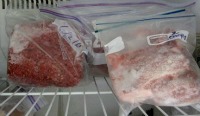 Save on meats by doing a bit of work at home as well. Sometimes, boneless, skinless chicken breasts are on sale at the meat counter. However, they are not as convenient as a bag of individually frozen breasts. You can easily create your own individually frozen ones. Spray a rimmed baking sheet with cooking spray to prevent the chicken from freezing to the pan. Place the individual breasts on the sprayed sheet. Place in the freezer. Set a timer for about two hours. Return to the freezer and pop the now nearly-frozen chickens in a zippered bag or air-tight plastic container.
Divide larger family packs of chops, steaks or ground beef into portions suitable for your household, wrap or bag and pop in the freezer.
Make a cake instead of buying cookies. A box cake mix, on sale, is less that a $1. Add two eggs and a bit of oil and you end up with a nice size pan of treats. A pan of store-bought cookies or brownies would cost $5 or more for the same amount.
Most of all, consider this an adventure rather than a chore. Every dollar you save is money you can use in other ways. Consider those dollars your reward for an organizing job well done.
 Author Lea Schneider, a columnist for What’s Cooking America, is a freelance writer and organizational expert whose organizing ideas have been published in many magazines including Woman’s Day, Better Homes and Gardens Kitchen and Bath Ideas, Family Circle, Parents Magazine, as well as numerous newspapers and websites. She is a member of the Association of Food Journalists.
Getting organized is all about living simpler and making things easier. The bonus is it often leads to saving money. Lea Schneider’s kitchen organizing columns tell you how to organize the many things that relate to kitchens, menus, meals, and special food events.
Check out all of Lea Schneider’s helpful home and kitchen columns at Organizing Kitchens, Pantries, Menus and Meals.
Categories:
Kitchen Organization