Bacon and Tomato Pizza - How To Make A Pizza


  Home    |   Recipe Indexes   |   Dinner Party Menus   |   Food History   |   Diet - Health - Beauty

Baking Corner |  Regional Foods | Cooking Articles Hints & Tips | Culinary Dictionary | Newspaper Columns


Follow What's Cooking America on Facebook


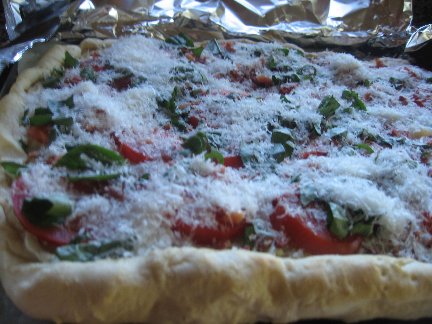
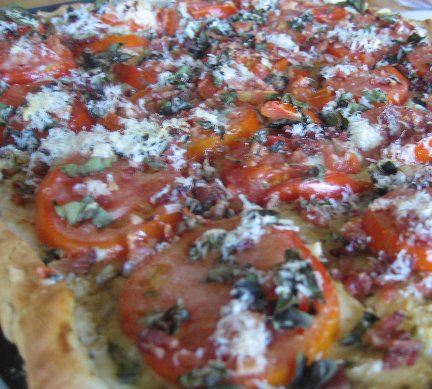
I created this wonderful and unusual pizza because of all the wonderful vine-ripened tomatoes growing in my garden that I needed to use. I also love the combination of bacon, tomatoes, and basil. Eating this pizza will remind you of a BLT Sandwich.
Bacon and Tomato Pizza

Bread Making Hints: Secrets to using the bread machine, About yeast in bread making, Sourdough Starter, Quick Breads.

More great Pizza Recipes and Bread Recipes for your bread making.


Bacon and Tomato Pizza Recipe

Recipe Type: Pizza, Pizza Dough, Tomatoes, Bacon
Yields: 2 (14-inch) pizzas or 1 (24-inch) pizza
Prep time: 20 min
Cook time:25 min


Ingredients:

Parmesan Thin Crust Pizza Dough (see recipe below)
Pizza Toppings (see recipe below)


Preparation:

Prepare Parmesan Thin Crust Pizza Dough according to recipe below.

Prepare Topping Ingredients according to recipe below.

When ready to assemble, preheat the oven and Pizza Stone or tiles to 450 degrees F.

Place the Pizza Toppings on the pizza according to the directions below.

Bake the pizza in the center of the oven until the crust is golden brown, approximately 15 to 20 minutes.

Remove your pizza from the oven and allow to cool for 5 minutes before transferring to a serving pan. This cooling down step allows the crust to stay crisp and the topping to set. Once cool, cut your pizza into slice and serve.

Makes 2 (14-inch) pizzas or 1 (24-inch) pizza.


Parmesan Thin Crust Pizza Dough:

1 to 1 1/2 cups warm water (110 degrees F.)*
1 tablespoon extra-virgin olive oil
1/2 teaspoon coarse salt
1/2 cup freshly-grated
Parmesan Cheese (Parmigiano-Reggiano)
3 cups bread flour
2 teaspoons instant active dry yeast

* The amount of Parmesan cheese used will indicated how much water will need to be added. I always seem to add more Parmesan cheese than the 1/2 cup water called for in the recipe. Because of this, I always need to add the extra 1/2 cup water. If you think you need to add additional water, add warm water, a tablespoon at a time).

Add all the ingredients in the bread pan of your Bread Machine. Process according to manufacturer's instructions for a dough setting. It should form a nice elastic ball. If you think the dough is too moist, add additional flour (a tablespoon at a time). The same is true if the dough is looking dry and gnarly. Add warm water (a tablespoon at a time).

When dough cycle has finished, remove dough from pan and place into a lightly oiled bowl. Cover the bowl tightly with plastic wrap and let the dough do a slow rise for 24 hours in the refrigerator before using. Do not skip this step.

When ready to use, remove from refrigerator and allow the dough to come to room temperature, approximately 1 to 2 hours.

Meanwhile preheat the oven and Pizza Stone or tiles to 450 degrees F.

Turn the dough out onto a large surface and dust the pizza dough with flour. Pick up the dough and, keeping both hands together, grasp it lightly at the top of the edge. Letting gravity do the work, start rotating the dough as though you are turning the steering wheel of a car and don’t stop until you’ve gone all the way around. This will stretch the dough without the risk of thinning out the center too much. Roll and stretch the dough out very thin to form a 24-inch or larger circle.

Place the dough on the prepared Pizza Peel. The dough should be docked. Thin pizza crusts usually needs to be well docked to help control blistering and bubble formation during baking. This just means to prick it all over the middle part (not the edges) so that it doesn't inflate. Either use a Dough Docker or use a fork to prick the dough thoroughly.

Pre-cook the pizza crust for approximately 4 minutes before adding any toppings. After pre-cooking, remove the partially baked crust from the oven and pop any large air pockets with a fork. Let crust cool before topping (this will produce a crispy and chewy crust).


Pizza Toppings:

8 tablespoons mayonnaise
3 tablespoons prepared Basil Pesto
Tomato Slices
Salt and pepper to taste
6 to 8 bacon slices, cooked crisp and crumbled
4 tablespoons coarsely chopped fresh basil leaves
3/4 cup freshly-grated
Parmesan Cheese (Parmigiano-Reggiano)

In a small bowl, combine the mayonnaise and pesto; using a knife, spread mayonnaise mixture over the top of the partially pre-cooked and cooled pizza dough.

Layer the tomato slices over the mayonnaise mixture; lightly season tomatoes with salt and pepper. Sprinkle the bacon and basil over the top. Sprinkle parmesan cheese over top of pizza.

Place on hot Pizza Stone or baking tiles and bake for approximately 15 minutes or until crust is golden brown on the bottom and the top is bubbly. Remove your pizza from the oven and allow to cool for 5 minutes before transferring to a serving pan. This cooling down step allows the crust to stay crisp while it cools. Once cool, using your Pizza Cutter or Pizza Wheel, cut your pizza into slices and serve.

Makes 2 (14-inch) pizzas or 1 (24-inch) pizza.


Pizza Making Hints & Tips
How To Use Pizza Stone - How To Use Unglazed Tiles - How To Clean Pizza Stones


Pizza Stones - How To Use Pizza Stones:

pizza stoneA baking or Pizza Stone should be placed on a oven shelf and preheated with the oven. Preheat the stone to the temperature you’ll be cooking the pizza at BEFORE you put the pizza dough on the stone. Pizza stones need at least 20 minutes to heat up fully. Once pre-heated, the stone evenly transfers intense heat to the food being cooked, ensuring a particularly crisply baked base. NEVER put a cold stone in your fully heated oven unless you want it to crack.

I have a large stone that fits on oven rack in my oven. Either this stone or some unglazed terra cotta tiles are usually in my oven most of the time as they are also great for bread baking. Casserole dishes can also be set on top of the stone.

Linda's Comments: As to if it might crack, this I do not know, as I have never had it happen. I always place the cold pizza stone in a cold oven. I then turn on the oven to preheat oven and stone. Once the stone is hot, I do not remove it from the oven. I place my prepared pizza on the hot stone in the oven.


How To Clean Pizza Stones: Think of your pizza baking stone as a sponge; it will soak up everything put on it. These "stones" are actually molded sand, tightly compacted under high pressure. Like sand on the beach, they will suck in any liquid exposed to the surface. Anything else in the water - including soap - goes right into the stone. Manufacturers warn you to use only clear, plain water to clean a baking stone.

First, completely submerge your baking stone in warm, clear, plain water for 15-20 minutes. This should thoroughly saturate the stone with clean water and dilute the soap residue. Next, remove the stone from the water and place it on a pie cooling rack on your kitchen counter. Allow the stone to dry completely overnight.

Repeat the same soaking and drying process five or six nights in a row. After the last round, bake some pizza dough on the stone. If the pizza stone still smells, I'm afraid your stone is destined for the trash.


How To Use Unglazed Terra Cotta Tiles:

unglazed tiles
I, personally use these tiles all the time in my oven. You must make sure that they are "unglazed" tiles only. They are very cheap to buy (You can find them at any hardware/home store. I buy them at my local Home Depot). I even leave them in my oven when using the self-cleaning cycle. I bought enough to line the bottom shelf of my oven. Most of the time, I just leave them in the oven all the time as these tiles don’t effect the oven’s performance and are great to help stabilize the heat when cooking or baking.


Hints from Shelley Booth of Phoeniz, AZ: For bread and pizza baking I use inexpensive unglazed terra cotta tiles. From experience as a potter I know that terra cotta is food safe when unglazed and not for storing liquid. Terra cotta in general is fired at a lower temperature when not glazed and has not vitrified, thus it is porous, which makes it ideal to use as plant pots but not for liquid storage.

I preheat the oven for one hour, tiles on lower rack, where it stays unless something bulky is baked. Dust the tiles with cornmeal and slide the pizza skin or bread and bake until done. I often pre-bake the pizza skin to a point where the skin is done and just starting to brown. Cool and then add whatever desired and baked again until brown and cheese bubbly.

Another thought, when baking anything I will put the container on the preheated tiles. The concept behind this that ovens, especially electric cycle on and off in order to maintain the set cooking temperature without spiking. This result in a variable oven temperature and when baking bread this could effect the end product. The tiles store heat and thus help maintain a consistent temperature. A gas oven, which I use, does the same cycling but not as often and maintains the temp profile better.


Dough Dockers:

dough docker
Thin pizza crusts (known as cracker dough) usually needs to be well docked to help control blistering and bubble formation during baking. This just means to prick it all over the middle part (not the edges) so that it doesn't inflate. Either use a Dough Docker or use a fork to prick the dough thoroughly. In a home setting, it is also common to use dough dockers if the pizza dough is to be pre-baked or par-baked before finishing. That applies mostly to cracker style pizzas.


Pizza Peels: Also known as a pizza shovel. Pizza Peels are a long-handled, wide wooden or metal spatula-like implement that slides quickly and easily under the pizza, keeping hands safely out of the fiery oven. It is used for moving pizzas to and from an oven. Sprinkle cornmeal all over the surface of a baker's or pizza peel before using.

metal pizza peel

wood pizza peel class=


Pizza Cutters/Pizza Wheels:

A good Pizza Cutter or Pizza Wheel will save you time when cutting your pizza into slices. The use of a pizza cutter instead of a sharp knife avoids the dislodging of loose toppings through the back-and-forth motion of the blade typical of a knife. Pizza cutters press their blade down vertically instead.

Pizza Tips:

A helpful hint is to put a piece of parchment paper on the peel instead of using cornmeal. I place the rolled-out pizza dough on the parchment paper and then add the toppings. The parchment goes into the oven with the pizza. This makes it easier to slide the pizza off the peel and onto the baking stone.

If you don't have a peel, an upside-down cookie sheet will do if you use parchment paper. Just slide the pizza onto the stone with the paper.

Does pizza have to be a circle? - You can make them triangular, square, diamond, or anything else you can imagine. Just change the shape of your pan to the shape of a crust that fits your imagination.