Boiling Points of Water
Sea Levels vs. High Altitude Water Temperatures
How To Boil Water:
Boiling water is very easy to do, but it is crucial to many meals, such as cooking rice and Pasta.
Choose a pot that is large enough to hold the amount of water you want to boil, and has a lid that fits.
You might be tempted to use water that’s already warm or hot from the tap, but this water has been sitting in your pipes for some time, getting stale. Use cold water if you are going to drink it or cook with it.
Do not fill the pot all the way up. Keep in mind that anything you add to the boiling water will increase the volume, and plus – you will need to allow room for those bubbles to do their thing. Without enough room in the pot, for example, rice or pasta will boil over.
Place the pot on the stove and turn the heat to high. If you want to speed up the process, put a cover on it
Check for steam escaping from under the lid, then lift the lid carefully to see how the water is doing.
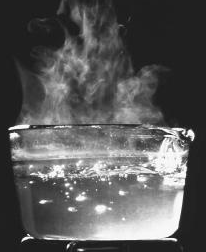
Look at the water. If large bubbles are rising from the bottom of the pot to the surface, the water is boiling. NOTE: Small bubbles that stay at the bottom or sides of the pot are air bubbles present in the water; they do not necessarily indicate that boiling is imminent. Wait for bubbles that rise to the top of the pot.
High Altitudes:
Water will boil at high altitudes, but it is not as hot as boiling water at sea level. This is because the air pressure is lower at high elevations. Boiling occurs when the water is hot enough to have the same pressure as the surrounding air, so that it can form bubbles. At high altitudes, air pressure is lower than at sea level, so the water does not have to get so hot to get to boiling.
Because the temperature of the boiling water is lower at high elevations than at sea level, it takes longer to cook at higher altitudes than at sea level. The speed that food cooks is not related to the time it takes to boil.
Adding a little salt to the water will cause the water to boil at a slightly higher temperature which can be helpful while cooking especially at high altitudes.
Boiling Points of Water:
From the book Kitchen Science by Howard Hillman
Salt: Salt, sugar, and practically any other substance elevates the boiling point and therefore shortens cooking time. The difference in temperature between unsalted and salted water (one teaspoon of salt per quart of water) is about 1 degree to 2 degrees F, a difference that can be critical in cooking situations demanding exactness.
Hard Water: Hard water defines water with a high level of dissolved mineral salts. Therefore, hard water boils at a higher temperature. The difference in the boiling point between typical supplies of hard and soft water is about a degree or two.
Alcohol: Alcohol has a lower boiling point that water (about 175 degrees F. as compared with 212 degrees F.). If you dilute water with alcohol, the mixture will have a lower boiling point up until the alcohol completely evaporates. Should you decide to alter an existing recipe by substituting a fair portion of wine for some of the water, remember to extend the cooking time by 5 to 10 percent depending on the alcohol strength of the wine and the heaviness of your touch.
Weather: The boiling point of water is a degree or two lower on stormy, as opposed to fair, weather days. Consequently, boiled food will take longer to cook on a stormy day.
Different Size Pans: Will a given volume of water boil at a higher temperature in a tall, narrow pot than in a short, wide one? Yes. since the tall, narrow pot has a great depth, its bottom-lying water is under greater pressure from the water above it than is the water at the bottom of the short, wide pot. The greater the pressure, the high the boiling point. The difference is approximately 1 degree F.
Altitude: The higher the altitude, the lower the atmospheric pressure. The less atmospheric pressure that bears down on the surface of the liquid, the easier it is for water molecules to escape into the air. Thus, the water comes to its full rapid boil at a lower temperature in the mile-high city of Denver than it can in coastal Miami. For each thousand feet above sea level, the boiling point of water drops almost 2 degrees F.
Temperatures of Water:
Approximate Boiling Temperatures of Water
Altitude – Temperature
Sea Level – 212 degrees F. – 100 degrees C.
1,000 ft. – 210.2 degrees F. – 99.00 degrees C.
2,000 ft. – 208.5 degrees F. – 98.06 degrees C.
3,000 ft. – 206.7 degrees F. – 97.06 degrees C.
5,000 ft. – 203.2 degrees F. – 95.11 degrees C.
7,500 ft. – 198.9 degrees F. – 92.72 degrees C.
10,000 ft. – 194.7 degrees F. -90.39 degrees C.
15,000 ft. -185.0 degrees F. – 85.00 degrees C.
High Altitude: Water boils at less than 212 degrees F. (approximately 96 degrees F.). Each 500 foot increase in altitude causes a drop of about 1 degree in the boiling point.
Sea Level: Water boils at 212 degrees F. and simmers at 190 degrees F.
Tepid Water – 85 to 105 degrees F. – The water is comparable to the temperature of the human body.
Warm Water – 115 to 120 degrees F. – The water is touchable but not hot.
Hot Water – 130 to 135 degrees F. – The water is too hot to touch without injury.
Poach – 160 to 180 degrees F. – The water is beginning to move, to shiver.
Simmer – 185 to 200 degrees F. – There is movement, and little bubbles appear in the water.
Slow Boil – 205 degrees F. – There is more movement and noticeably larger bubbles.
Real Boil – 212 degrees F. – The water is rolling, vigorously bubbling, and steaming.
Additional Interesting Articles on Water:
Water – The Fountain of Youth – I am sure you have heard it many times “Drink more water, it’s good for you!” For thousands of years, people of all countries have been seeking a mythical fountain of youth. If I told you that there is something that will give you beautiful glowing skin, diminish those fine lines and wrinkles, increase your energy level, and help your overall health, I bet you would listen and be interested. All the time, this fountain of youth has been right here in our everyday life. Yes, the fountain of youth is water!
Poaching vs. Simmering vs. Boiling – The difference between poaching, simmering, and boiling is just a matter of temperature degrees.