
What is the first thought that comes to your mind, when you think of strawberries?
It is probably of a mouth-watering dessert of strawberries mixed with fresh cream? There’s nothing that says “Hello Summer” quite like eating a juicy vine-ripened strawberry that has been ripened to perfection in the early summer sunshine. Strawberries serve more than just fulfilling the sweet tooth. It is packed with hordes of health benefits, making a nutritious fruit for mind and body.
Selecting and Purchasing Strawberries:
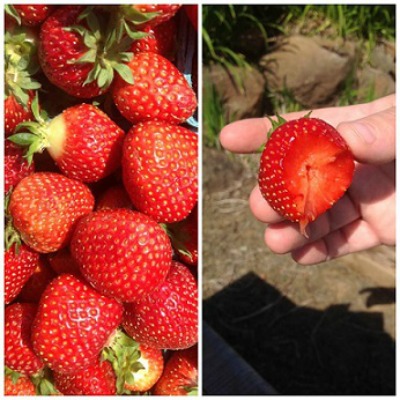
Naturally the best strawberries are the ones you pick yourself from your local strawberry fields or purchase from your local produce stands and/or Farmers’ markets.
In the stores, always choose locally grown strawberries during the harvesting season (they are sweeter and juicier than those that are bred for shipment). Remember, your local strawberry season only lasts 3 to 4 weeks.
When purchasing berries from the grocery store, shop with your nose. Always pick the plumpest and most fragrant berries. They should be firm, bright, and fresh looking with no mold or bruises, and fresh green caps (stems). The caps should be bright green, fresh looking and fully attached. Berries should be dry and clean; usually medium to small berries have better eating quality than large ones.
Strawberries do not ripen after they have been harvested, so choose strawberries that have been picked fully ripened. They should have bright red color, natural shine and fresh looking green caps.
Select berries that are in dry; unstained containers (stained containers may indicate over soft berries that are not freshly picked). Mold on berries spreads quickly – Never leave a moldy berry next to a good one.
Strawberry Equivalents:
Fresh Strawberries (approximate):
Basket of strawberries refers to the market package. 1 tray or flat of strawberries = 12 baskets or pints.
1 small basket = 1 pint strawberries = 12 large strawberries = 24 medium strawberries = 36 small strawberries.
1 pint = 2 to 2.5 cups sliced (1/4-inch thick slices) strawberries.
1 pint = 1.25 to 1.5 cups pureed (mashed) strawberries.
Frozen Strawberries (approximate):
20-ounce bag frozen whole strawberries = 4 cups whole strawberries = 2.5 cup sliced strawberries = 2.25 cups pureed (mashed) strawberries.
10-ounce package frozen sliced sweetened strawberries = 1.25 cups frozen strawberries in syrup.
Storing and Preparing Strawberries:
Use the berries as soon as possible as strawberries ripen no further once picked.
Before using or storing, sort through the strawberries and separate the soft ones from the firm, fully ripe berries. Discard any mushy or spoiled berries.
Leave the caps (stems) on the strawberries until ready to eat or use in your recipes.
For best flavor, do not wash the strawberries until you are ready to eat or use them. Moisture is the enemy when it comes to storing strawberries.
As strawberries tastes best at room temperature, remove from the refrigerator approximately 1 hour before they are to be used.
Store fresh strawberries in a colander in the refrigerator. This allows the cold air to circulate around them. Do not cover them.
 Remove caps from strawberries only after washing (the caps keep the water from breaking down the texture and flavor inside the strawberries). Remove the green caps (stems) with a light twisting motion or with the point of a paring knife. It is as easy as a twist of the wrist. You can also purchase a strawberry de-stemmer/huller at your local kitchen store or online (see photo on right).
Prepare strawberries for serving by rinsing, with caps still attached, under a gentle spray of cool water; pat dry with a paper towel. Wash the berries just before you plan to use them. Tip: To keep strawberries from absorbing large quantities of water when washing them, place in a salad spinner to remove excess water.
Video tip on freezing your fresh berries
Strawberry Nutrition:
Strawberries are not only good to eat, they are also “good for us.” They are an especially tasty source of vitamin C (ascorbic acid). In fact, one cup of fresh strawberries provides about 88 milligrams of ascorbic acid, which more than meets the Recommended Daily Dietary allowance of 45 milligrams for the average adult. Vitamin C is well retained when the strawberries are handled carefully. Capping, injuring, cutting, or juicing, however, will reduce the vitamin content.
Strawberries are low in calories as one cup of unsweetened strawberries has only 55 calories. So if you are on a reducing diet, use strawberries to add flavor, food value, and pleasure to meals. You can even eat some as a between-meals snack.
One 140 gram serving of eight (8) medium-sized strawberries has:
Strawberries are also rich in vitamins A and C, folic acid, selenium, calcium polyphenols (such as ellagic, ferulic and coumaric acids, quercitin, anthocyanins and phytosterols). They contribute 29% of your Daily Value of manganese.
140% of the Daily Value for vitamin C
12% of the Daily Value for dietary fiber
Only 7 grams of sugar (lowest among the top-selling fruits)
Strawberries are fat-free and salt free – no fat – no cholesterol – no sodium
Freezing Strawberries – How To Freeze Strawberries:
Cooperative Extension Service, College of Agriculture
University of Illinois at Urbana-Champaign
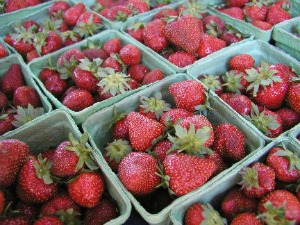 When you have more strawberries than you can eat or when strawberries can be obtained at a reasonable cost, freeze them to eat later. For freshly made strawberry jam at any time of the year, freeze berries and then make the jam at your convenience.
Strawberries are easy to freeze as you can use a Dry-Sugar Pack or a Syrup Pack. The dry-sugar pack is especially easy and gives the best flavor and color for sliced or crushed berries. For whole frozen berries a syrup pack is recommended because it produces a plump, well-shaped berry after thawing. For special sugar-free diets, strawberries can be frozen unsweetened, but they will not be as high in quality as sugar- or syrup-packed berries.
No matter which type of pack you choose to use, follow these general directions for preparing and packaging strawberries for freezing:
Use only firm, fully ripe berries.
To avoid bruising and soaking the berries, wash only a few at a time in cold water. colander or
Drain on absorbent paper or in a colander or sieve.
Remove the hulls with the tip of a floating blade peeler.
Chill the fruit in ice water to lower its temperature for fast freezing.
When packaging for freezing:
Do not fill containers completely; allow a head space of 1/2 inch for pints, 1/4 inch for 1/2 pints, and 1 inch for quarts.
Ascorbic acid (vitamin C) may be purchased in crystalline or tablet form or as a commercial ascorbic acid mixture to help prevent darkening of foods. If using the crystalline form, dissolve 1/2 teaspoon of ascorbic acid in each pint of water. For a dry-sugar pack, mix the ascorbic acid with the sugar. If using tablets, use 1,500 milligrams per pint; crush the tablets so that they will dissolve more readily. When using a commercial mixture, follow the manufacturer’s directions.
Seal containers and label with the name of the product and the date frozen.
Freeze promptly, then store at 0 degree F or below.
Dry-Sugar Pack:
Halve, quarter, or slice clean berries into a bowl or shallow pan. If desired, berries may be crushed rather than sliced.
Sprinkle sugar over berries, using 1/3 to 3/4 cup sugar for each quart of fruit.
Gently turn berries over and over until the sugar is thoroughly dissolved.
Package and freeze.
Syrup Pack:
Make a syrup using 1 1/4 cups water to each 1 cup sugar. Dissolve the sugar in either cold or hot water; if hot water is used, be sure to chill the syrup before using.
Use about 1/2 to 1/3 cup of syrup for each pint container. Place whole or sliced berries in containers and cover with cold syrup. Package and freeze.
Unsweetened Pack
Pack whole, sliced, or crushed berries in containers.
Cover whole or sliced berries with water or berry juice. For better color retention, add ascorbic acid to the water, berry juice, or crushed berries. Cover crushed berries with their own juice. Package and freeze as discussed earlier.
Legends and Lore of Strawberries
In provincial France, strawberries were regarded as an aphrodisiac. Newlyweds were served always served a cold strawberry soup.
The strawberry was a symbol for Venus, the Goddess of Love, because of its heart shapes and red color.
Have you every eaten a double strawberry? Legend says that if you break the strawberry in half and share it with a member of the opposite sex, you will soon fall in love with each other.
In parts of Bavaria, people still practice the annual rite each spring of tying small baskets of wild strawberries to the horns of their cattle as an offering to elves. They believe that the elves, who are passionately fond of strawberries, will help to produce healthy calves and abundance of milk in return.
Queen Anne Boleyn, the second wife of Henry VIII had a strawberry shaped birthmark on her neck, which some claimed proved she was a witch.
To symbolize perfection and righteousness, medieval stone masons carved strawberry designs on altars and around the tops of pillars in churches and cathedrals.
The strawberry, a member of the rose family, is unique in that it is the only fruit with seeds on the outside rather than the inside. Many medicinal uses were claimed for the wild strawberry, its leaves and root.
Did you know that the American Indians were actually cultivating strawberries in 1643? They crushed the strawberries into a mortar, mixing them with meal to make a strawberry bread.
By the 1800s, commercial strawberries had been cultivated. Strawberries are the leading small fruit crop in the United States today. T hey are farmed from Florida to Alaska, with the largest strawberry-growing centers located in California, Washington, Oregon, Louisiana, Michigan, and Tennessee.
Favorite Strawberry Recipes:
Assorted Berry Salad with Sauvignon Blanc
Blended Fresh Strawberry Margarita
Boccone Dolce (Sweet Mouthful)
Spinach Salad With Strawberries
Strawberries Dipped In Chocolate
Strawberries in Lemon-Lavender Syrup
Strawberries with Champagne and Roses
Strawberry Rhubarb Crisp & Pie