
Donning regal robes of maroon and cream, radicchio reigns supreme among traditional Italian vegetables. Beloved by chefs and gourmands alike, this often misunderstood red chicory endures a love or hate relationship among those that try it because of its slightly bitter nature.
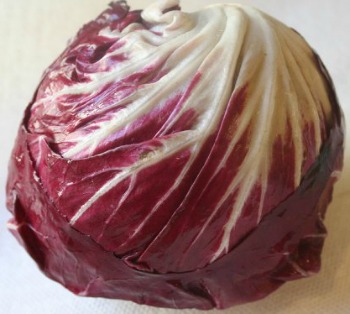
Cultivated since the fifteenth century in the Veneto region of Italy, the deep red radicchio of today was developed by Belgian agronomist Franco Van den Borre. Van den Borre used a technique imbianchimento (whitening) or pre-forcing to create the dark red with white veined leaves. Plants are removed from the ground and placed in water or sand in a cool dark cellar. The lack of light inhibits chlorophyll production causing the plants to lose their green color. For those of us that have neither root cellar nor desire to go to such lengths, a paper bag or pot turned over each head for a while will produce somewhat similar results.
Although many folks that are familiar with radicchio view it as a salad component, radicchio lends itself to numerous other culinary possibilities. It is delicious roasted, grilled, braised, sauteed, stir fried, or fried. Raise the bar even higher by combining it with pasta, baking it inside a pizza crust or strudel pastry, or cooking it in a risotto until it manifests into a creamy, melting consistency.
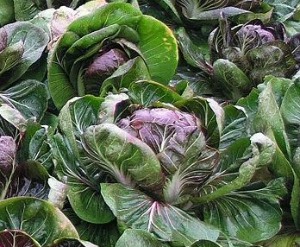 Grow these leafy vegetables like lettuce in spring or fall. Some varieties are better for fall preferring the cooler nights. With fall crops the flavor mellows with the onset of cold weather. Direct sow the tiny seeds in a sunny location planting them in rich, well dug soil 1/4-inch deep and 1/2-inch apart in rows 18-inches apart. Thin the seedling 10 to 16 inches apart.
Although direct sowing is most often recommended, setting out greenhouse transplants works well for me. Radicchio has a shallower root system than its other chicory cousins, preferring more frequent but not deep watering. Infrequent watering will lead to a more bitter tasting leaf. It is an easy vegetable to grow, requiring little care unless you get into some of the complex blanching methods use by commercial growers.
Given its cost at the market and the relative ease of growing it, tuck some of this royal plant into your fall gardens. Radicchio, the queen of Italian vegetables is a gustatory treat and beauty to behold. That’\ is the short and “bitter” sweet of it!
Various Types of Radicchio:
Cichorium intybus – relatives of endives and escarole – commands a high price in produce markets and comes in the guise of several types and cultivars. Varieties of radicchio are named after the Italian regions where they originated.
Radicchio di Chioggia – with its ball shaped head is the most commonly found type in supermarkets and include such cultivars as Palla Rossa, Rouge de Verone and Leonardo.
Radicchio di Treviso – is elongated like a Belgian endive and has a distinctive tangy taste. Hard to find in US markets, it is highly prized in Italy as a favored vegetable to grill.
Radicchio di Castelfranco – has a lovely yellowish cream leaf with red speckles. This beautiful and tender lettuce like ball unfolds like a rose making it the most regal of radicchios.
Radicchio di Puntarelle – sometimes known as Italian dandelion is described by Nichols Garden Nursery as a dandelion on steroids. Puntarelle looks like an asparagus grown out of a fennel bulb covered by dandelion leaves. This rarity has slightly bitter undertones with crisp tender stems working well in stir fries or salads.
Radicchio di Tardiva – comes from the more uncommon di Treviso. After first frost, a complex growing-forcing method is employed so the plant grows into a uniquely shaped strong plant. Tardiva is more flavorful than the milder Treviso with strong bitter accents and a crisp consistency. Saute or dress with hot vinaigrette.
Source: This article is by Robert Hammond, chef and owner of The Kitchen at Honeyman Creek Farm in Warren, Oregon.