
Mango Salsa just might let you see just how versatile a homemade salsa can be. Mango salsa goes wonderfully with fish and chicken dishes, as well as a being a unique dip. The sweetness of the Mango is not overpowering and the peppers and onions bring out a bright new taste that I hope will be a nice surprise for you.
Salsas are a main staple in Hispanic cooking, but they are certainly not limited to what many people think of as salsa. I have found very few jarred salsas that I would ever even consider serving on my table, and there really should be no reason for anyone to resort to a jarred salsa when making one is so easy.
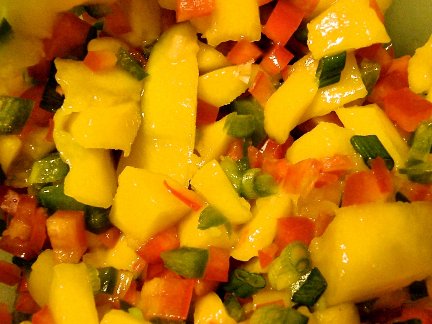
- 1 large fresh mango*
- 1 or 2 jalapeno chile peppers, seeds and membranes removed and finely diced**
- 1 small clove of garlic, crushed fine with 1 teaspoon of sea salt
- 1/2 large red bell pepper, seeded and diced
- 1/2 large red onion, finely diced (1/4 cup sliced green onions may be substituted)
- Juice of 1/2 fresh lime
-
Peel and dice the Mango into 1/2-inch pieces.
-
To Cut a Fresh Mango:
-
Slice both ends off the mango with a sharp knife, making a stable flat base and revealing the long, slender seed inside.
-
Stand the fruit upright and remove the skin. With the seed perpendicular to you, slice the fruit from both sides of the seed, yielding two large pieces.
-
Turn the seed parallel to you and slice the two smaller pieces of fruit from each side. Cut into desired shape.
-
Prepare the jalapeno chile peppers by removing the seeds and membranes and dicing, add to the prepared mango pieces.
-
Preparing Fresh Chile Peppers - Check out What's Cooking America's tutorial on preparing fresh chile peppers.
-
 Warning: Always wear gloves when working with hot chile peppers (fresh, dried or roasted chiles). Never touch your eyes when working with chiles. Gloves will protect your hands, but the capsicum oil in the chile pepper sticks to all it touches, and if you touch near your eyes it will burn.
 -
Wash the chile pepper first. There is no certain way to tell if a pepper is hot by looking at it, although I have heard many, many wife's tales about dark spots, cracks and anything else. But the only sure way to tell is by tasting.
-
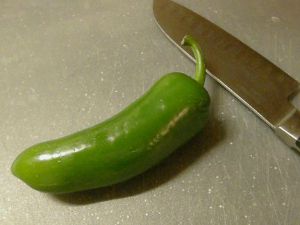
Slice the chile pepper down the center with the tip of your knife. You can see the membranes and seeds here in these two halves. The membranes are where the capsicum is stored. It is this part of the chile pepper that carries the heat. The seeds are not as hot, but since they are a part of the membrane they do have a slight bit more heat than the green outer chile pepper.
-
Prepare and slice the garlic.
-
Preparing Garlic for Cooking - Check What's Cooking America's photo tutorial on preparing garlic for cooking.
-
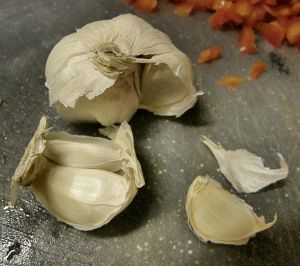
Remove the paper skin from the garlic by hitting it with the flat side of a large knife, and then dicing coarsely. Sprinkle the salt over the garlic and use the flat side of your knife to “crush” the garlic clove into a paste. The abrasive salt is what helps to make it a fine consistency. Pull off a the number of cloves required for your recipe.
-
Using the flat side of a large knife, carefully hit the clove with the knife using the palm of your hand. This will crush the clove partially and break loose the paper like skin around it. You can now easily peel off the skin.
-
Coarsely chop the garlic. Add the salt, using the amount required in the recipe or a part of that amount. If you are not adding the entire amount of salt, do not forget to add the rest later.
-
Using your palm against the flat blade again, press down forcing the salt to rub into the garlic. This will grind the garlic into a fine almost paste.
-
The resulting garlic and salt mix will be finely chopped, easier to distribute through-out the recipe.
-
Dice the bell pepper and onion, and add this along with the crushed garlic. Stir the mixture well.
-
Squeeze the lime half over the mixture, and stir it well. Not only will the lime give a tartness to the salsa, it will help keep the other ingredients fresh and slow any browning to the mango pieces.
-
Refrigerate this for at least 1 hour to allow the flavors to incorporate well.
-
Serves approximately 4 to 6 people.
* When choosing a mango to buy, pick one that is plump and heavy for its size. The mango should be fragrant when held near your nose. Mangos are ripe when you can indent them slightly with your thumb.
** Most often jalapeno chile peppers are green when mature but sometimes red. They are very hot, with an immediate bite. Use whenever recipe simply calls for hot chile peppers.
Source: This recipe is courtesy of Cynthia Detterick-Pineda of Andrews, TX. Check out more of Cynthia’s Southwest Recipes.