
How To Make Homemade Corn Tortillas
By Cynthis Detterick-Pineda. or Andrews, TX.
My first experience with corn tortillas came years ago when I was still in high school. I would go to the home of a friend after school, and as most of the “moms” in this area who are of Spanish descent, she would be in the kitchen cooking up a snack. I say snack because it was never intended to be a meal, even if there was most than enough food for at least one meal if not more.
Abby (my friend) was not Mexican, but Puerto Rican. Her mother cooked in a classically Puerto Rican style, which included fresh corn tortillas with every meal. I would watch her as she mixed the masa, form the balls, and place them in the tortilladora to press them. Seems easy doesn’t it? Well, I found out later that it was not nearly as easy as she had made it seem.
Maybe if I had been doing it for 20 years, my first batch would have come out looking better and even edible! So for those of you who dare to try it, and you won’t regret the effort it takes.
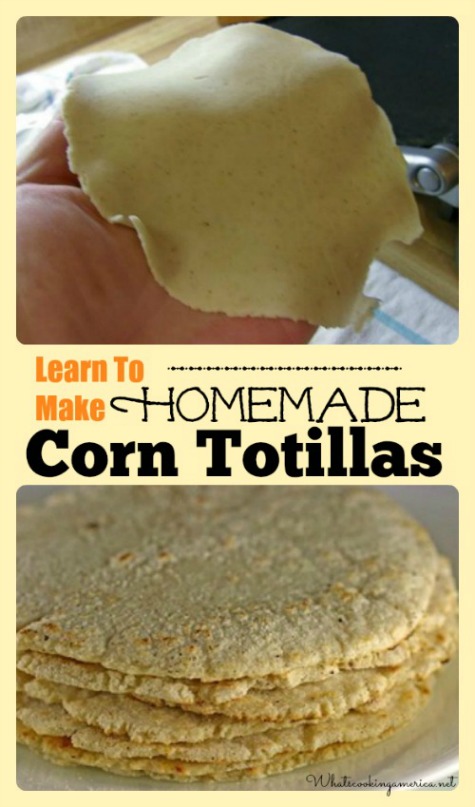
Below are some step-by-step instructions on how to make your own fresh corn tortillas.
Population in the United State and far northern parts of Mexico, wheat flour is what the immediate assumption when someone mentions tortillas. Corn, however, was the starch used throughout Mexico and large portions of the southwest for hundreds of years before wheat flour was introduced. Even with the massive amounts of wheat grown in the United States, it remains second behind the production of maize (and corn) as a bread/cereal crop.
Even with the popularity of flour tortillas in the northern parts of the Southwest, the corn tortilla will always have its place. Enchiladas, tacos, chilequilas, flautas, and or course the chips served in almost every Mexican/Spanish restaurant are only a fraction of the numerous dishes centered on the corn tortilla. This is not to say you cannot use flour tortillas for these entrees, but there is a reason to using the corn tortilla versus the flour.
Corn tortillas are not as likely to soak up the sauces used in some dishes (enchiladas for example). Flour tortillas would simply become soggy, mushy gruel if used in a dish with a large amount of sauce. Corn tortillas also fry better, partly because they do not soak up as much oil as flour tortillas, but also because they will continue to hold their crisp shape even when they have cooled down. For dishes that would work equally well with either the flour or the corn tortilla, it simply comes down to personal taste. The same goes for serving tortillas on the side.
So why do almost all restaurants serve only flour tortillas on the side? Some will give patrons the choice, but even with a choice, most people of European descent will opt for the flour tortilla to go with their meal. Maybe it is because wheat flour based breads are what our ancestors ate for thousands of years, or because we simply have not been exposed to the wonderful, light and delicate flavor of a freshly cooked corn tortilla.
Also learn how to make Flour Tortillas (Tortillas de Harina).
Learn about the history of Tortillas and Tacos.
- 2 cups Masa Corn Mix*
- 1 1/3 cups warm water
-
 Although I try to keep all my ingredients as fresh as possible, I do not make my own corn masa because of the limited availability of calcium hydroxide (lime) where I live. I have seen older women soak their own corn in the water and lime mix, wash the husk off the corn and even grind them into using a metate, but I find the mix taste just as good when the tortillas are made.
 -
In a large bowl, place the 2 cups of Masa Mix. Make a well in the center of the mix and add the warm water all at once. Using a large wooden spoon or your clean hands (my preference), mix the ingredients together, making sure to scrape the dry ingredients from the bottom and sides.
-
NOTE: The dough should be very wet. If your dough is too dry, the tortillas will be crisp and brittle. If the dough becomes too dry to work with, knead in additional waster. You can also mix the dough in a stand-up mixer with the dough blade.
-
Once the masa has begun to stick together, use a kneading motion within the bowl to mix completely. You should have semi-clean bowl sides once you have mixed it all together.
-
Knead the masa for approximately 3 to 5 minutes. The masa should be slightly soft, but hold its shape. Set aside for approximately 5 minutes.
-
Using a spoon or cookie scoop, take small amounts of masa (approximately 3 tablespoons) and form these into balls. Unlike the masa balls for flour tortillas, these just need to be rolled in your hands to a ball shape.
The masa will dry out quickly, so keep the balls inside the bowl covered with a piece of plastic wrap while making your tortillas. -
Heat a Comal, cast-iron griddle, or small skillet to about 450 degrees F. over medium to medium-high heat until water droplets "dance" when dropped on the surface.
-
Definition of comal: Mexican Comal or cast-iron plate used to make tortillas. If you do not have a comal, a large cast iron skillet or griddle works well, or even an electric griddle can be used when heated up to 400 to 450 degrees F.
-
Tortilla Press: Known as a "tortilladora" in the Mexican language, a tortilla press is a simple metal or wooden object with a base, top, and handle used to make corn tortillas. The press is used to make only corn tortillas. -
-
What to use if you do not have a Tortilla Press:
If you do not have access to a tortilla press (tortilladora), you can hand roll corn tortillas with your rolling pin. Use the same concept of the wax paper or plastic wrap to place on top and bottom of the masa ball. Then press and roll out between the them. You could also press the masa ball between two plates or under a cast iron skillet. This is not as easy, but it is possible. -
-
-
Place either two pieces of parchment paper, wax paper, or two sandwich-sized plastic bags (with the zip top cut off) over each side of the tortilla press. -
NOTE: Even if you have a press that says it is non-stick, you should use something to help the dough to release from the press and to help transfer the tortilla over to the pan, as they are very fragile before cooking.
Take one of the masa balls and place it on top of the parchment paper, wax paper, or plastic bag on the bottom of the tortilla press. It should sit slightly towards the hinge side of the press.
Place the second piece of parchment paper, wax paper, or plastic bag on top of the ball and press it with your hand to flatten it out to about 1/4- to 1/2-inch thick.Bring the tortilla press top down to flatten the masa ball. Use the handle to press the tortilla flat with a smooth even pressure. -
Holding the press down for a few seconds will often help flatten the tortilla more completely.
-
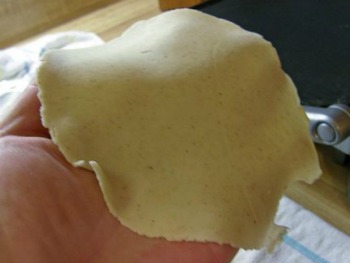
Slide the tortilla off the press using the wax paper on the bottom and place it over the fingers of your other hand.
-
Peel off the wax paper before gently flipping it onto the hot pan.
-
You may cook the corn tortillas as you make them or store them for later. Uncooked corn tortillas can be held, covered, at room temperature for up to 4 hours before cooking.
-
-
To Cook Corn Tortillas:
-
Preheat the Comal or cast-iron griddle over medium-high heat. Your Comal or griddle must be hot before cooking the tortillas.
-
Place a tortilla round (working with 1 tortilla at a time) on the hot cooking surface. Cook no more than 30 seconds.
-
Using a spatula, gently flip the tortilla over and allow the second side to cook another 30 seconds (it should take no more than 30 seconds on each side to cook the tortilla completely).
-
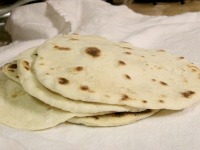
NOTE: Brown spots on your tortillas are good - an indication that they are handmade, rather than punched out of a big machine and cooked assembly-line fashion.
-
Place the cooked tortilla into a tortilla warmer or on a plate (lined with a damp dish towel or paper towels to keep them warm), to keep them moist and warm.
-
Serve immediately or refrigerate and reheat.
-
Repeat the cooking process with the remaining tortillas.
-
Storage: Cooked corn tortillas can be transferred to a zipper-lock plastic bag and refrigerated for up to 5 days. To reheat for serving, sprinkle each tortilla with a few drops of water and heat on a preheated nonstick pan for 10 to 15 seconds on each side. They can be also frozen (corn tortillas freeze very well, much better than flour ones)
-
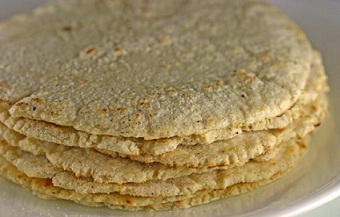
Makes approximately 2 dozen fresh corn tortillas.
-
 Although I try to keep all my ingredients as fresh as possible, I do not make my own corn masa because of the limited availability of calcium hydroxide (lime) where I live. I have seen older women soak their own corn in the water and lime mix, wash the husk off the corn and even grind them into using a metate, but I find the mix taste just as good when the tortillas are made.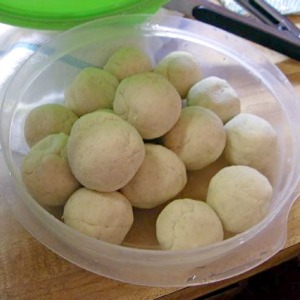
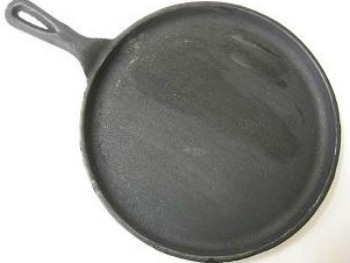 Heat a Comal, cast-iron griddle, or small skillet to about 450 degrees F. over medium to medium-high heat until water droplets "dance" when dropped on the surface.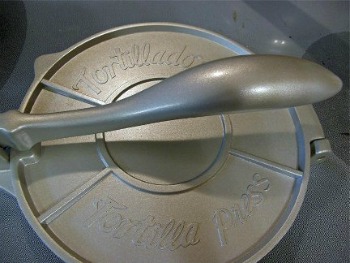
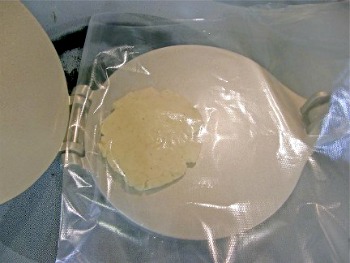
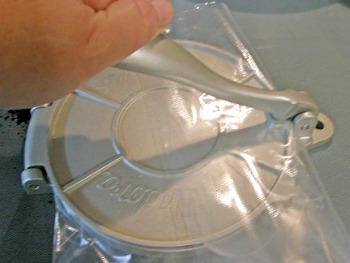 Bring the tortilla press top down to flatten the masa ball. Use the handle to press the tortilla flat with a smooth even pressure.
  Place a tortilla round
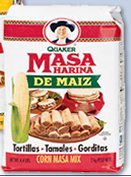
 * Masa Corn Mix is whole corn flour that is found in the baking aisle of most grocery stores (not to be confused with corn meal). Most grocery stores carry bagged masa pre-made in their store.
** I like to heat my water in a glass measuring cup in the microwave for 1 minute.)
Categories:
Cinco De Mayo Cooking Lessons - Cooking 101 Corn Fried Bread Mexican Southwest Breads Tortillas
One Response to “Corn Tortillas Recipe”
KG
A wonderful recipe! So easy and the tortillas do not fall apart when they are filled!