
Madeleine is a French form of Magdalen (Mary Magdalen, a disciple of Jesus, is mentioned in all four gospels).
18th Century:
Madeleines are always associated with the little French town of Commercy, whose bakers were said to have once, long ago, paid a “very large sum” for the recipe and sold the little cakes packed in oval boxes as a specialty in the area. Nuns in eighteenth-century France frequently supported themselves and their schools by making and selling a particular sweet. Commercy once had a convent dedicated to St. Mary Magdelen. Historians thing that the nuns, probably when all the convents and monasteries of France were abolished during the French Revolution, sold their recipe to the bakers.
According to another story or legend, during the 18th century in the French town of Commercy, in the region of Lorraine, a young servant girl name Madeleine made them for Stanislas Leszczynska, the deposed king of Poland when he was exiled to Lorraine. This started the fashion for madeleines’ (as they were named by the Leszczynska). They became popular in Versailles by his daughter Marie, who was married to Louis XV (17101774).
19th Century:
Another story lays the origins of the madeleine with Jean Avice, considered the “master of choux pastry,” who worked as a pastry chef for Prince Talleyrand (1754-1838. Jean Avice is said to have invented the Madeleine in the 19th century by baking little cakes in aspic molds.
20th Century:
1923 – They were made famous by Marcel Proust (1871-1922) in his autobiographical novel la recherche du temps perdu, translated Remembrance of Things Past, Volume 1, Swann’s Way. This novel was left unfinished upon his death, and his brothers published the book in 1923. He wrote:
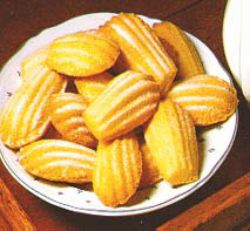
She sent for one of those squat plump little cakes called “petites madeleines,” which look as though they had been molded in the fluted valve of a scallop shell … I raised to my lips a spoonful of the tea in which I had soaked a morsel of the cake. No sooner had the warm liquid mixed with the crumbs touched my palate than a shudder ran through me and I stopped, intent upon the extraordinary thing that was happening to me. An exquisite pleasure invaded my senses …
And suddenly the memory revealed itself. The taste was that of the little piece of madeleine which on Sunday mornings at Combray … when I went to say good morning to her in her bedroom, my aunt Leonie used to give me, dipping it first in her own cup of tea or tisane …. and the whole of Combray and its surroundings, taking shape and solidity, sprang into being, town and garden alike, from my cup of tea.
Categories:
Cookies History
2 Responses to “Madeleine Cake History”
Shrek
very good.
Marie Godbold
Yummy cookies