
Lutefisk
It is said that about half the Norwegians who immigrated to America came in order to escape the hated lutefisk and the other half came to spread the gospel of lutefisk’s wonderfulness.
– Norwegian-American saying
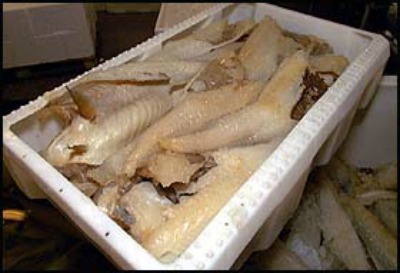
Lutefisk History:
Lutefisk (pronounced LEWD-uh-fisk) is dried cod that has been soaked in a lye solution for several days to rehydrate it. It is rinsed with cold water to remove the lye, then boiled or baked, and then served with butter, salt, and pepper.
The finished lutefisk usually is the consistency of Jello. It is also called lyefish, and in the United States, Norwegian-Americans traditionally serve it for Thanksgiving and Christmas. In many Norwegian homes, lutefisk takes the place of the Christmas turkey. In Minnesota and Wisconsin, you can find lutefisk in local food stores and even at some restaurants. It is a food that you either love or hate, and, as some people say, “Once a year is probably enough!”
During the fall in Wisconsin, people watch their local newspapers for announcements of lutefisk suppers, which are usually held in Norwegian churches. Usually every Norwegian church will host at least one lutefisk supper between October and the end of the year. The dinners have become so popular that lovers of this special cod dish drive great distances, and these are not just people of Scandinavian descent.
The history of lutefisk dates back to the Vikings. On one occasion, according to one legend, plundering Vikings burned down a fishing village, including the wooden racks with drying cod. The returning villagers poured water on the racks to put out the fire. Ashes covered the dried fish, and then it rained. The fish buried in the ashes in the ashes thus became soaked in a lye slush. Later the villagers were surprised to see that the dried fish had changed to what looked like fresh fish. They rinsed the fish in water to remove the lye and make it edible, and then boiled it. The story is that one particularly brave villager tasted the fish and declared it “not bad.”
Norwegian-Americans believe that lutefisk was brought by their ancestors on the ships when they came to America, and that it was all they had to eat. Today the fish is celebrated in ethnic and religious celebrations and is linked with hardship and courage.
Lutefisk Recipe:
Family friend Neil Sticha of Bloomington, Minnesota, persuaded one of his favorite Norwegian cooks, Shirley LaBissonniers, to share her recipe for lutefisk:
First of all, invite brave people over for dinner who do not have misconceptions about this wonderful fish!
Next, go to a store that carries the freshest fish and seafood. Ideally, you would get the lutefisk that they pull out of a barrel (most stores hate those barrels a lot and don’t do that anymore). Second best, it comes skinless and “trimmed” and packaged in a plastic. Purchase the lutefisk a day before you want to serve it.
Take it out of the plastic bag, put it in a large bowl, and cover with ice water. Change this water two to three times (to remove the lye) and keep in the refrigerator until ready to use (if your family will let you). This firms up the fish.
Stovetop Cooking: Lutefisk does not need any additional water for the cooking. Place the well rinsed cod in a frying pan over low heat, (do not use an aluminum pan as the lye in the fish will discolor the pan). Add salt, cover with a lid, and steam cook approximately 20 to 25 minutes.
Oven Baking: Place the well rinsed cod in an ovenproof dish, cover with aluminum foil. Put in a preheated oven at 375 degrees F. for 25 to 30 minutes. The fish is done when it flakes easily with a fork.
Do not overcook the Lutefisk or it will look like white Jello! The fish will be not brown.
In Minnesota, we allow at least a pound of lutefisk per person, served with hot melted butter.
The two side dishes are riced potatoes and very small cooked frozen peas – no exceptions.
And, of course, you must have Lefse. This is a ritual which we try to repeat as often as possible and as long as we can get the fresh lutefisk.
Categories:
Christmas Fish and Seafood History Food History Great Lakes Norwegian Recipes Seafood & Fish Recipe Index Thanksgiving
29 Responses to “Lutefisk History and Recipe”
Stephanie Eastwood
Thank you for the lutefisk lore and helpful cooking instructions. Hoping to revive Grandma’s Christmas custom with my own first lutefisk.
Linda Olson
I loved this! My dad was a swede and I remember him eating this on new years
My parents both came from Norway; my dad in 1929 and my mother in 1930. So of course I grew up having it and I love, love it. I don't even mind the smell becauIn Ingeborg Kari (Hollo) Dickhoff Great Falls, Mt
My dad came from Norway in 1929 and my mother in 1930. They knew each other in Norway and after Mother came they were married in Edingbirg. ND. I grew up having lutefisk and loved it, loved it. I still do and I am having a friend who cam over to America and I am serving Lutefisk and fish balls. I even like the smell of lutefisk because I know what is coming. I can almost smell it now.
My mother was from Nesbyen, Hallingdal and my dad from Bruma not sure of spelling. I have been to Norway three times. I still have 3 aunts living there and much family.
Sandy
My grandfather would prepare this from scratch(stinking up the neighborhood) as my grandmother would say and all of us kids’ would dive into it, smothering it with pepper and butter and spreading it and peas on our lefse. Kind of a Scandinavian Burrito.
Keith
My father (who was Swiss) would drive many miles to eat lutefisk. I sometimes wondered how he managed to get invitations for these meals, I have never tasted it but am willing to try.
Curtis Boe
I am originally from Minnesota and presently live in North Carolina. We had lutefisk for Christmas for many years growing up. How can one acquire lutefisk in North Carolina?
Ronald Anderson
I was born on December 19, 1956. Except that first year, I have eaten Lute Fisk on Christmas Eve every year since. ( and hundreds more times through out the years) . When done properly, it ranks right up there with lobster, shrimp or walleye. Very important NOT to over cook!.. I bake on an elevated rack 375 for 30 minuets, not one second more. White gravy, melted butter, boiled potatoes, side of Korv (potato sausage) is essential for the best Lute Fisk experience. It’s that time of year,,, Uffda it’s GOOD! TRIVIA Olsen Fish Market, Minneapolis Mn. is the worlds largest lutefisk processor..
Carol Southern
Ronald Anderson: That’s the way we used to eat it; a layer of boiled potatoes smashed on the plate, a layer of fish, and finally smothered in white sauce, salt and pepper. Potato sausage or blood sausage on the side. Aquavit optional!
Ron
I was born in Parkers Prairie, MN on Feb 5th, 1937. I grew up having lutefisk and Lefsa every Christmas until I left Wadena in 1954. I loved both and I miss both. My Sister in St. Cloud, MN makes Lefsa every year and sends a package. I live in Maryland now, and look forward to having Lefsa. My Sister buys it now and it is just as good.
Letty
I grew up in La Crosse WI. Last name Johnson, of course. My mother would fix lutefisk about once a year for my grandfather. I would have to leave the house I found it so disgusting. I could not even wash the dishes! To this day I can’t eat fish of any kind I found this so traumatizing! Lefse on the other hand was the best thing ever!
Vernon Hanson
I love lutefisk. My Grandfather was from Goteburg, Sweden. We always had lutefisk and mashed potatoes for Christmas. We were made to eat what was on our plates so I aquired the taste for lutefisk, cod gravy, pickled pigs feet and salted side pork. I consider all of these dishes great food!! My wife doesn’t like lutefisk or any of the other dishes I’ve mentioned, so I have to go and pay 12 to 15 dollars a plate for lutefisk these days.
Karla
I was an exchange student to Sweden in 79/80. We had lutfisk for Christmas dinner and from what I’m reading above, she overcooked it. It was like Jello. I am a fish lover but that didn’t taste like fish. I would like to know the process and necessary ingredients for taking salted cod and using the lye to rehydrate it. I use “food grade lye” in my goat milk soap making process so I’d like to give it a go.
thela ostling
Kayla, If the lutefisk was like jello it was overcooked. It must be watched carefully and retmoved from water just as it turns opaque and flakes.
Andy M.
I’ve tried lutefisk twice, once going down and once coming up! Seriously, I love it, even though German/Bohemian ancestry and usually able to go to a couple lutefisk suppers every Holiday Season.
Jacquie Beveridge
A few years ago this piece was one of five shortholiday memories published in a local paper. I was happy to make the cut!
“Christmas Eve lutefisk, a tradition common in Scandinavian households and absent in the U.S., except in Minnesota, is a delicacy one either likes or doesn’t. One never says, “Oh, I’ll just have a little bit” to be polite. Many Swedes vow they will never require their children to eat lutefisk; it is the brunt of many jokes. After being cured in lye, it takes on a scary gelatinous quality when poached and served, traditionally, in a heavy cream sauce with enough cholesterol to elevate yours off the scale. Reason enough to avoid it altogether unless you are a rare breed like us.”
Vern T Chandler
I’m half Norwegian (the other half WASP). My mom didn’t like it but told me about the barrels back when she was young (she passed in 2016 at 101). My German wife (we’re both from Wisconsin) finally got me to try it this year. I guess her mom made it around Christmas along with several other Norwegian treats every year. She said it had to be cooked just right. We had it at our Lutheran church in Coon Rapids and it was great. I can’t imagine how many people go Yuck when they talk about it. They had it cooked perfectly and served it with butter and cream gravy. We also had potatoes, meatballs, green beans, and lefse!!! Now I guess I need to make some rommegrot – LOL!!!
TO JEANNE ROBERTS (ANSWER TO MYSELF!!!!
FIND YOURSELF A “SONS OF NORWAY” CLUB. THEY HAVE IT ALL THE TIME EVERYWHERE
JEANNE ROBERTS
Would sure like to know how the Norwegians use LYE for the fish. Do I have to go to Norway?????
Janet Carlson Sagendorf
My grandparents were both from Sweden and we had lutefisk every Christmas. My grandmother served it on boiled potatoes with a cream sauce and sprinkled it with Allspice. I loved it
Nancy
It is an acquired taste, but if you don’t try it, you’ll never know if you like it!
Rod
My 8 1st generation Norwegian uncles never pronounced it LEWD-uh-fisk. Always LEWT-uh-fisk. Ya shore, ya-betcha.
Shirley Kirkelie
My Dad, a Norwegian, loved lutefisk. My German Mother did not. For every holiday we would have lefsa as that was a family favorite. My Dad taught me to count in Norwegian and taught me two songs. When he gave the blessing it was always the Norwegian prayer.
Rev. Jim Shelden (ret.)
I wish to clarify the derivation of the name. Lutefisk is a transliteration for “Lutheran Fish.” (What else?) Anyway, I encouraged my young bride to try this and she almost divorced me right there! However, over the years, she learned to appreciate it and our two daughters did as well. Just today my wife and I just taught our 15 yr old granddaughter to make Lefse. Next year – out comes the lutheran fish.
Nancy
Thank you for the clarification. Have a wonderful Thanksgiving!
Lowell Johnsson
For the last 25 years or so we make the pilgrimage to the San Jose Sons of Norway Lodge for the annual Lutefisk Christmas Dinner. The same people have been putting on the two day event since we first attended. The Lodge usually has three seatings each day serving perhaps 1,000 persons. Most of the attendees arrive with many members of their group, adding greatly to the festivities. The “Fisk” and all of the side dishes are served family-style. Two or three lodge volunteers roam among the throng selling beer, wine, mixed drinks and of course the obligator Aquavit!
Wouldn’t miss it. It has been the event that starts our Christmas season. This year, due to the Covid-19 Pandemic, however, it is a take-out deal.
(My Dad’s parents were from Karlskoga in Sweden)
Kari
I am not Norwegian, but I sure loved visiting that beautiful country. I can’t wait to go back to show my son the fjords. I am Jewish and it is hilarious that this could be a Jewish family talking about gefilte fish (stuffed fish loaf). It is definitely an acquired taste and I never acquired it! But it is there on Jewish New Year and Passover, like it or not. My mother has learned to keep my plate empty. We eat it with horseradish (the only way to make it slightly palatable) and it is something you love or hate. I love how all of us are more similar than we are different no matter what culture we grew up in. And yes. Lefse is delicious!
Mathieu
I was staying in Norway for 3 months between October and January. Being Canadian, I was used to eat fish but not that type of fish. It was cooked by the lady where I was staying on Christmas eve. It is still, one of the most interesting culinary experience I ever had. I remember the smell, texture and taste. Unique, you cannot describe it. Just to give an image, it is a mix of jello, fish and fermented japanese beans (natto). It is really addictive if you like it. I wanted more and more. But most people don’t actually like it and eat it by custom or tradition, at least where I was. I think it is the kind of black and white type of dish, you will love it or find it disgusting. At least try it.
Andreas Solemsli
I’m Norwegian and that pronunciation LEWD-uh-fisk is wrong. It is more loo-tuh-fisk.
Mike
Born 1949…half Norwegian, half Swede. Had lutefisk on Thanksgiving and Christmas. When cooked properly it’s awesome. Overcooked…yuk. Some of the best lutefisk I’ve eaten was at Shooting Star casino in Mahnomen, MN. Looking forward to holidays with lutefisk and lefse.