
History and Legends of Popcorn, Cracker Jacks and Popcorn Balls
There is a legend that old-timers tell of one particular summer when it got so hot that the corn in the fields stared popping right off the stalks. The cows and pigs thought it was a snow blizzard and they lay down and froze to death.
In American Indian folklore, some tribes were said to believe that quiet, contented spirits lived inside of each popcorn kernel. When their houses were heated, the spirits would become angrier and angrier, shaking the kernels, and when the heat became unbearable, they would burst out of their homes and into the air in a disgruntled puff of steam.
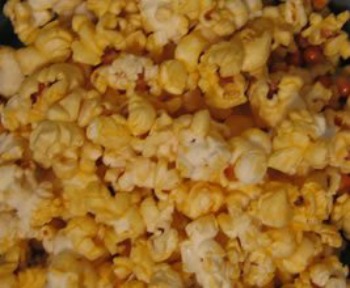
Popcorn History:
Most of the world’s popcorn is grown in the Midwestern part of the United States – principally in Nebraska, Iowa, and Indiana where it can get mighty hot in the summer. Although popcorn has been with us since pioneer times, it was not until 1890 that popcorn became important enough to be raised as a crop for market. Before that time, individual families raised their own popcorn or bought it from their neighbors. Since that time, popcorn has brought enough income to its growers to earn the name “prairie gold.”
Prehistory – The oldest ears of popcorn ever found were discovered in the Bat Cave (a site known to have been occupied by cave dwellers practicing primitive agriculture three thousand years ago) of west central New Mexico in 1948 and 1950 by anthropologist Herbert Dick and botanist Earle Smith, Harvard graduate students. They discovered layers of trash, garbage, and excrement, which had accumulated over two thousand years. In the trash were 766 specimens of shelled cobs, 125 loose kernels, 8 pieces of husks, 10 of leaf sheath, and 5 of tassels and tassel fragments. The deeper they dug, the smaller and more primitive the cobs, until they reached bottom and found tiny cobs of popcorn in which each kernel was enclosed in its own husk.
Among those prehistoric kernels, they found six that were partly or completely popped. These grains have been so well preserved that they would still pop. In fact, they took a few unpopped kernels and dropped them into a little hot oil to prove that they could still pop. They have been carbon dated to be about 5,600 years old.
4th Century A.D. – A Zapotec funeral urn found in Mexico and dating about 300 A.D. depicts a Maize god with symbols representing primitive popcorn in his headdress. Also ancient popcorn poppers (shallow vessels with a hole on the top and a single handle) have been found on the north coast of Peru and date back to the pre-Inca culture of about 300 A.D.
10th Century – In southwest Utah, a 1,000 year old popped kernel of popcorn was found in a dry cave inhabited by predecessors of the Pueblo Indian.
16th Century – Hernando Cortes (1485-1547), Spanish explorer and conqueror of the Aztec Empire of Mexico, got his first sight of popcorn when he invaded Mexico and came into contact with the Aztec people. Popcorn was an important food for the Aztec Indians, who also used popcorn as decoration for ceremonial headdresses, necklaces, and ornaments on statues of their gods.
An early Spanish account by Father Bernardino de Sahagun (1499-1590), Franciscan priest and researcher of the Mexican culture, of a ceremony honoring the Aztec gods who watched over fishermen read:
“They scattered before him parched corn, called momochitl, a kind of corn which bursts when parched and discloses its contents and makes itself look like a very white flower; they said these were hailstones given to the god of water.”
17th Century – Early French explorers in the Great Lakes region reported that the Iroquois Indians popped popcorn in a pottery vessel with heated sand and used it to make popcorn soup, among other things.
Some historians suggest, but this theory has never been proved, that when the early English colonists held their first Thanksgiving celebration on October 15, 1621, an Indian named Quadequina brought an offering for the feast – a great deerskin bag of popped corn. The Pilgrims enjoyed this treat, which was to become a unique part of the American way of life. The early colonists called it popped corn, parching corn, and rice corn. Native Americans would bring popcorn snack to meetings with the English colonists as a token of goodwill during peace negotiations.
In American Indian folklore, some tribes were said to believe that quiet contented spirits lived inside of each popcorn kernel. When their houses were heated, the spirits would become angrier and angrier, shaking the kernels until the heat became unbearable, at which point the spirits would burst out of their homes and into the air in a disgruntled puff of steam.
Colonial housewives served popcorn with sugar and cream for breakfast (the first “puffed” breakfast cereal). Some colonists popped corn using a cylinder of thin sheet-iron that revolved on an axle in front of the fireplace like a squirrel cage.
19th Century – Popcorn popularly really began to ‘burst’ during the 1890s.
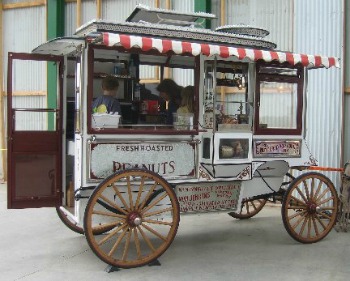 1880s – The Albert Dickinson Co. of Odebolt, Iowa seems to be the first company to (since the 1880’s). Their brands of popcorn were called Big Buster and Little Buster.
The first popcorn machine was invented by Charles Cretors of Chicago, Illinois in 1885. In order to test his machine, it was necessary for Charles to operate it on the street as the customer. He was issued a peddler’s license to use the machine on December 2, 1885. Until then, poppers were made to sit in front of stores to attract attention. The huge, ponderous popcorn machine with its gasoline burner became a familiar part of the scent. Street vendors used to follow crowds around, pushing steam or gas-powered poppers through fairs, parks, and expositions.
This practice continued up until the Depression years (1929-1939). Today much of the popcorn you buy at movies and fairs is popped in poppers made by the Cretors family.
20th Century – In 1914, Cloid H. Smith founded the American Pop Corn Company in the heart of corn country (Sioux City, Iowa) and launched America’s first brand name popcorn called Jolly Time. In 1925, he introduced Jolly Time in a can designed specifically for popcorn. To show his confidence in h is new package, he flagged the can with a “Guaranteed to Pop” statement. It was a bold statement in those days.
With the opening of movie theaters across the nation early in the 20th century, popcorn became a part of the new excitement. During the Depression years (1929-1939), popcorn was one of the few luxuries down-and-out families could afford. While other businesses failed, the popcorn business thrived. There is a story about an Oklahoma banker who went broke when his bank failed. He bought a popcorn machine and started a business in a small store near a theater. After a couple years, his popcorn business made enough money to buy back three of the farms he had previously lost.
During World War II (1941-1945), sugar was sent overseas for American troops. This meant that there wasn’t much sugar left in the United States to make candy. Due to this unusual situation, Americans ate three times as much popcorn as usual.
When television became popular in the 1950s, popcorn sales again made a sudden rise. As families started buying television sets, they were changing their life-styles and staying home more and eating popcorn as they watched television.
Cracker Jacks History:
Cracker Jack and the Sailor Jack and Bingo characters are Registered Trademarks of RECOT, Inc., used by Frito-Lay, Inc., 1998.
1871–
According to the article, All Things Art and Cracker Jack, by Penny Nakamura, Bend Bulletin, March 3, 2015 – In an interview with the great grand daughter of Frederick Rueckheim:
My great-grandfather, Frederick Rueckheim (1846–1934), first came over from Germany, at age 14, to work on a farm. He managed to save $200, and he helped an elderly man whose popcorn shop burned down in the Great Chicago Fire (of 1871), eventually buying him out.” As the story goes, by 1893, her great-grandfather had saved enough money to bring over his younger brother, Louis Rueckheim (1849-1927), from Germany.
The reason the boxes are red, white, and blue is because it was coming off World War I, and my great-grandfather was German. There was some talk that he wasn’t patriotic enough or something like that. So he started using all red, white, and blue so the public could see he was a patriotic American.
According to the article How Cracker Jack Began, by Jeffrey Maxwell gives an fairly accurate story on his website
The brothers called their company F.W. Rueckheim & Bro. They bought candy-making equipment which started marshmallow and other confections to their well off business. The brothers moved five times between 1875-1884. Then in 1885 they settled down in a three-story brick building at 266 South Clinton Street. In 1887 the building was destroyed by fire. In 1893 the brothers made combined peanuts, popcorn, and molasses.
1893 – At the first World’s Fair in Chicago (called the World’s Columbia Exposition) which opened to show the world what progress Chicago had made since the fire of 1871, the two brothers came up with the idea of covering popcorn with molasses. It was billed as “Candied Popcorn and Peanuts.” People at the Worlds Fair didn’t like the stickiness and the harness of the early Cracker Jack. So Louis made a formula that made a great molasses coating that was crispy and dry. This secret formula is still a secret ic the Cracker Jack Company today.
1896 – Legend notes that the name “Cracker Jack” came into use when a customer or a salesman, who tried the Rueckheim product, exclaimed “That really a cracker – Jack!” Actually the words “cracker jack” was a slang expression on those days, meaning “something very pleasing or excellent.” As the brothers loved the name “Cracker Jack,” they received a trademark for it under F.W. Rueckheim & Brother of Chicago. Their slogan was “The more you eat, the more you want” was also copyrighted that year.
1899 – 1902 – Cracker Jack was sold in large tubs up until 1899, when it began to be sold in boxes. Henry Eckstein (1860-1935), a part owner and partner of the company, invented the “triple proof package” or “waxed sealed package,” a moisture proof paper package to retain freshness. This new type of packaging allowed the company to mass produce and sell Cracker Jacks worldwide, and thus become a national icon. The company was re-organized in 1902 under the name Rueckheim Bros. & Eckstein.
1908 – The 1908 song called Take Me Out To The Ball Game, written by Jack Norworth (1879-1959), vaudeville entertainer and songwriter, with the line, “Buy me some peanuts and Cracker Jacks” immortalized Cracker Jacks. Note: This song is still sung at baseball games today. According to historians, as Jack Norworth was riding a New York City subway train, he spotted a sign that said “Ballgame Today at the Polo Grounds.” Some baseball-related lyrics popped into his head, that were later set to some music by Albert Von Tilzer, to become the well known baseball song, “Take Me Out To The Ballgame.”
The song was first performed by Norworth’s wife, soprano Nora Bayes, at the Ziegfield Follies and, by 1910, was a staple at all big league ballparks in America. The cry, “Getcha’ peanuts, popcorn, and Cracker Jacks!” is still heard at sporting events and carnivals in America. Despite the fact that neither Norworth or Tilzer had ever been to a baseball game at the time the song was written, it is one of the most widely sung songs in America.
In 1958, on the 50th anniversary of this song, the Major League Baseball, Inc. presented Jack Norworth with a gold lifetime ball park pass.
1912 – There was not always a prize in a box of Cracker Jacks. In 1910, coupons were included in the boxes which could be redeemed for prizes. It wasn’t until 1912 that children’s prizes (miniature books, magnifying glasses, tiny pitchers, beans, metal trains, etc.) were place in the boxes. The company slogan was “a prize-in-every-package.”
1918 – Fred Ruekheim’s grandson, Robert (who died of pneumonia at the age of eight), was put on the box in his sailor suit with his pet dog Bingo. They called him “Jack the Sailor.” They also changes the outside of the boxes to have red, white, and blue stripes to show their patriotism during World War I. In 1919, they became registered trademark logos.
1922 – The company was named The Cracker Jack Co.
1964 – The company was sole to the Borden Company.
1997 – Frity-Lay purchased Cracker Jack from Borden.
Popcorn Balls:
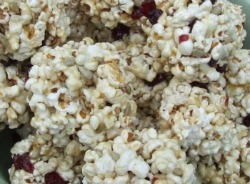 There is a Nebraska legend that the popcorn ball is actually a product of the Nebraska weather.
It supposedly invented itself during the “Year of the Striped Weather” which came between the years of the “Big Rain” and the “Great Heat” where the weather was both hot and rainy.
There was a mile strip of scorching sunshine and then a mile strip of rain. On one farm, there were both kinds of weather. The sun shone on this cornfield until the corn began to pop, while the rain washed the syrup out of the sugarcane. The field was on a hill and the cornfield was in a valley.
The syrup flowed down the hill into the popped corn and rolled it into great balls with some of them hundreds of feet high and looked like big tennis balls at a distance. You never see any of them now because the grasshoppers ate them all up in one day on July 21, 1874.
From American Eats, by Nelson Algren, published by University of Iowa Press, 1992
Sources:
Albert Dickenson Co, Odebelt Historical Museum Association.
American Eats, by Nelson Algren, published by University of Iowa Prewss, 1992
Cornzappopin, by Barbara Williams, published by Hold, Rinehard and Winston, New York, NY, 1976.
CrackerJacks: A Brief History, FritoLay.
Doug Eckstein, Great-Great-Grand Nephew of Henry Eckstein.
Frito-Lay Press Releases.
How Cracker Jack Begin, by Jeffrey Maxwell.
Panati’s Extraaordinary Origins of Everyday Things, by Charles Panati, published by Harper & Row, 1987.
Peanuts, Popcorn, Ice Cream, Candy and Soda Pop, by Solveig Paulson Russell, published by Abingdon Press, 1970.
Story of Jolly Time Popcorn.
The Food Chronology, by James Trager, published by Henry Holt and Company, 1995.
The Secret Life of Food, by Martin Elkort, published by Jeremy P. Tarcher, 1991.
The Story of Corn, by Betty Fussell, published by North Point Press, New York, NY, 1992.
Wyandot Popcorn Museum.