
What is Vegemite?
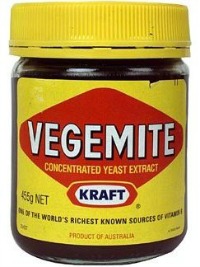 Vegemite is considered as much a part of Australia’s heritage as kangaroos and the Holden cars. It is actually an Australian obsession that has become a unique and loved symbol of the Australian nation.
A Vegemite sandwich to an Australian kid is the equivalent of a peanut butter and jelly sandwich to an American kid – but the taste is QUITE different!
Vegemite is one of several yeast extract spreads sold in Australia. It is made from leftover brewers’ yeast extract (a by-product of beer manufacture) and various vegetable and spice additives. It is very dark reddish-brown, almost black, in color, and one of the richest sources known of Vitamin B. It is thick like peanut butter, it is very salty, and it tastes like – well let’s just say that it is an acquired taste!
Australian children are brought up on Vegemite from the time they are babies. It is said that Australians are known to travel all over the world with at least one small jar of Vegemite in their luggage, for fear that they will not be able to find it.
Want to try Vegemite, you can purchase it here on Amazon.
Did You Know?
22.7 million jars of Vegemite are manufactured in Australia every year – that’s 235 jars per minute.
30 jars are sold in Australia for every one exported.
Vegemite is in nine out of ten pantries in Australia.
History:
In 1922, Fred Walker (1884-1935) of Melbourne, Australia decided to try to make a special “yeast extract” that would be as delicious as it was nourishing for his Fred Walker Cheese Company to sell. The chief scientist in the company Fred owned was Dr. Cyril P. Callister, and it was Dr. Callister who invented the first Vegemite spread. He used brewer’s yeast and blended the yeast extract with ingredients like celery, onion, salt, and a few secret ingredients to make this paste.
In 1924, a national competition and a prize of 50 pounds was offered to the winner or winners to name the new product. The name ‘Vegemite’ was finally chosen from the entries by Fred’s daughter Sheilah.
With its unusual and unique flavor, Vegemite was not an immediate success and sales were slow. In 1928 Vegemite was renamed and registered as Parwill in an attempt to boost its sales and to attract customers of the rival spread Marmite (an English yeast spread that dominated the Australian market since 1910). “If Marmite…then Parwill” was the rationale behind Walker’s strategy to carve a niche in the market for his spread. The name Parwill and Walker’s play on words didn’t catch on. It was only sold as Parwill for a short time in Queensland. The name was withdrawn in 1935, and the original name was reinstated.
Earlier, in 1925, Walker had arranged with the Chicago, Illinois firm of James L. Kraft to make processed cheese in Australia. A company called the Kraft Walker Cheese Co. was established alongside Fred Walker and Co. In 1935, Walker used the success of his processed cheese to launch a new campaign to revive Vegemite. The company launched 2-year coupon redemption scheme whereby a jar of Vegemite was given away with every purchase of other products in the Fred Walker Cheese Company. Australians tried the product and loved it. Vegemite was well and truly on the road to success.
Two years later, the company held a poetry competition and once again brought this product into the national spotlight. This time its success the prizes were imported American Pontiac cars. Entries flooded in and sales multiplied.
In 1935, the recipe and manufacturing methods was sold to Kraft Foods and has been wholly owned and made by American companies. In 1939, the product received endorsement from the British Medical Association which allowed doctors to recommend it as a Vitamin B-rich, nutritionally balanced food for patients.
In World War II, soldiers, sailors, and the civilian population of Australia all had Vegemite included in their rations. Soldiers’ Vegemite came in three sizes: seven-pound tins for the platoon, eight-ounce tins for soldiers on the go, and half-ounce rations for behind enemy lines. This war-time demand meant that civilian were limited. Hence, advertisements were run to explain the situation:
Vegemite fights with the men up north! If you are one of those who don’t need Vegemite medicinally, then thousands of invalids are asking you to deny yourself of it for the time being.
The main change to the original recipe in recent years has been to reduce the salt content from 10% to 8%.
Vegemite’s rise to popularity was helped by the marketing campaigns written by J. Walter Thompson advertising in 1954. They used groups of smiling, attractive healthy children singing a catchy The Happy Little Vegemite Song (see below). The song was first aired on radio in 1954 and then on television in 1956. This advertising campaign continued until the late 1960s.
The Happy Little Vegemite Song
We are happy little Vegemites as bright as bright can be,
We all enjoy our Vegemite for breakfast, lunch and tea,
Our mummy says we’re growing stronger every single week,
Because we love our Vegemite,
We all adore our Vegemite,
It puts a rose in every cheek!
- Favorite bread
- Butter or margarine, softened
- Vegemite
-
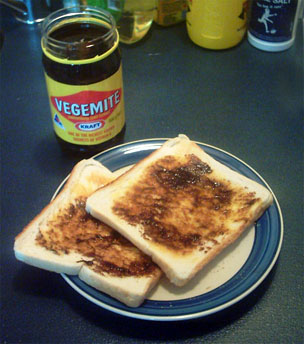
Spread butter on a piece of toast or bread.
Cover very thinly with Vegemite (for the optimum Vegemite sandwich you only need a dab).
Dip your knife in the Vegemite, and scrape up just a bit (it will mix right in with the butter and spread easily). Some people like to "marble" the Vegemite into the butter.
Eat it open-faced and enjoy!
Comments from South NSW, Australia:
Your explanation is mostly fine, but some of us like a fair coating of the stuff, not just a scrape.I’ll eat it out of the jar!But one of the most useful tips to give any cook, is how it can save an anemic gravy: When a gravy lacks colour or flavour, a quarter to a half teaspoon or so always saves the day.Young-uns often wonder why my gravy is always so good; and if they’re nice, I let them in on the secret that my Grandma told me.Funny to think my family has used a product since it was invented.Thanks for the history lesson, and try Vegemite in your gravy, you’ll love it!
You might like to know that when the company sold overseas, it was cause for national concern…everybody was outraged, and worried that “the Yanks would stuff-it-up”.People were ringing radio stations calling for the government to stop the sale.Private citizens were trying to raise funds to make a counter offer…you wouldn’t believe the furor it created.
Another favourite use of my Mum’s, when she felt run-down, was vegemite ‘soup’;just a teaspoon of vegemite in boiling water.I used to like thinly sliced raw cabbage, garlic and vegemite sandwiches. Sounds terrible, but very healthy and yummy. Every kid in Australia ate Vegemite on SAO biscuits; often with tomato, and, or cheese.This combo is particularly yummy grilled as an open sandwich with Kraft sliced cheese (the way it bubbles up and browns-off…yum!).
I’m an easy going old bloke, and I have a young lodger who gets away with murder because I “don’t give a rats” about money or anything – you could hit me with a cricket bat and I’d blink at you, LOL – anyway, he used the last of the Vegemite the other month.God he was lucky I didn’t rip his head off – LOL.Now I keep an emergency jar hidden away for myself, just in case.
Growing-up, only ‘pommies and wankers’ ate marmite.I still haven’t tasted it (excuse the language).We all agreed the best pies were “Sergeants pies,” though we’d eat”Four and Twenty” if that was all we could get.People argued about Ford and Holden; and we’re still arguing about which code of football is best…but apart from cricket, vegemite is one of the great unifying forces – no matter your politics or standing in life, we all love our Vegemite.
What ever you do, don’t muck with the recipe too much, or you can forget about being allies.LOL.It was a national tragedy the day that Sergeants stopped baking pies.People went around buying-up the last run, and freezing them.It was very sad I remember.We mourned their passing for years, quite literally.The new ones are ok, but not a patch on the original.Aussies used to have them flown overseas when touring.It’s the highest praise for a pie to say it’s almost as good as a Sergeants.
Comments and Reviews
Leave a Reply
42 Responses to “Vegemite History and Recipe”
Tina Haveman
I love my vegemite, and the new cheesymite. I’m thankful I can now order it from Amazon. Two of my kids had it daily when they were toddlers, and suddenly I couldn’t get it anymore. (I live in Canada now.) Now they think it’s gross… When I lived in Australia and was pregnant, on my dietary list the doc gave me on what to eat foods during pregnancy, vegemite sandwich was on it for every day. I use it in stew, soups, gravies, with cheese, liverwurst, there are tons of different ways to use it.
Steve
Where can I get this “cheesymite”?
Astrid Doolaege
I would love to try it. I live in California. I wonder if I can find it in a store here, maybe Whole foods. If not, I will look in Amazon
Mark Forrester
Having tasted both spreads, Vegemite is a pale imitation of the orginal Marmite.
Still tasty though.
Vahid
Crazy. I’ve practically lived on vegemite my whole life. I love it. You poor Americans!
Marek
Our first trip to Australia a few years back got me hooked on Vegimate. We love it, but it is hard to get in the U.S. at a reasonable price. Any suggestions? Please let me know.
cheers,
Marek
Kai
One can buy it at Cost Plus Worldmarket. Marmite as well.
The best yeast extract, though, is Vitam-R from Germany: less tart/ bitter and less salty but more flavourful than than the two others, overall more balanced and softer to spread. No idea if available outside Germany, though, and there only in certain “holistic” stores nationwide and online. With and without added herbs. Perfect with butter and cheese on a hearty rye bread.
MIKE
Walmart.com has it. I don’t know what is reasonable for the price but shipping was free.
Heather
Very interesting read.
leonie finlayson
Myself, my children, grandchildren, and great grandchildren have all grown up with vegemite. I am in shock to find the original flavour has gone. I have tried the original and the salt reduced to find it now causes me to gag and I can no longer have it in the house. Something has changed since the new ownership of the Company. Has anyone else noticed this subtle change. I need the original one back again.
Jody smith
I agree leonie. They have changed something in the recipe besides salt to make it halal approved. I have not eaten vegemite since the change as it tastes bland but my children were still eating until just recent when a jar of vegemite had gone mouldy. I have never in my life seen this product go mouldy even after it was in cupboard for years. Disgusting they can take a product and change it when it didn’t need to be. Lost me
Wendy Stringer
I agree with Leonie and Jodie; the taste is very different, with a disagreeable pong. I keep it in the refrigerator because I no longer believe this new recipe lasts as long as the original. But we’re all aware that nowadays most goods are manufactured with a short life in mind so that there’s a high turnover. People having the Vegemite sitting happily in the cupboard for ages is not good for business.
And…look what happened to Arnott’s biscuits…the thickness was trimmed down. Have you noticed that Iced VoVos no longer have pink marshmallow …it’s now fondant. And the jam strip down the centre is a poor copy.
And…Milo has changed for the worse…the quality of the Milo itself…it’s now a fought powder whereas the original was more uniform in texture. The taste is awful.
But, we still buy it , more for nostalgia.
Danny
Thin layer??? Nah just whack it on like your peanut butter. Vegemite is a staple in my diet. Nothing like Vegemite toast with a cup of Lipton tea in the morning.. I know my father in law puts Vegemite in a beef marinades or he bastes it on I’m not sure. Yes couldn’t live without it.
Steve
I just bought a whole flat of 12 jars from Amazon to get the best price. So now I’m wondering if anyone knows if I can freeze the jars. Just thaw out a couple at a time. Anyone?
Chris
Steve,
I bought a small jar of Vegemite more than 5 years ago (maybe 10? Not sure. . .) in (I think) a Fairway Market store. At any rate after I opened it it went in the refrigerator – and when I moved to my new house almost five years ago, it moved with me, with only the small marks of the fork tines I used to sample it still there. In all this time there has been no mold growth or anything else, and it tastes just as it did the day I opened it so long ago. I just had a little mixed with some peanut butter, and having it that way isn’t bad at all . . . I’d like to use up the jar, might try it in some recipes or on toast with butter, like our hearty friends down under enjoy it . . .
Mark
It should be “richest known sources”.
shantel
Wow – vegemite is the best although it’s a little bit to salty. Anyway who am I to say that, it’s not like I am the president of the United States of America.
Patty Roland
Where is Vegemite available in the USA?? Sounds interesting!!! & healthful.
John B. Daugherty
Found mine at World Market. A generous spoon full goes in with every batch of gaspacio I make in my blender.
Chris W
I was born in the US and loved the ‘Fluffer-nutter’ as a kid. In 1972 at age 7 I was transplanted in the land of criminals… my mother stolen away by my step-father.. a True Australian man – but I grew up eating toast and vegemite daily – LOVE it! I moved back to the States at the onset of the 1st Gulf War to serve as a MP. I used to buy it from Aussie products stores, IE: http://www.aussieproducts.com/ but now also amazon.com. I give it to American friends… 1 guy (Caleb) Loves it! – trying it with another friend who recently got sent to the sandbox for a year! Strict instructions given! LOL. I also like spreading it on top of meat pies with tomato sauce- (Aussie bakery in GA). MMMMmmm! Luv it mate! 🙂
Patrick Jean Divorne
Just to inform that now in Brazil you can find a very similar product to Marmite or Vegemite with the name of Cenovit.
Cenovit has the same great taste and beside spreading on the bread with butter, you can use it in many recipes and the main result will be to bring up all the flavors because Cenovit give a lot of “umami”.
Enjoy trying Cenovit.
Mrs. Golden
Why are they now adding wheat to the recipe, when so many are allergic to wheat now? There was no wheat in the original.
Jayah
I feel bad for all you Americans cause you have to pay money to get vegemite shipped and delivered but on the other hand I can go down the road and get it for less then $5!!!
Nancy
I guess we have to come visit you so we can get it from your store. You are so lucky!
Ben
For a new comer, you’re most likely to enjoy Vegemite very thinly scraped, on hot-buttered and toasted bread. White bread seems to go better for some reason, and toasted Turkish and Lebanese bread make excellent alternatives for extra crunchiness. For some reason it doesn’t go all that well with multigrain or wholemeal breads. Make a nice hot cup of tea to wash it down.
Jess
This is the funniest post I have ever read..
course however should be changed to main meal.. not snack!!
My kids eat Vegemite off a spoon! And I just can’t believe that an American website has a recipe on how to make a Vegemite sandwich
😂😂
alan vogt
My wife and I are in our late 70’s and we went off Vegemite about a year ago as the taste had changed to be too severe, some friends also noticed it. No matter how fine it was spread we could not adapt to it. Recently we tried a smaller jar which was 20% less salt.. HALLELUJAH this is what it used to be like! We are now happy little Vegemites again.
Nancy
Wow, it sounds like the sodium content has increased in the vegemite in recent years.
Mitzi
I reside in California and I picked up 2 jars for a $1 each at an outlet store. I had no clue what I was buying but I had assumed I could use it as seasoning, broth based for veggies now I see it is for sandwiches.
Peter Green
I haven’t done it for a long time, but, if I had cooked potato in the fridge from last night’s meal, I would cut thin slices and put them on a lightly toasted crunchy toast (whole grain or multigrain) with butter and Vegemite, and grill cheese on top of the lot.
A very tasty and sustaining snack and a good way of disposing of excess potato.
I don’t eat a lot of Vegemite, so the content of the jar only slowly diminishes. I have never had mould formation.
Theresa
I just go straight for the brewers yeast powder and put it on popcorn. Lends a cheese flavor.
JAMES
I never heard of Vegemite until I ran into some Aussies on a train in Europe while backpacking in the 1980s. They never had peanut butter which shocked me as an American. We grow up eating it, and it’s a good high protein backpack food because it lasts forever without refrigeration. In a moment of international diplomacy, we exchanged sandwiches. I wasn’t crazy about vegemite but could eat it, and they didn’t care for peanut butter. They couldn’t believe I didn’t like it, and how can anyone not like peanut butter? It goes to show that you like what you’re used to.
Stuart SS
Hey
Vegemite is a second stringer ~ Concept is a fabulous product ~ but the Vegii ~ IS FAR FAR TOO salt laden ~
In our House it is ONLY a “Three Ms ” (all australian Company ~ for ever~ ) and they make “Mighty Mite ” ~
It is fabulous ~ I love to get up in the Morning and take spring water followed by a Tea spoon of “Mighty Mite” ~ far less salt and tangy ` Luve it !
Works for Us ~ Forget about Vegemite ~ TOO much Salt ~
Mel S
I can’t start my day without Vegemite and tea – it wouldn’t feel right – I don’t like to deprive myself of a good thing – I do like happy beginnings to my days!!!
Mel S
I don’t start my day without Vegemite and tea – it wouldn’t feel right to deprive myself of a good thing and I like happy beginnings to my day!!!
Daryl Jones
Vegemite is NOT THE SAME it has been ruined by American ideas. I cannot eat this new muck it’s vile.
They have ruined Arnott biscuits and many other Aussie foods by changing things. They are used to bland we are not. I’m 66 years old I looked at the ingredients list . I can tell you the changes that have ruined our Vegemite .
Potassium chloride causes gastric ulcers and has made the product unspreadable it’s just a gluey mass that won’t spread thinly, Hydrolised Vegetable Protein from SOY has altered the flavour, lower salt and they have dropped celery salt from the original recipe. And this stuff does go mouldy over time . I refuse to buy it now
Paul
Born 1961 in Melbourne, of course among four and twenty pies, Vegemite was never aloud to be missing
1972 shifted to Switzerland and till this day today never ever had a shortage of Vegemite, well currently in my food bunker of course I do have a small stock to cover at least the next 3 years to come, come Vegi, come good
So long live AC / DC, Vegemite and four and twenty pies
Clint
I’m an old coot and a native-born American, but I do love Vegemite and Billy tea as a great start to each day.
Charles Bangwiner
An American here, just discovered Vegemite about a year ago and can’t understand why this stuff isn’t sold over here (except in stores that import exclusively or Amazon). After reading all of these comments, I’m saddened that what I’ve just learned to love has been altered from its original form, yet at the same time surprised that everybody doesn’t have the same opinion. This must be like the Cocacola debate. Whatever, I am absolutely addicted to the stuff now and love finding and trying the other ‘Mites’ from around the world.
Michael surendra
Live in the Fiji islands just love vegemite
E from QLD AU
I disagree with those that say it should be heavily slathered on. That’s a personal preference but since it is an acquired taste for those that didn’t grow up with it, the base point for trying Vegemite is a thin swipe of it. You should still see the bread/butter underneath, much like the photo. Then if you like it, feel free to try putting as much as you like on!
Blitzo
Amazing! I love your recipe very interesting to follow.