
Article by Dr. Linda Posch MS SLP ND
Health Benefits of Walnut Oils:
 Walnuts and their oils are excellent sources of omega-3 fatty acids. Most of the research on the health benefits of walnuts has focused on consumption of the nut itself, although interest in walnut oil has grown over the last decade. The health benefits of walnuts and walnut oil are similar if the oil is unrefined, fresh (6 month shelf life), and uncooked. However, the serving size of walnut oil is less than the amount of walnuts needed to get the same nutritional benefit. For example:
A 35 gram serving of walnut oil provides the same nutritional benefits as 50 grams of walnuts.
Walnuts are rich in phytonutrients and are an excellent source of selenium, phosphorous, magnesium, zinc, iron, and calcium.
Walnuts and/or walnut oil provide hefty levels of Vitamins B-1, B-2, and B-3, coupled with Vitamin-E and niacin.
The health benefits of walnuts were first identified in 1937 when researchers discovered that they were a significant source of vitamin C. Over the last 70 years, numerous other studies that evaluated the effects of walnut and walnut oil consumption on mortality, disease prevalence, and disease risk factors have been performed. It has now been well established that eating walnuts on a regular basis has definite health benefit. The most significant of which being a reduction in the risk of coronary heart disease. Adding walnuts to the daily diet can certainly help one maintain a healthful body balance.
Consumption of walnuts or walnut oil has been shown to lower total cholesterol, LDL (bad cholesterol) and the ratio of LDL to HDL (good cholesterol). Furthermore, regular walnut oil consumption reduced triglyceride levels 19 to 33% in a 45-day study. In 2004, the Food and Drug Administration stated:
“Supportive research shows that eating 1.5 ounces per day of walnuts, as part of a low saturated fat and low cholesterol diet may reduce the risk of coronary heart disease.”
The cardio-protective benefits of walnut oil are primarily due to the high concentration of alpha-linolenic acid (ALA), which is an omega-3 fatty acid that ultimately is converted to eicosapentaenoic acid (EPA), and docosahexaenoic acid (DHA), and omega-3 fatty acids that are easily utilized by the body. A study published in the American Journal of Clinical Nutrition reported that one tablespoon of walnut oil provides 1.4 grams of ALA. Men require 1.6 grams and women 1.1 grams of ALA per day. Walnuts differ from other nuts because they primarily consist of omega-3 fatty acids whereas monounsaturated fats are found in higher levels in most other types of nuts.
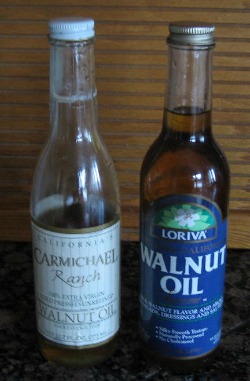 Walnuts and walnut oil are also rich in antioxidants and are one of the best antioxidant sources among the tree nuts. Antioxidants are substances that counter the effects of free radicals, which are substances that cause cell damage and accelerate the aging process. Walnuts are especially dense in the antioxidant ellagic acid, which aids in controlling the replication of malignant tumors and has anti-bacterial, anti-inflammatory, antiviral and antiseptic properties. Gallic acid and malic acid, both antioxidants, are present in smaller quantities and have similar protective effects. This demonstrates yet again that nutrition is best derived from whole foods verses liquid vitamins and other vitamin supplements.
Overall, regular use of walnut oil provides a dietary source of essential fatty acids and antioxidants, both of which are often difficult to attain in adequate quantities within a typical Western diet. The practical benefits of this regular use are significant reductions in coronary heart disease risk and possible decreases in cancer risk and slowing of the aging process.
Using walnut oil in your cooking:
Walnut oil has a rich, nutty flavor that is perfect for salad dressings, to flavor fish and steaks, to toss with pasta, and to jazz up desserts. Walnut oil is best used uncooked or in cold sauces because when it is heated, it can become slightly bitter. This flavor, however, can be a pleasant taste when experienced in moderation.
Unrefined walnut oil is terrific on salads, particularly when you combine it with bits of walnuts. Add walnut oil to a chicken or turkey salad along with some grapes and chopped walnuts. Brush a thin coat of walnut oil on grilled fish and steaks just before serving. Toss freshly cooked pasta in a mixture of walnut oil and spices. Try using walnut oil in dessert recipes that will be enhanced by the nutty flavor.
6 Responses to “Health Benefits of Walnut Oil”
Dorothee Herlyn
Where can I buy unrefined cold pressed walnut oil?
Linda Stradley
Try Whole Foods.
Irina Mak
Where can I buy organic unrefined ( for salad) and refined (cook with temperature) cold pressed walnut oil in glass bottle and how much?
Rosemary Armstrong
Where can I buy walnut oil to put on salads and for cooking in Oxford
Soumya Shrivastav
Hello Linda,
Great article. Walnuts benefits are mainly known to everyone but its oil benefits are rarely known. Its awesome to know its details. Thanks a lot for sharing this with us, keep posting!!
Curtis Parker
Is walnut oil pure or is it mixed with other oils?