

How To Cook A Perfect Baked Potato – No Foil Baked Potato
A Perfect Baked Potato will have a crisp skin with a light and fluffy inside. The steps to achieve these results are effortless!
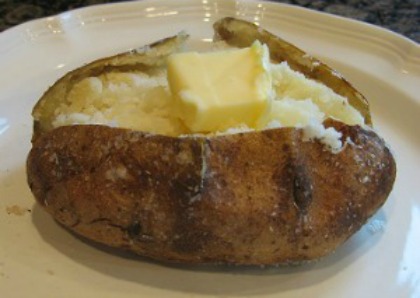
Most home cooks have been taught to cook a baked potato wrapped in foil, but this step is not necessary. If you enjoy baked potatoes from your favorite steakhouse restaurants, you will recall they have a crispy skin with a soft fluffy inside. Baking a potato in the oven with no foil wrapping is the secret to baked potato perfection! So – throw out that aluminum foil! Rub the outside of the baked potato with olive oil or butter instead. If you follow our easy guidelines below, you will always have perfect baked potatoes!
Which potato should I choose for baked potatoes?: Any potato can be baked, but for the perfect baked potato with the desired flaky texture, it is recommended that mature, baking-type potatoes such as the Russet potatoes be used. Russets are known as a starchy potato, a baking potato, or a mealy potato. The starch gives the potato it’s characteristic fluffiness. When you’re in the mood for a good, classic baked potato, it’s Russet Potatoes.
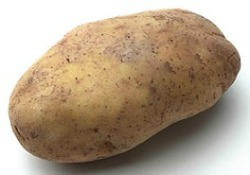 Important: Make sure that the skin of your potatoes has a nice even brown tone without a greenish cast. Inspect the potatoes thoroughly to make sure that there are not any significant bruises, discolored spots, or sprouts.
A sprout of any size can be toxic, but you would have to eat many sprouts to get sick. Do not buy potatoes if they have sprouted or have a green tint to the skin. The same is true for potatoes that turn a greenish hue. A potato in this condition is “light-struck” which causes a build-up of a chemical called Solanine. This is a natural reaction to the potato being exposed to too much light. The green part, if eaten in large quantity, can cause illness.
When baking a lot of potatoes at one time, choose potatoes with uniform shapes and sizes; they will cook more evenly and get done at the same time.
Check out Linda’s Potato Hints, Tips, and Information, and The History and Legends of Potatoes.
Perfect Baked Potato Recipe- No Foil Baked Potato Method:
- 1 teaspoon olive oil, vegetable oil, or butter
- 1 medium potato (Russet Potato)
- 1/2 teaspoon coarse salt or sea salt
-
Adjust the rack in your oven to the middle position and preheat oven to desired temperature (see Cooking Temperature Chart below).
-
Rinse and scrub (I use a stiff-bristled brush) each potato under cold running water, as you will be eating the skins of these perfect potatoes. Do not soak the potatoes (that will make them soggy. Also do not use hot water or you will start cooking the outside and the inside will not catch up). Dry each potato thoroughly with a clean towel.
-
Look the cleaned potatoes over and remove any bruises or discolored spots with the tip of your knife.
-
Pierce each potato deeply with a fork or sharp knife four (4) times on each side at approximately 1-inch intervals (this will allow steam to escape during the baking). If you do not pierce the potatoes, they may explode during baking in your oven. You do not want this to happen as it makes a terrible mess in your oven!
-
Wrapping the potato in aluminum foil will produce a soft skin (not crispy). Technically this is steaming rather than baking (as the moisture in the potato remains trapped) and the light, flaky texture will be missing. The texture of a steamed potato is entirely different from that of a perfect baked potato. Save yourself the trouble and expense of wrapping potatoes in aluminum foil and serve perfect baked potatoes. My suggestion is to NEVER use aluminum foil when baking potatoes!
-
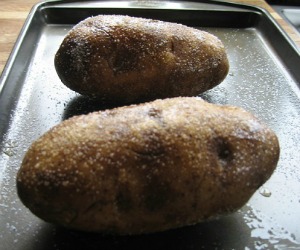
For a crispier potato skin: Rub the outside of the potato with olive oil, vegetable oil, or butter over the skins. I like to roll the potatoes in coarse or sea salt after rolling in the oil and before baking. Place coarse salt onto a small plate. Roll potatoes lightly in the salt. The skin is so yummy to eat when baked!
-
Bake on racks of oven until tender.
-
Bake according to the Temperature Chart below. Do not overcook potatoes as the insides will be dry, so it’s important to be vigilant.
-
The higher the oven temperature, the shorter the cooking time will be and the crustier the skin. Larger potatoes will take longer to bake. Bake potatoes along with whatever else you are baking and gauge the cooking time according to oven temperature.
-
Turn the potatoes over halfway through the baking time to prevent browning of the undersides where they touch the oven rack.
-
Potatoes are done if tender when pierced with a fork to see if it slides out easily and you can check the internal temperature reaches 210 degrees F. Use a meat thermometer to test for doneness. You can also test for doneness by gently squeezing the middle of the potato (using a pot holder or oven mitt). If it gives in easily to your touch, it is done.
-
When baked to perfection, remove potatoes from the oven. Slit across the top with a sharp knife. Gently pinch (squeeze) in each end of the potato towards the middle (using your thumb and index finger). The potato will then pop open and loosen the fluffy white interior from the skin. Be careful as there will be some steam.
Oven Temperatures for Perfect Baked Potatoes:
Conventional or Regular Oven:
(about 5 ounces, medium-sized potatoes, or 150 grams each)
45 minutes at 400 degrees F.
60 minutes at 350 degrees F.
90 minutes at 325 degrees F.
(about 8-10 ounces, large-sized potatoes or 227-283 grams each)
60 minutes at 400 degrees F.
80 minutes at 350 degrees F.
Place the potato directly on the oven rack in a preheated oven. Place a baking sheet (I put a piece of aluminum foil) on the lower rack (below the potatoes) to catch any drippings.
Convection Oven:
(about 5 ounces, medium-sized potatoes or 150 grams each)
45 minutes at 375 degrees F.
60 minutes at 325 degrees F.
90 minutes at 300 degrees F.
(about 8-10 ounces, large-sized potatoes or or 227-283 grams each )
60 minutes at 375 degrees F.
80 minutes at 325 degrees F.
Convection ovens cook up to 20% faster than regular ovens. Also, the food in a convection oven is cooked at a lower temperature than in a regular oven to achieve the same results.
The general rule is to decrease your oven temperature at least 25 degrees lower than a regular oven.
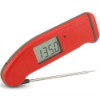
This is the type of cooking and meat thermometer that I prefer and use in my cooking. I get many readers asking what cooking/meat thermometer that I prefer and use in my cooking and baking. I, personally, use the Thermapen Thermometer shown in the photo on the right. To learn more about this excellent thermometer and to also purchase one (if you desire), just click on the underlined: Thermapen Thermometer.
You now have a perfect baked potato – All you need to do is load it with your favorite toppings and enjoy!
Favorite Baked Potato Toppings Ideas:
- Butter
- Sour Cream
- Salsa
- Sliced green onions or chives
- Bacon bits
- Shredded cheese
- You could even make a meal out of your baked potato by topping with taco ingredients or additional meats and vegetables on top. Get creative!
What goes well with the Perfect Baked Potato – the Perfect Steak!
It’s hard to think of eating a juicy steak without a baked potato. These two foods go hand in hand.
Learn how to Cook the Perfect Steak.
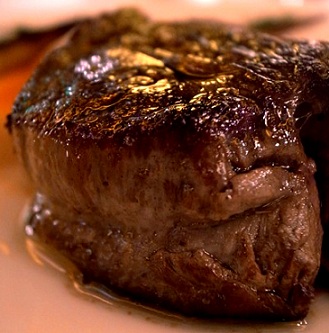 Filet Mignon
Comments from readers:
I’m a good cook. A while back I was looking for alternate baking times for potatoes so I could synchronize with other oven dishes. Your tutorial – it’s that good – on baking potatoes nailed the subject. I used to be a tech writer years ago. Your informative, tight, and expert writing is about as good as it gets. Thanks.- Jack Labusch, Niles, Ohio (10/16/14)
I had never made a baked potato before. I remember the ones my mother used to cook when I was a kid being really dry but I wanted to make one, so I googled it and found your site. My baked potatoes were delicious and I have you to thank for it. They’re now a regular staple in my ever-burgeoning cooking repertoire. Thank you so much. I so appreciate a recipe that turns out beautifully. – Diane (12/20/13)
I was just looking online at new ways to bake a potato AND I SAW YOUR SITE. PERFECT just like you said with no aluminum foil used and salt, pepper, and butter on the outside – perfect cook times. They were amazing! I don’t think I came up for air, it was the best baked potato I’ve ever had at home or anywhere else! – from Facebook (10/30/13)
Hi Linda – Your recipe is perfect. I am a terrible cook and have always assumed you have to wrap a baked potato in Reynolds Wrap. I have also cooked them at too high a temperature. I followed your instructions and they turned out perfectly. You are right – the consistency is totally different. – Regards Cindy (4/21/13)
I’m 55 years old and tonight I cooked my very first baked potatoes. I don’t cook much. I didn’t cook my first chicken until I was 50, the list goes on. I don’t particularly like baked potatoes but my husband does. During our 15 year marriage, I did a bake potato for him once a few years ago in the microwave – it was edible. I think! Tonight I decided it make him real baked potatoes with his dinner and decided to look up how to do it. I found your website and followed your directions to the letter (except my husband doesn’t like a lot of salt so after baking with the olive oil and sea salt, I wiped off the sea salt before serving). He said he could still taste the salt and they were two of the best baked potato’s he has ever eaten. I didn’t have them but wanted them to be good for him and they were. From a hopeless cook and an American abroad, thank you so much for the Perfect Baked Potato. Cheers – Karen Harland, Middleton St. George, England.
54 Responses to “Perfect Baked Potato Recipe”
Brooke
I have to bake apx. 30 potatoes at one time in a regular oven. How would you adjust the time/temp? Also am I safe to wrap them in foil after they’ve been fully cooked for serving purposes?
Linda Stradley
If you leave room for each potato to not touch each other during baking, you should be able to bake all the potatoes at once without any time or temperature adjustment.
If you wrap the potatoes in foil after baking, you will be steaming the already baked potatoes. Don’t do this unless you absolutely have to. You didn’t say how long you would need to hold the potatoes. If your time period is less than 1 hour, how about turning the oven off and leaving the potatoes in the oven until serving time.
Cici
I baked 1 potato at 400 degrees F. Checked it at 45 minutes and it was not done so I kept cooking it for 10 more minutes, then 5 more minutes. Finally the potato was done in the middle! The skin was not crisp at all, just tough. I did not put oil on it before cooking because the information said that would give a soft skin. We wanted a crisp skin. This method did not give the results desired!
Linda Stradley
My method is to rub olive oil and srpinkle salt on the skin before baking and you will get a nicely cooked potato skin and soft potato on the inside. By not rubbing with olive oil, you did not actually follow my recommended method.
Also Remember – Great cooks use a cooking thermometer as their guide – not a clock. Cooking thermometers take the guesswork out of cooking, as they measure the internal temperatures of your cooked meat, poultry, seafood, baked goods, and/or casseroles, to assure that a safe temperature has been reached, harmful bacteria have been destroyed, and your food is cooked perfectly. Always follow internal cooking temperatures to be safe!
Internal temperature of perfect baked potatoes:
210 to 212 degrees F.
98 to 100 degrees C.
Please follow the recipe for perfect baked potatoes. I make these baked potatoes all the time. You will not be sorry!
Stacey
Thank you so much. This was really helpful.
Virginia Donaldson
I have to cook lots of potatoes for a potato bar we are having tonight. My dilemma is that I need to attend a family baby shower prior to the time I need to leave for the event. How can I bake about 30 potatoes (l have double ovens) when leaving my house at 1:00 PM, returning about 4:30 PM, and then needing to leave for the event with my potatoes at 4:45PM. HELP!! Please ????
Crissy
Amazing baked potato’s. I come back to your site every time I bake potato’s. Follow the instructions and you will have an amazing tater. My husband doesn’t like salt so i just don’t salt his and no complaints….. Love them.
Milly
I make extra baked potatoes then put one or two in the refrigerator..over night in the morning slice the cold potato with skin on into half dollar sizes , fry in olive oil until golden brown on each side ,yummy the best home frys in the world…
Katzmeow
That sounds really good!
Rita Barker
I live in Denver now and am wondering if I need to just time or temperature at altitude.
Asad
I baked potatoes at 190 °C for 65 minuites and the potatoes were raw and uncooked. I put the potatoes inside the baking tray. What seems to be tge problem im male.
Whats Cooking America
You need to make sure to first pre-heat the oven and add the potatoes once the oven temperature reaches 350 degrees F.
Cliff Indiana
Be creative with the fat! Bacon grease, lard, beef tallow are all very tasty used as coatings on these potatoes!
Edward
What I loved the most about this website is its varieties. I have found many recipes that are fresh for me to cook. Thanks a lot.
Libby Murphy
Amazing post! Thanks a lot for a great piece of advice. I like cooking, in particular potatoes, as well as my job (professional typing) so much. Actually, if I have a choice what to eat – a wonderfully cooked steak or potatoes – I will choose potatoes. I don’t know why, I just really like it and have tried a lot of ways to cook it. My favorite recipe is the simplest one: boil a few potatoes, at the same time I simmer vegetables in a pan (choose whatever you like: corn, green peas, carrots, broccoli, savoy cabbage). When vegetables and potatoes are almost ready, I just mix them in a frying pan, add paprika, black pepper, curry and Italian herbs, mix again and leave it for a few minutes. It’s delicious!
Dew Solo
So how long to a I bake BIG potatoes? All the recipes I find are for dinky 5 to 8 ounce potatoes. The ones I like to eat, the ones my local grocery sells as “baking potatoes” weigh between 10 to 16 ounces. I usually end up baking them for a lot longer than the 45 to 60 minutes most recipes state and then dinner is late and I have a grumpy family
Linda Stradley
Potatoes are done when the internal temperature reaches 210 degrees F. on your thermometer.
Sharon
I’ve also heard that restaurants bake them to 185 as they continue to cook for a bit once removed from the oven. Might try that, as they were *very* dry cooking to 210.
Would foil help them not dry out? Family win’t eat skins no matter how amazing they are, so I might as well go for the perfect interior.
lora
Please send potato skins to us We’ll trade for the interior 🙂
Whats Cooking America
You need to make sure to first pre-heat the oven and add the potatoes once the oven temperature reaches 350 degrees F. For large pototoes (about 8 ounces), I will usually bake for 90 minutes, then test with fork. If fork slides out easy the interior of the potatoes are done and the skin gets a nice wrinkle and crispness.
Hassan
Be creative with the fat! Bacon grease, lard, beef tallow are all very tasty used as coatings on these potatoes!
foster
good post.thank you
Bob Mente
This is the first time I have baked potatoes. Different kind and sizes were handled by fork tests. All from a friends garden. I am so greatful for the help. They taste great!
Nancy
Per recipe, use oil, “For a crispier potato skin: Rub the outside of the potato with olive oil, vegetable oil, or butter over the skins. I like to roll the potatoes in coarse or sea salt after rolling in the oil and before baking. Place coarse salt onto a small plate. Roll potatoes lightly in the salt. The skin is so yummy to eat when baked!”
Bee Turland
I had to bake the potatoes (6) at 350 degrees for closer to an hour and 40 minutes to get them fully done and fluffy the way I wanted with crispy skins. Otherwise, a really good recipe!
Karen Pereira
Perfect potato!
Christine
Delicious! I would not have thought of rubbing olive oil on the potatoes and the cook times were perfect. Even my 1 and 3 year old picky eaters loved it. 5 stars!
Nancy
Thank you, I am glad you liked it. I love the crispy skins!
Christine
Also, the no foil method is much better for the environment.
Nancy
Thank you Christine, good point to add to the web page. It’s always good to practice good environmental techniques.
Pat
Every December our fire company has its annual election meeting and lunch. I bake potatoes for it. They never cook right. I had been doing them in foil as we have done for 50 years, but they seem to take hours to bake. We usually bake about 75 potatoes. I have the privilege of having two very large gas ovens with two racks in each and two electric wall ovens with two racks each. This past December we tried using all four ovens and spreading the potatoes out more because we thought putting them all in the two large gas ovens may not have given enough air space around them. We thought of getting potato nails for this year and seeing if they help. I will try without the foil this year and see what happens. Have you ever tried the potato nails?? My mother used to use them.
Brian C.
Great approach to baked potatoes – crispy skin, creamy insides – nice! I would just suggest that, instead of slicing the potato open, which leaves just two sides, use a dinner fork and “stab” it to about one inch deep 6-8 times on an angle from one end to the other, then squeeze the potato open from the ends. It will give you a lovely, well-opened center that is just waiting for the butter and anything else going on it!
Nancy
Sounds like you have potato cutting down to an art!
Joe
We have used nails forever.Passed down from our parents.Cuts down on the cooking time.
Nancy
Interesting way of cooking them.
sandra
Hi, i love your post glad i read it cuz i was going to wrap them in foil, one question tho, i am doing a BP bar for Thanksgiving ( i am vegan no turkey on my table? after potatoes are done, can i keep them on a chafing dish to keep them warm?. than you
rohit aggarwal
thank you whatscookingamerica for giving me wonderful information
Susan
I a going to try your recipe…sounds delicious. But I live in the white mountains, 6500 ft. What cha vessels should I make for time??? 4 potatoes at 325 degrees. (The prime rib will be in the same oven) Thank you.
Joanne
I had previously wondered about sprouted potatoes and the greenish hue. Thank you for your information!
Beauty
How do i cook accordian potato without a microwave
Honey
How do i cook acordian potato( without microwave)
Nancy
Here is a recipe for Hasselback potatoes: https://whatscookingamerica.net/Vegetables/HasselbackPotatoes.htm
Whats Cooking America
Check out our recipe instructions for Accordian potatoes: https://whatscookingamerica.net/Vegetables/GarlicAccordianPotatoes.htm
Gord
Ok, I tried the recipe only used bacon grease instead of olive oil and now there is no going back to tinfoil ever again… they were amazing! Thank you.
Robbie
I have always used an exact recipe, instead of foil I put potatoes on a sheet pan with a baking rack. After rubbing with olive oil, course salt and fresh ground pepper. Bake for 55-60 minutes at 400 degrees let rest for 5 minutes. And serve.
Lester
This web page is bookmarked and has become my “go to” for potatoes. It’s also easy to share the link when friends & family ask why my baked potatoes turn out so good.
Evelyn
For those who must leave the house before start time for baking the potatoes, they should be fine with delay start, if your oven has that option. Also, a chef neighbor of ours said he takes larger amounts of baked potatoes to events in a cooler that has been warmed with hot water and well dried. It hold the potatoes at serving temperature so nicely!
Laurie Kay Goforth
Cooked 15 minutes longer than what the suggested cooking time and they came out great. Put a little oil and rolled in salt; yum. Loved putting the slice and pinching ends together to make it nicely presentable. Thank you for posting such a basic recipe.
zebama
The suggested cooking time was exceeded by 15 minutes, resulting in great-tasting food. A little oil was added and salt was rolled in, making it delicious. It was enjoyable to make it look presentable by slicing it and pinching the ends together. Thank you for sharing such a simple recipe.
zebama
If you need to leave the house before it’s time to start baking the potatoes, you may want to consider using the delay start option on your oven. Additionally, a chef in our neighborhood recommends using a warmed, well-dried cooler to transport larger amounts of baked potatoes to events. This will keep the potatoes at the perfect serving temperature.
Jennie
I top my baked potatoes with Chile Verde made with pork meat, sour cream and chopped green onions. Had my first at our county fair once and started to make my own at home. I make the chili sauce from scratch also giving them so much more flavor, DELICIOUS
Nancy
That sounds delicious!
potato
can you not be roasting my family? potato
Dixie
Baked two 10-oz olive-oiled & salted russet potatoes in the fancy new airfry/convection/toaster oven – set for convection bake at 375ºF for exactly 60 minutes…I’m telling you, the best baked potatoes and skins ever, couldn’t possibly be better! Thanksomuch for the info!!!