
Question:
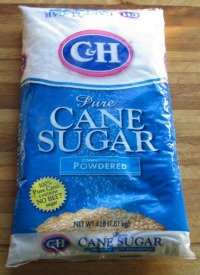 What is the difference between confectioners sugar and powdered sugar. Why do all recipes call it the first and not the second?
Answers:
Commercial confectioners’ sugar and powdered sugar are the same thing with an additive of cornstarch to prevent caking. – Otherwise there is no difference unless you make your own powdered sugar and don’t add the cornstarch. (see instructions below)
Confectioners’/powdered sugar is also sometimes also called 10X sugar and is most commonly found in grocery stores. 10X sugar refers to the number of time the sugar is processed to produce fine powder.
According to our reader Hikari,
“You do NOT want to use confectioner’s sugar in some applications, because the cornstarch will be what people taste more than the sugar, because the cornstarch will ruin the entire concoction. Drinks are the obvious example here. The only time I use confectioner’s sugar is for meringues, where the cornstarch stabilizes the meringues from getting over-processed while the sugar melds with the egg whites.
I use powdered sugar for everything else, and I never buy it at the store. I simply put regular sugar in the food processor or blender, and grind it up to the consistency I need. Just use half the amount of regular sugar for whatever amount of powdered sugar the recipe requires.”
How To Make Confectioner’s Sugar
Mix 1 cup granulated sugar and 1 tablespoon cornstarch in a blender or food processor at high-speed for several minutes. As with most substitutes, the consistency and texture of the dish may be altered. If at all possible, take the time to purchase and use the sugar asked for in your recipe.
How To Make Powdered Sugar
Simply put regular cane sugar in your blender or food processor on high-speed and grind for several minutes. You can control the coarseness of the sugar by adjusting the amount of time you grind it. Less time for more coarse, more time for a finer sugar that is good for using in whipped cream.
Refined sugar vs natural sugar
Refined sugar is broken down rapidly in your body. This quick digestion often leaves you still hungry after consuming foods with refined sugars. Consuming refined sugar also causes your insulin and blood sugar levels to skyrocket. Whenever possible choose natural sugars instead such as those found in whole fruits. Whole fruits also have fiber your body slowly digests the fiber first, causing the sugars to be digested slower as well.
Remember – One (1) teaspoon of sugar has 15 calories.
One (1) gram of fat, on the other hand, deliver 9 calories. Fats are stored for later use. Energy from fat cell reserves is released only when other sources are not available.
People gain weight when they take in more calories than they burn. So, if you are concerned about your weight, eat reasonable amounts, drink plenty of water, and maintain an appropriate level of physical activity. People should limit their sugar intake less than 10 per cent of their daily diet.
Artificial Sweeteners – Many people use artificial sweeteners because they think they are cutting calories and will lose weight. Often, these people will eat artificially sweetened foods or drinks and then eat even more of other foods. They may even end up gaining weight! The calorie savings with artificial sweeteners are not as great as most people think. Also remember, there are very few artificial sweeteners that are natural. If you want to use an artificial sweetener try using Stevia, as it is a plant base sugar.
It is not necessary to use artificial sweeteners to eat less sugar because foods taste just fine made with less sugar. Today’s health-conscious consumers need to ask, “Is saving a few calories worth abandoning an all-natural food like sugar?”
Guide for baking with less sugar
For every cup of flour, use only:
Cake and Cookies – 1/2 cup sugar
Muffins and Quick Breads – 1 tablespoons sugar
Yeast Breads – 1 teaspoon sugar
Comments from Readers:
Just a little aside for you – I just read your Q & A on Icing/Confectioners sugar. When I lived in Lancaster, PA, my Amish (and other) neighbors kept talking about 10X sugar. It turned out to be the name they used for confectioners sugar. My Amish friend used to buy milk crumbs as well to make cup cheese. This term certainly took me for a loop Turns out, what she was referring to was very dry, large curd cottage cheese. Great site – I really enjoy it.
16 Responses to “What is The Difference between confectioners sugar and powdered sugar?”
Kirsten
Your information about sugar versus fat is not accurate. Sugar consumption actually increases hunger feelings and cravings. Fat actually satiates the body and is essential for proper functioning in your body, especially your brain. Please look at the newer research on this, especially how the sugar industry shaped the nutritional recommendations in this country decades ago, and we are now facing the consequences.
Scott
Actually, you’re both right/wrong. Fructose, which is a type of sugar, in shown in studies to increase appetite and food intake. Glucose, another form of sugar, does NOT increase appetite.
So, what’s the difference? Fructose is generally found as a food additive and includes refined table sugar and high-fructose corn syrup (common food/drink additive). Glucose is naturally occuring in things, such a fruit.
Does this mean I should avoid adding sugar to foods or use artificial sweeteners? No. Proper brain function depends on sugar. 1/2 of your sugar intake is used for energy in the brain. Too much, however, can hurt brain function. So, as with most things, moderation is best, NOT elimination.
Joseph
Umm…actually, fructose is found in fruit and honey. Sucrose is table sugar. Glucose is the form of sugar that our bodies burn for energy. They are all sugar. Whatever type you eat (or any other food, for that matter), your body must convert it to glucose in order to burn it for energy.
Shawn
The problem is “sugar” is a scientific term for an entire family of chemicals. Artificial sweeteners are in fact sugars but the body has no way to digest them. We’re unsure what happens when they hit your gut though. There could be whole families of gut bacteria that feed on artificial sweeteners. That could be good or bad depending on your intake.
Glucose is the sugar which the human body uses. We have a way to survive without it but our body will produce it in all but extreme scenarios.
Fructose is a sugar that plants often produce.
Sucrose is table sugar. It’s simply glucose bonded to fructose. As soon as it gets into your body it is quickly and easily split into fructose and glucose. It’s best to just consider that anything “sugary” is a mostly even split between the two. High fructose corn syrup is made artificially but it still ends up as fructose and glucose in your body.
It’s important to note that the human body can not use fructose. The liver runs it through a process similar to alcohol and converts it then stores it. This process has some by products like uric acid which can build up and cause other problems. The other scary problem is the liver simply can’t use all this energy it’s storing. The end result is non alcoholic fatty liver disease.
On the other side all that glucose you’re ingesting is forcing your body to release a lot of insulin. If you’re overweight or have other risk factors you quickly become insulin resistant. This means you must produce more insulin and possibly damage your ability to produce insulin. The common end result is diabetes.
This doesn’t mean sugar is the devil of course. It has benefits but only in moderation. If you’re going to eat fudge make sure you don’t gorge on it and avoid other sugars the rest of the day.
JAS
what the different between castor sugar and confectioner sugar ?
Linda Stradley
Check out What’s Cooking America’s column on Types of Sugar.
Jim Schultz
Powdered sugar and confectioners sugar are not the same. Confectioners sugar is powdered sugar that has had an anticaking additive (usually corn starch) added to it.
Janie Palmer
So I have to use confectioners sugar as I am baking cake for my one ur old and don’t want him having to much sugar
Ricky
Thanks for the help & all the comments too
Spinster
The body does not take the fat you eat and the sugar you eat and pack it away like a mouse as it arrived, so your analogy is wrong. Both are broken down by the intercellular Kreb’s cycle. Please read up on this so you pass along correct information to your readers. Fat takes additional energy to break down while sugar does not.
Hikari
It is WRONG WRONG WRONG that there isn’t a difference between confectioner’s and powdered sugar.
Powdered sugar is sugar that’s been ground to a finer powder than regular sugar.
Confectioner’s sugar is powdered sugar with cornstarch added to prevent caking of the sugar.
Most powdered sugar in the US comes in 3X grind, while confectioners is in the 10X grind. The finer the grind, the more easily the sugar blends into stuff like meringues, frosting or batters.
You do NOT want to use confectioner’s sugar in some applications, because the cornstarch will be what people taste more than the sugar, because the cornstarch will ruin the entire concoction. Drinks are the obvious example here. The only time I use confectioner’s sugar is for meringues, where the cornstarch stabilizes the meringues from getting over-processed while the sugar melds with the egg whites.
I use powdered sugar for everything else, and I never buy it at the store. I simply put regular sugar in the food processor or blender, and grind it up to the consistency I need. Just use half the amount of regular sugar for whatever amount of powdered sugar the recipe requires, and let the Cuisinart go to town on it. I use what looks about like a 3X grind for sugar cookies and other sugar-dusted items, and 10X for frosting and whipped cream.
Takes almost no time at all to do my own.
Nancy
Hikari, thanks for your comments, you are correct, confectioner’s sugar does contain a small percent of cornstarch to prevent caking. According to the Sugar Association, confectioner sugar is made by grinding down cane sugar to a powdered form, so they are one in the same and manufacturers label them Confectioners Powdered sugar. I can’t seem to find a commercial product without the stabilizing cornstarch. I assume that is why you prefer to make your own so that you can control the taste in recipes such as beverages.
I took the liberty of updating this post with your helpful information.
Thank you
Barbara Purol
you say refund sugar instead of refined sugar
Nancy
Thank you for catching the typo! We love good editors.
Nancy
Peggy Waldron
I don’t have a food processor. How else can I make powdered sugar?
Cruzie
I make my own caster and powdered sugar in a Vitamix.