

Outside of New York City, the bialy is little known. Bialys came to the United States from Bialystok, Poland, and they are sometimes known as Bialystok Kuchen.
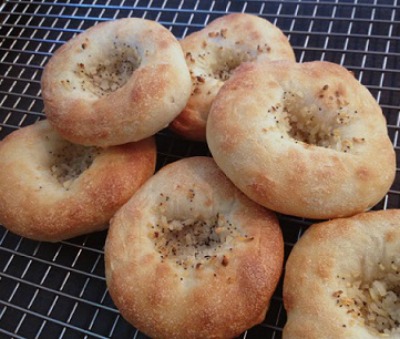
In the early 1900s, hundreds of thousands of Eastern European Jews immigrated to American and settled in New York City. They brought with them their taste and recipes for bialys. While there were once dozens of bialy bakeries in New York, the number can now be counted on one hand. Bialys have long been a staple in New York delicatessens and a favorite of the Jewish community. True bialy lovers know where the best bakeries are. In fact, Manhattan’s Lower East Side is lovingly called “Bialy Central.”
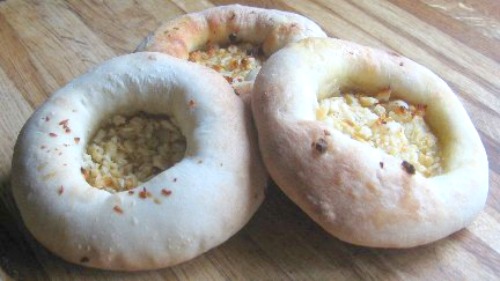
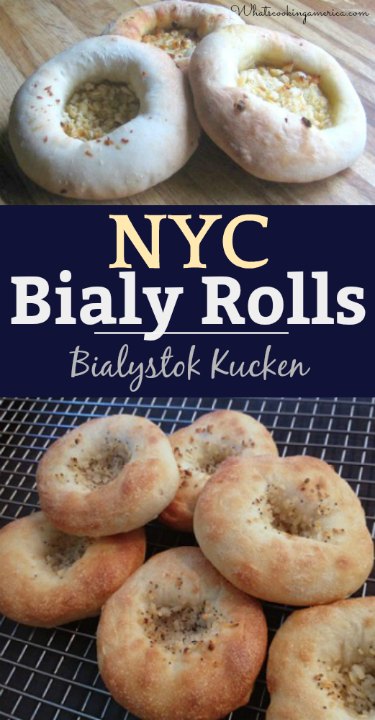
A bialy is similar to a bagel, in that it is a round, chewy roll. But it is unlike a bagel in three important ways: One, it does not have a hole in the middle, but a depression; Two, bialys never became popular outside of New York City; and Three, bagels are boiled and bialys are baked.
The indentation in the middle of the dough is filled with onion, garlic, or poppy seeds. Because the bialy has a very short shelf like, about 6 hours, they do not lend to being shipped around the country. They can be modest in size, 3 to 4 inches, or the size of a small pizza. Similar to the bialy is the onion pletzel and the onion board, popular Jewish breads from other countries.
Learn how to make more mouth watering bread recipes.
History of Bialys – Bialystok Kucken:
Jessica (Jess) Selin of Chicago sent the following interesting story about her family’s history with the bialy:
My great-great-great grandfather, Moshe Nosovich, was a baker in Bialystok, then part of the Russian empire, and now part of Poland. Despite the extensive research we have conducted, we do not know how he became such a successful man – a Jew owning three bakeries in czarist Russia. It is perhaps doubly curious because the fashion in those days was for Jewish men to be pale and academic, while the women were more down-to-earth and worldly. But he did well as a baker. So much so, in fact, that family tradition holds him to be the inventor of the bialy, not a mere baker thereof.
Moshe had four children, three girls and a boy. Two of the girls became involved in the bakeries. My great-great-grandmother, Neshka, was one of those two girls. She worked at the bakeries because her husband, pale and academic, and not the man Moshe had picked out for her (thus defying custom), died young. She and her four children, all daughters, worked in the bakeries. On very cold nights, they slept there as well, warming themselves on the residual heat of the ovens. But we know they did not live over the bakery, as poorer shop owners did. My great grandmother, Bella, talked about walking past the prison to get to the bakery.
Bella was the oldest of Neshka’s four children and so started working fairly young. There was a lot of work to do, as bialys were a central part of the Jewish diet in Poland, eaten at all three daily meals. Perhaps she tired of this work, because she immigrated to the Untied States in 1899 when she was seventeen years old. We do not know if she brought the family recipes for bialys or anything else.
After my family visited Bialystok in 1993, we confirmed where the family had lived and where the bakery had been. A number of stories, including this one, went from Bella to Ida to Nina, to me; but alas, no bialy recipes.
Don Damiano, originally from Brooklyn, New York and now living in California, sent the following interesting story about the bialy roll and the Kuznitsky family:
While glancing through the Sunday papers, a familiar word caught my attention, Bialy Roll. It happened to be an article by a book critic; the book’s title was The Bialy Eaters. The author was on a mission to find the origin of this delectable roll. A simple flat roll with a dimple in the center, much like you would make with a thumb imprint. This indentation carried a delicate layer of onion, lightly sprinkled with poppy seeds. The dough was very much like that of pizza. I found this article very interesting, as I am well aware of the delicious bialy roll, as an Italian boy from Brooklyn. I came to California 38 years ago and married my beautiful Jewish bride, Janice, whose parents have been in the bakery business forever, going back to the town of Bialystok, Poland, where the Kuznitsky family originated.
I attended a funeral for my father-in-laws’s sister. After the services, we came back to the house to “nosh,” as a old video was set up to show the Kuznitsky family in the old country of Bialystok, Poland. How endearing to see the entire Kuznitsky family gathered together, as the children frolicked and adults waved with joyous broad smiles for the camera, knowing the video was going to the USA. The video was taken by my father-in-laws’ uncle, Jacob Kuznitsky. Uncle Jake traveled to Bialystok, Poland around 1938/1939, to visit all the relatives in the old country. Fortunately, he brought back the film with the lasting images and memories of the family.
This big Jewish family, I thought to myself, was very much like my Italian family, very close knit. The video panned the entire group of over 50 people. Then, one by one, they approached the camera for a close up smile with waving hand to say “hello.” As we watched the silent black and white video, the “oohs” and “aahs” came from the audience along with “Oh, there is Marilyn, there is Philip,” and so on till the video ended. Then the mother shocker was announced, “All the people you saw were swept away by the Nazis, taken to concentration camps, Auschwitz and Dachau, all killed, no survivors!” The Kuznitsky family, over 50 people, were wiped out – lost family history.
I thought you might find this Kuznitsky family lineage interesting, going back to Bialystok, Poland. Before the war, some of the family settled in Chicago, where this bakery family set up shop making cakes, rolls, bread, bagels, and the bialy roll. In 1935, my father-in-law and his father, Phillip, opened a bakery in Los Angeles (Wabash Avenue, in Boyle Heights). He also opened a bakery in Monterey Park with the aid of his wife, Coy. Later to have his two sons, Larry and Phil, join their bakery efforts. Their Atlantic Square Bakery was successful for over 40 years. There is another Kuznitsky family bakery in Mission Hills, San Fernando Valley, which has been operated by the children of this family for over 40 years.
The bialy comes from Bialystocker Kuchen or bread from Bialystok, Poland. In the old country, rich Jews ate Kuchen with meals – for the poor Jews, Kuchen was the meal. Now for us in the states, it is mostly eaten in the morning, heated and topped with butter. The most inventive bialy roll eaters would put cream cheese topped with lox, and the toppings go on and on. As for me, I’m old fashion, and I like my bialy roll fresh from the bakery, heated with a spread of butter and with coffee. This way I’m a very happy man!
Today, the town of Bialystok is not even a shadow of what it was. There are a handful of Jews there, no Kuznitsky’s and no bialy rolls can be found. Hard to imagine, but both have lost their identity in Bialystok, Poland, where they both ironically originated!
However, the Kuznitsky’s name flourishes in the states, as do the bialy rolls.
This wonderful recipe was sent to me by Bonni Lee Brown of Bradenton, Florida. Bonni grew up in New York City where her father owned a pharmacy in Brooklyn. Bonni says, "This is the closest recipe I've played with that approximates the fresh bialys my Dad would bring home on Sunday mornings. I was never a big bagel fan, but cream cheese and lox on a bialy I could go for anything. My children think these bialys are the best they've had outside of New York City."
- Cornmeal
- 2 cups warm water (110 to 115 degrees F.), divided
- 1 package active dry yeast
- 2 teaspoons granulated sugar
- 2 1/4 teaspoons salt
- 1 3/4 cups bread flour
- 3 1/2 cups all-purpose flour
- 1 tablespoon vegetable oil or olive oil
- 1 1/2 teaspoons poppy seeds
- 1/3 cup onion, minced
- 1/2 teaspoon coarse salt or kosher salt
-
Cover two baking sheets with parchment paper and sprinkle lightly with cornmeal.
-
Prepare Onion Topping; set aside.
-
In a large bowl, combine 1/2 cup water, yeast, and sugar; let stand 10 minutes or until foamy. Add remaining 1 1/2 cups water, salt, bread flour, and all-purpose flour. Knead by hand or with dough hook of mixer for 8 minutes until smooth (the dough will be soft). If you think the dough is too moist - add flour, a tablespoon at a time. If the dough is looking dry and gnarly - add warm water, a tablespoons at a time.
-
Form dough into a ball and place in a lightly oiled bowl, turning to oil all sides. Cover with plastic wrap and let rise 1 1/2 hours or until tripled in bulk. Punch dough down in bowl, turn it over, cover with plastic wrap, and let rise another 45 minutes or until doubled in bulk.
-
On a floured board or counter, punch dough down and roll into a cylinder shape. With a sharp knife, cut cylinder into 8 rounds. Lay dough rounds flat on a lightly floured board, cover with a towel, and let them rest 10 minutes. Gently pat each dough round into circles (a little higher in the middle than at the edge), each about 3 to 4 inches in diameter.
-
Place bialys on prepared baking sheets, cover with plastic wrap, and let rise an additional 30 minutes or until increased by about half in bulk (do not let them over-rise).
-
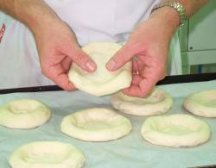
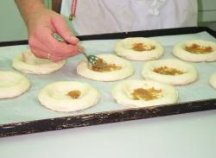
Make an indention in the center of each bialy with two fingers of each hand, pressing from the center outward, leaving a 1-inch rim. Place approximately 1 teaspoon of Onion Topping in the hole of each bialy. Dust lightly with flour, cover with plastic wrap, and let rise 15 minutes.
-
-
-
Preheat oven to 425 degrees F.
-
Bake on upper and lower shelves of the oven for 6 to 7 minutes, then switch pans and reverse positions of pans (front to back), and bake another 5 to 6 minutes until bialys are lightly browned. These are soft rolls, and it is important not to bake them too long or they will be very dry. Remove from oven and let cool on wire racks.
-
After cooling, immediately place in a plastic bag (this will allow the exterior to soften slightly). These rolls are best eaten fresh, preferably lightly toasted and smeared with cream cheese. For longer storage, keep in the freezer.
-
Makes 8 bialys.
-
-
In a small bowl, combine vegetable or olive oil, poppy seeds, onions, and salt; set aside.
-
33 Responses to “Bialy – Bialystok Kuchen History and Recipe”
Betty Peck
My father came from Bialystok also, around the same time as the Kuznitskys.
I live in Mi., but I will be in L.A. from 9/12 to 9/19.
I would love to visit one of the bakeries. Just wondering if they are still in existence and if so, where are they?
Linda Stradley
I’m sorry, but I have no information if these bakeries are still open. How about googling them?
Heidi
https://m.facebook.com/bellbialy/
🙂
Suzanne Bracker
My father, Michael Bracker, was born and raised in Bialystok, Poland. His grandfather was Moishe Griskie, who had a bakery in Bialystok. My father was a Holocaust survivor who passed away many years ago. However, growing up my father told me many stories about my grandfather who was referred to as Moishe Griskie the baker, who my father told me had invented the bialy in Bialystock. I authenticated this story with my uncle Izik Braker, who lived in Tel Aviv, and other relatives in my father’s family. My father and uncle had no reason to lie about their grandfather and his contribution to Jewish bakery goods.
Joanna Krahelska
Hi, the Polish name of what you call “bialy” is “cebularz” (“cebula” means “onion”), You can google a lot of recipes on Polish culinary websites 🙂 Greetings from Poland 🙂
Alan greenstein
I’m staying in Bialystok on Tuesday (today)Are there any bakeries making bialys????
Alan
Heidi
G’day from Australia. Saw these on ‘Bizarre Foods’ the other day, Andrew was in Boston. Yum.
https://m.facebook.com/bellbialy/
vince diporta
Each time I make the Bialy’s, I become home sick. My wife and I sit and tell stories of the old neighborhood and the great food we enjoyed growing up, while eating them
This morning I was to make them again, but the recipe is missing from the story. Has it been taken out, if so can you please forward me the recipe.
Thank You
Vince
Linda Stradley
Thank you for letting me know. I don’t know what happened, but I fixed the error and added the recipe. – Linda Stradley
Susan R Hakimi
I am in touch with larry who wrote the Atlantic square bakery recipe book. I am looking for recipe for Butternut crunch cake—my absolute favorite cake! .I’m waiting for his reply…Does anyone have this recipe?
SueAnn Norris
I was watching food network and saw the Bialy episode. Interested…I searched and found these stories and was captivated. Thank you for sharing the stories and the recipe. I will make Bialy’s and remember those that were lost.
Jay
Do you still have the details on the Bialy episode. I’d love to see it. I’m in Texas and you CAN’T find any real bagels or bialy’s here. I typically bring 5-10 dozen home when i do go to NY. My favorite is Kossars. Also, I recently found on AMAZON no less , REAL AUTHENTIC Bialys, only problem they were $22 a dozen…Still worth it to me.
Curious, did you make them? How did they come out?
Susan R Hakimi
Just checking if anyone has a copy if the Atlantic Square Recipe book? I’ve been in touch with the author and previous owner if the bakery and he cannot find a copy.
ed kadyszewski
I wonder if anyone can give me some advice on my one problem in creating bialys like those of the old Kossar’s bakery on E14st in Manhattan (circa 1965). My problem is that very often the center closes up and almost encloses the onion/poppy filliing. I’m guessing that my shaping skill is not quite right and that perhaps they are underrisen when I put them in the oven. I’ve tried to remedy both of these issues, but still do not reliably produce bialy’s with the large thin center. Help, it’s winter here in Connecticut and when I’m not shoveling snow, I’m baking to help keep the house toasty.
Jay
Ed,
Did you get a response on the center closing up? I’d love to know what was done to solve this.
Bonni Lee Brown
By happy chance I wandered into this discussion. Linda was kind enough to include my bialy recipe on page 51 in her lovely book “I’ll Have What They’re Having” in 2002. The key to getting that large flat center (which is the way true bialys should be) is to think of the shaped round of dough as a child’s wading pool. You want an indentation in the center that seems OVERLY LARGE AT THE TIME with the outside rim being only about 1″. You need to do that because after shaping, as it rises, it tends to fill in toward the center which will make the flat space smaller. To help maintain the center space, after you shape the bialy take a fork and “dock” (stab down gently multiple times to make small holes in the dough) before placing the onion filling in it. The holes will help prevent that area from puffing up during baking and the narrow rim, which will puff a bit, will still leave the center flat & filled with the onion mix. If you have any questions feel free to email me at bonnibakes@gmail.com A fresh warm bialy is a delicious thing!!
Nancy
Bonnie is correct about the indentation. I was just talking about bialy baking last week with my dad. He was a bialy baker at Kossar’s in Manhattan for many years in the 60s, 70s and 80s. Oh how I miss bialys. We had a seemingly never ending supply, as he always brought them home from work. I’m going to give baking some a try soon. That’s how I happened upon this site.
Kelena
Cant wait to try making your Recipe. We’re fortunate on Oahu, HI we have a bagel bakery”This is it!” Bakery and deli that fortunately make Bialy, Pretzels, and also Pita And other not usual Local breads. So my Montreal friends love to claim the best bagels😉 but it was there I had had my first Bialy experience so they are migrating from NYC!👍🏽🤙🏽
Susan
Hi, Im still looking fir the recipe for the Butternut Crunch cake from Atlantic Square bakery, anyone????
Roman
For the first – greetings from today’s Białystok!
It’s sadly the most hurting truth about wiping down all Jews history in our city, but believe me, peoples are remember the major role of Your society in city Life before WWII.
There’s a beautiful David’s Star in the middle of Wyszyńskiego street ( at the middle of mass Jewish Cementary), there’s a memorial made to Great Bialystok’s Synagogue, in city center (metal roof construction monument, broken in due to fire made by nazists), Cementary on road to Supraśl city, where today’s Bialystokers are taking a care for it.
And basically a lot of other places, where You can expect even tears, if You will say Who You are and Who Were Your Relatives before WWII .
I’m personally missing of those times with city center full of Jewish shops, points of Suh different services, town market and horse trains on Lipowa Street, as well as Great Synagogue, in due to want of getting new physical experience while visiting it, thinking about God, and world history .
You are always welcome here, as well as You and Your Relatives have made history of our city. We used to be neighbors, friends and sometimes families.
Wish You all the best!
Whats Cooking America
Thank you for your greetings Roman! Best wishes to you in return.
Robert Nesfield
I had 2 problems when I tried this recipe, the center rose up and the bialys never browned; I left them in for a few extra minutes but they never browned . I followed the recipe to the “t”. I need help please.
Whats Cooking America
You may need to press down the indentation a 2nd time, then add filling and immediately place in oven to bake. Not sure why your Bialys did not brown, perhaps check your heating element in your oven.
Tony Simms
As an old(84) Brooklyn boy, from the Brownsville section, as a kid I would go to the bialy bakeries to get fresh from the oven, bialy’s at least twice a week.For those of you having problems with the center indent, just use a whisky shot glass to deeply depress the dough. I’ve been baking my on bialy’s since I came out West, over 50 years ago,and after using the shot glass, I (naturally) have to place a libation,or two, to drink while bialy’s are in the oven. Guaranteed to work just fine. Enjoy.
Adrian Radulescu
I tried the “Brooklyn Bialy Recipe” as listed above, as I lived in NYC for many years and I know what a bialy is supposed to look and taste like, and I found the hydration (ratio of water to flour) to be completely off. I mean by A LOT! I ended up with a porridge-like mixture and I had the feeling that something was off by just glancing at the numbers before I mixed up everything. I had to almost double the amount (close to that) of flour for the 2.5 cups of water the recipe calls for. I have no idea what is going to look or taste like. I kept everything the same (yeast, salt, sugar). The dough is resting and raising as I’m typing this. I’ve baked bread before (sourdoughs, etc) and I have experience with bread making which helped me mend the recipe on the fly. I think it should be OK (we’ll have to see until the final product bakes in the oven). I’m writing this to let people who might try the recipe, to be careful and prepare in advance.
Whats Cooking America
The water to flour ratio in the recipe is correct. If the directions are followed correctly, the water is divided. 1/2 water is mixed with the yeast and sugar and sits until it becomes foamy. The remaining 1 1/2 cups water is added along with the salt and flour and kneaded together until smooth. The results should be a soft dough than what is used for regular bread loaves. If the dough is too moist and tacky, then add one tablespoon of flour at a time. If the dough seems too dry, then add 1 tablespoon of warm water at a time. The texture of bread dough can change each time it’s made depending on the weather and amount of moisture in the air. That’s why it’s recommended to go by the feel of the dough each time it’s made to determine if additional flour or water needs to be added.
Adrian Radulescu
OK. I’ll chalk this up to an error then though it was my daughter and I mixing everything in the kitchen and we both agreed that what we measured in terms of water/flour was as per recipe. Maybe my “cup” measure was off. I use a simple plastic cup with gradations for a full cup ( and increments of 1/4, 1/2., etc) along with what that means in milliliters. I had to add another cup or more to what I had already measured in “cups” following the recipe. But the end result was fantastic — the recipe-mended bialys were super delicious.
mike
From a Brooklyn boy: don’t forget the dusting of flour before loading your bialys into the over. It adds a key textural dimension.
I enjoyed reading the oral hiustories included here. Kossar’s is still in business in NY’s Lower East Side. They are the only place I know where I can get a pletzel (can never get just one). See there history here: https://kossars.com/our-story/#history
A youg worker from Kossar’s bakery went to Queens in the 1950s to open Slim’s Bialy’s, also still operating at two locations.
Bell Bialy’s on Flatland Avenue and East 80th Street was our favorite destination for a late night snack in the 1970s because they carnked out fresh, hot bialys 24 hours a day. They have since moved to New Jersey and increase their output. Unlike Lender’s Bagels, which pale in comparison to hand made bagels, the Bell bialy, depite it’s industrial production scale, remains true to form (though sometimes there is an inadeqaute inclusion onion).
Enjoy! Zei Gezundt!
http://www.fox5ny.com/news/223264842-video
https://www.facebook.com/mycanarsie/videos/1041587338099/?v=1041587338099 (sound will come on at about 0:13)
ed kadyszewski
thanks Bonnie Lee Brown. I used your suggestions on my last batch and got the shape I was looking for.
kim turim
i am looking for recipes on
bialy boards
long bialy rolls
thanks!
kim
thanks
Grant K (Kuznitsky) Cousens
I worked with my Father, Zadie (Grandfather), Bubbie (Grandmother), and other relatives at the Kuznitsky Bakery on Devon in Rogers Park, Chicago through Jr HS, HS, and College.
I worked even younger at the short-lived one on Milwaukee but I was too young to work at the one on Lawrence (Albany Park). I do not remember the one on Kedzie in Albany Park.
I still make Bialy’s at home (I have small 20 quart bench mixer). I did have to laugh at the notion that New York was the center-that’s what we said about Chicago :)!
The dough is simple as is the handling. But they are meant to be hearth baked which can be difficult in a home environment. But I have noticed in various recipes a real mess with the onions. Just chopped onions with a pinch of salt and poppy-seed to taste. You want them to be a little drier-NOT a wet, soggy concoction. BTW- I did visit one of the Family bakeries in LA both as a teenager and again as a young adult in my 20’s. I also recall Phillip visiting in Chicago (there was a famous cake decorating school-before the days of air brushes and deep in-edible colors).
Suzanne Bracker
Thank you all for these sweet comments. G-d bless and stay healthy!
Steve
My grandparents had a bialy factory right below their apartment in Brooklyn. I can remember going there on Saturday night after Shabbos as they started baking for the following day. The aroma filled my house with this recipe. The taste is great. Thank you.