
Plum pudding is a steamed or boiled pudding frequently served at holiday times. Plum pudding has never contained plums. The name Christmas pudding is first recorded in 1858 in a novel by Anthony Trollope.
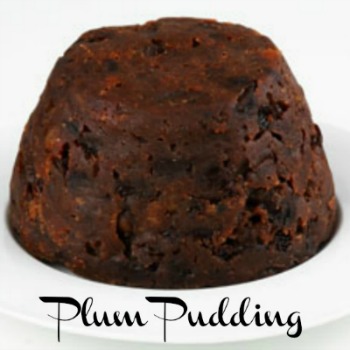
Why is Plum Pudding called Plum Pudding when there are no plums in it?
In the 17th century, plums referred to raisins or other fruits. Plumb is another spelling of plum. Prune is actually derived from the same word as plum – the Latin word was pruna, which changed in the Germanic languages into pluma. But the terms were quite confused in the 16th and 17th centuries and people talked about growing prunes in their garden.
(1) Defination of “plum” in the Oxford English Dictionary:
A dried grape or raisin as used for puddings, cakes, etc. This use probably arose from the substitution of raisins for dried plums or prunes as an ingredient in plum-broth, porridge, etc., with retention of the name ‘plum’ for the substituted article. The OED then goes on to list occurrences of this use in literature. Samuel Johnson defined a “plum” as “raisin; grape dried in the sun.”
(2) Some information from A Gourmets Guide by John Ayto:
“Dried plums, or prunes, were popular in pies in medieval times, but gradually in the sixteenth and seventeenth century they began to be replaced by raisins. The dishes made with them, however, retained the term plum, and to this day the plum pudding, plum cake, plum duff etc. remind us of their former ingredients.” And yes, the raisins were sometimes called plums in the 19th century, but only when they were in a plum pudding or plum cake.
(3) Quote from The Gourmets Guide:
“Nowadays served only at Christmas, and so called exclusively Christmas pudding, this was formerly a common year-round pudding (albeit not always as rich as the festive version); indeed, in 1748 Pehr Kalm, a Swedish visitor to England, noted that “the art of cooking as practised by Englishmen does not extend much beyond roast beef and plum pudding”. And in 1814, one of the traditional English delicacies introduced to the French by Antoine Beauvilliers in his Lart du cuisiner was plomb-poutingue.”
During the Puritan reign in England, plum pudding was outlawed as “sinfully rich.” Traditionally, in England, small silver charms were baked in the plum pudding. A silver coin would bring wealth in the coming year; a tiny wishbone, good luck; a silver thimble, thrift; an anchor, safe harbor. By Victorian times, only the silver coin remained. In England these tiny charms can still be bought by families who make their own puddings. It is also traditional for every one who lives in the household to simultaneously hold onto the wooden spoon, help stir the batter for the pudding, and make a wish.
This recipe comes my husband’s great-great grandmother. I adapted this recipe to modern standards. I have not yet made the recipe.
- 1 cup granulated sugar
- 1 cup butter, room temperature
- 1 cup milk*
- 2 eggs, beaten
- 2/3 cup molasses
- 1/4 teaspoon salt
- 1 teaspoon baking soda
- 3 tablespoons baking powder
- 3 1/2 cups all-purpose plus 2 tablespoons flour
- 1 1/2 cups raisins, finely chopped
- 1 cup dates, chopped
- 1/2 cup nuts, chopped
- 3 tablespoons orange or lemon citron, candied and finely chopped
- 1 1/2 cups apples, chopped
- 1 teaspoon cinnamon, ground
- 1/4 teaspoon cloves, ground
- 1/4 teaspoon nutmeg, ground
- Boiling water
-
Grease two 2-pound coffee cans, two 2-quart pudding molds, or two 2-quart oven-proof deep dishes.
-
If you do not have a steamed pudding mold, you can use a small bowl, but a pudding mold is inexpensive and pretty easy to find at a kitchen store or online.
-
In a large bowl, combine sugar, butter, milk, eggs, molasses, salt, baking soda, baking powder, and flour; add raisins, dates, nuts, candied orange or lemon citron, apples, cinnamon, cloves, and nutmeg.
-
Fill each greased pan 1/2 full of batter. Cover tops of pans with lids or 2 layers of aluminum foil. In a large pot or roaster, place molds on trivets or a rack and add boiling water 2/3 up the side of the mold; bring rapidly to a boil. Reduce heat to medium-low, cover pot or roaster, and boil gently 4 to 4 1/2 hours (add more boiling water as necessary) or until fork comes out clean when put into center of pudding.
-
Be sure to let the pudding cool to room temperature in the mold before removing it. Wrap the cooled pudding tightly in plastic wrap and store in a sealed plastic bag. The pudding will keep for about 3 weeks in the refrigerator or may be frozen for longer storage.
-
While the Plum Cakes are ripening you can unwrap them periodically and add more cognac or other spirits. Piercing the puddings with a fine skewer or needle makes this process easier.
-
To Serve: The pudding may be put back into its pudding mold and reheated for 1 to 2 hours (depending on size of Plum Pudding) in a hot water bath at the time of serving. However, the easier way today is to simply microwave the pudding for just a few minutes until it is heated. Unmold and serve hot with Nutmeg Sauce.
-
Yields 2 puddings.
-
In a large saucepan over medium-high heat, combine sugar, cornstarch and salt. Add boiling water and cook, stirring constantly, 3 minutes until ingredients are well blended.
* 1/2 cup fruit juice and 1/2 cup brandy may be substituted for the milk if desired.
** Brown sugar may be substituted for the granulated sugar if desired.
Source: Photo from Zarbo Delicatessen and Cafe, Auckland, New Zealand.
23 Responses to “Plum Pudding Recipe”
Zeek Wolfe
I never heard of English pudding before reading “The Theft of the Royal Ruby” by Agatha Christie. The ruby was hidden in a pudding and discovered by Colonel Lacey who complained about almost breaking a tooth. Hercule Porot solves the mystery. What is a mystery to me is where you put an English pudding while it is aging. In the refrigerator, in the basement or on the counter next to the toaster? What, may I ask, is the difference between an English pudding and a fruit cake? I like fruit cake and even make it once in a great while. Thanks, ZW
Linda Stradley
Christmas pudding and fruitcake are basically the same. Christmas Pudding or Plum Pudding was originally cooked by steaming. I believe that fruit cake is a variation of Christmas Pudding and the name was changed by the cooks of America.
Rose Browning
Sorry, but they are not the same. I use my grandmother’s steamed pudding recipe, one from the late 1800’s. I have never seen another recipe like her recipe for steamed pudding and it doesn’t resemble a fruitcake at all. The only fruit in her recipe are golden raisins. She always steamed hers in an old coffee can. I use a pretty pudding mold.
Katie koxvold-Figueroa
Thank you, Linda, for all of the history on plum pudding! I enjoyed it but not as much as eating it! Thank you for the information.
Donna Hunter
This recipe is very very close to the one my grandmother had that was passed down to her. It is not the same as a fruitcake but probably could easily turn into one if you put more fruit in it. Her recipe called for using tin soup or vegetable cans lined on the bottom and sides with wax paper. With wax paper over the top and held on with string. Also we always had what was called a Delicious Sauce which makes the entire dessert so special. The tins are put in a pan with water and steamed. When you remove the plum pudding from the tins I always wrap them in wax paper and parchment paper then aluminum foil (never let aluminum foil touch your food) and freeze. When time to eat thaw at room temperature and can reheat. Make slices and serve with sauce. Very rich dessert!!
Mary Jane Eldridge
My Mother made Plum Pudding and got the recipe from her mother-in-law who was from England. They both put dimes in the pudding before cooking it in a cloth in a big pot. Naturally the dimes were from the early 1900’s and did not have copper in them.
They both used beef suet in place of the butter. I still cook mine in a cloth in a big pot of water!!
Mary Dickerson
I would like to cook my pudding in a tin mold. After cooking, how long can I keep it in this mold or will the pudding acquire a metal taste. ? Also, can I add rum or brandy if the pudding is still in the tin? Thanks so much
Linda Stradley
Be sure to let the pudding cool to room temperature in the mold before removing it. Wrap the cooled pudding tightly in plastic wrap and store in a sealed plastic bag. The pudding will keep for about 3 weeks in the refrigerator or may be frozen for longer storage.
While the Plum Cakes are ripening you can unwrap them periodically and add more cognac or other spirits. Piercing the puddings with a fine skewer or needle makes this process easier.
To Serve: The pudding may be put back into its pudding mold and reheated for 1 to 2 hours in a hot water bath at the time of serving. However, the easier way today is to simply microwave the pudding for just a few minutes until it is heated.
Connie
As for the date of the pudding also known as Christmas pudding was mentioned in several times in the Christmas Carol written by Charles Dickens in 1843 and it seems it was an old English tradition at that time. Mrs. Cratchit’s Christmas pudding which she boiled and brought out with a blaze on it which is often how it is served as well. And Scrooge’s reference to it when talking about all those that loved Christmas “Should be boiled in his own pudding with a stake of Holly through his heart.” So clearly it is a very, very, very old pudding. This far predates the 1858 date. Thought you would like to know this. I have not tried this yet but might this year.
Katharine Whitmore
This is a great recipe to use when you are caught without a Plum Pudding! This year I was very slow to purchase my Christmas pudding, and realized I was going to have to come up with one myself, and fast. I found this recipe and followed it closely. For pudding molds, I simply used the ones that came with the puddings I have purchased in the past. I covered them tightly with aluminum foil. Yes, the pudding was made about 30 hours before we ate it, but it was delicious, and really did taste like the “real thing”. My 93 year old mother loved it. Thank you!
Jean Krupsaw
On Christmas day my mother always made “suet pudding”, cooking it inside a coffee can in boiling water on top of our wood burning stove. She made a tart lemon sauce to serve on top for our Christmas dinner desert. It was the most delicious part of the meal. Has anyone heard of a recipe like this that is eaten the very day that it is prepared? I would love to hear of any recipe like that, my mother passed before I could get the recipe from her.
Katie koxvold-Figueroa
My mother always made steamed plum pudding made with ground suet for Christmas Day dinner. She served it warm out of the pan by unmolding, topped it with a crown of red candied cherries and sugar cubes soaked in brandy then would light the cubes to service the flaming master piece. She also served “hard sauce” with it made with butter, powdered sugar and vanilla. I make it to this day and include lots of different kinds of candied fruit: lime peel, candied orange peal, dates, citron, candied pineapple, currants and raisins. I got the recipe from my 1970s Betty Crocker cook book and I doctored it up a little. My whole family loves it! I made it for my dad one Christmas when my mother was in the hospital before she died. My dad said it was the best he had ever had!
Plum pudding is definitely very different from fruitcake. Fruitcake is what it says, a cake in loaf form. The texture is dryer and more compact that a plum pudding. I plum pudding is dense but light at the same time and very moist.
Katie koxvold-Figueroa
Jean, I can give you the recipe I have from Betty Crocker. It is excellent and probably just what you are looking for. I doctored up the recipe a little but I think you will love it. It is made with suet and steamed for what seems like hours. I have steamed them in the pressure cooker or in my cast iron pot. I live in Mexico City, Mexico which is over 7,000 ft. so EVERYTHING takes longer to cook. My email is kjfiggie @hotmail .com and if you wish, I could send you my recipe. I know what it is like to live far from my family and need a little of home in my life!
Andrea Philipps
Have been having plum pudding from the ‘30s when it was made by my grandmother (recipe from her English MIL) in India, my mother after we moved to Canada and I still make it every year. We can buy “mincemeat” here in the grocery stores around Christmas time. Cross & Blackwell is the preferred English brand but there are also suet free vegan options available. The beauty of the plum pudding, a way to ensure that flavour of rum or brandy and to warm up the pudding is in the lighting. Serve it on a large platter with a lip by dousing it with warm rum or brandy and setting it aflame with a match or other lighter. It’s spectacular and delicious. Serve slices with a dollop of hard sauce. The hard sauce melts all over the hot pudding.
Victoria McGann
Cross and Blackwell is a standard in my family, decorated with holly plucked from a tree outside, and brandy poured and lit up just before serving. Unfortunately it is getting harder and harder to find the brand, so I’m grateful for the recipe and the comments, I can’t wait to try it.
Mary McDonald
I’ve spent a lot of time trying to figure out modern ingredients for an old family recipe I’ve never tried, but copied from my mom’s genealogical papers when I was a teenager. Imagine my surprise to come across Grandma Fisher’s Plum Pudding and nutmeg sauce recipe here, as this is the same! Please email me I have questions as to how I’m related to grandma Fisher. 🙂
Aldyth Barbr
My recipe calls for “suet”. I have asked for it any several meat markets. Most don’t know what I am asking for. Some just want to give me beef fat. I know it should be from the fat around the kidneys of the animal. Where can I get it? What can I use in place of the suet. Butter tends to make the pudding more greasy.
Aldyth
Whats Cooking America
Small pieces of beef fat from the butcher will work.
Crystal caccamo
We do a traditional 1890chrodtmas with our young boys every Christmas Eve since we moved in to a as h old Victorian home (I actually think build date is 1860s of our home!) I made this recipe. I must admit we were not a fan. So sad because it took so long to make.
Perhaps I didn’t cook it properly however it just did not turn out that tasty.
Patricia
Instead of beef suet you can use Atora Vegetable Shredded Suet—it is a UK product. You may find it in the supermarket as I did (although I live in a British Overseas Territory.). You may also find it on Amazon (possibly in US but definitely on Amazon UK).
I am making British style plum pudding for the first time this year. I would like to add apples. Can someone say if the apples are added to the fruit (soaking in brandy) or during the mixing?
Susan
Can someone tell me about soaking the fruit in brandy I am completely missing it in the instructions. I also don’t see anything about the ripening process. Help
Nancy
This recipe doesn’t have you soak the fruit in brandy prior to use. The Ripening process, is after cooked and cooled, they are wrapped and stored in the refrigerator for up to three weeks. At this point you can unwrap and prick the puddings with a tooth pick and pour the brandy over them as they ripen. – Nancy
Cammie McDaniel
I just made this dish for my Xmas 2021 dinner, and made a few slight additions. I added 1 cup chopped pruners, 1 cup chopped cranberries,1/2 cup apricots, 1/2 cup raisins and 1/2 cup chopped pineapples . What I learned, (since the person who posted the recipe admitted to not having made the recipe) is the importance of not putting the mold directly in boiling water. It should be made in a seal tight mold that cannot have water get in. The pudding should be steamed from 4 to 6 hours in a pot with water not touching the mold. In other words, use a pot that the mold can sit on the outer edges of the pot, and the water can steam it, without boiling on the mold. Very important! It turned out beautiful. Send me a request,l and I will forward a picture of my finished product. Tastes delicious. I was in London in 2019, and wish I had seeked out a place to try it in London.