
New Mexico Sopapillas
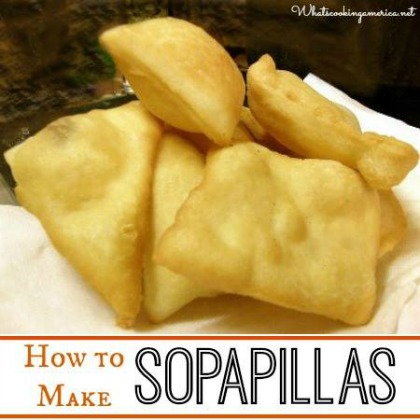
Sopapillas are one of many foods that New Mexico can call it’s own – The New Mexican Quick Bread. People call them little pillows, but the name really means “holding soup.” Their history is over 200 years old, originating in the Albuquerque, New Mexico area. It is often as much a staple of many New Mexican meals as the tortilla.
Both sopapillas and tortillas are used as “sop” breads, either soaking up the liquids in a dish, or stuffing them with the foods so they can be eaten without the use of knife and fork. The recipe for both the tortilla and the sopapillas are virtually the same, the difference is in the cooking method. Like tortillas, I learned this recipe from watching friends and relatives make them. So it is hard to say these are the exact measurements, as everyone I watched simply shook out some flour into a bowl and began adding the other ingredients just by putting them in their hands. They would make alterations based on the way the dough felt to them, much the same way as many people measure ingredients for biscuits after they had made them for many years. In fact, you will mix these much the way you do biscuits.
This recipe, comments, and photos are courtesy of Cynthia Detterick-Pineda of Andrews, TX.
- 3 cups all-purpose flour
- 2 teaspoons baking powder
- 1 teaspoon salt
- 4 to 6 tablespoons vegetable shortening or lard (your choice)
- 1 1/4 cups warm milk (approximate)
- Vegetable Oil (for frying)
-
I
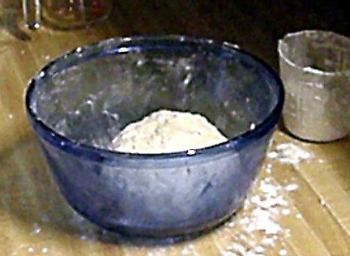
 n a large bowl, blend together the flour baking powder, and salt.
With a pastry cutter (unless you are one of those, like my teachers, who always used their hands) cut in the lard or shortening.
Add the milk all at once, and mix the dough quickly with a fork or by hand until the dough forms a mass.
Turn the dough onto a well-floured board and begin to knead the dough by folding it in half, pushing it down, and folding again. It should take about a dozen folds to form a soft dough that is no longer sticky.
Cover the dough with a towel or plastic wrap to let it rest for approximately 10 to 15 minutes.
Divide the dough in 1/2, keeping the 1/2 you are not working with covered with plastic wrap or a towel so it does not dry out.
Roll the dough half you have chosen on a floured board with gentle strokes. Roll the dough to 1/8-inch thickness. The more you work the dough, the tougher your sopapilla will turn out. However, to keep a sopapilla well puffed after cooking, you may want to work the dough a minute or so longer.Cut the dough into rectangles that are about 10-inch by 5-inch. Divide the triangle into a 5-inch squares, and then cut this into a triangle. NOTE: If you find the dough beginning to dry as you work with the remainder, cover this loosely with a some plastic wrap.
Do not attempt to reform and roll the leftover dough scraps. They do not roll out well on the second try. You can cook these dough scraps along with the others, and they taste just as good.
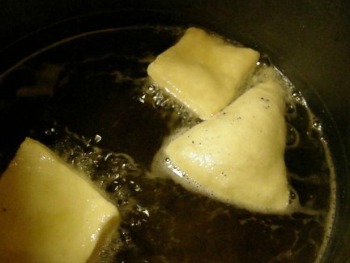
Heat some vegetable oil in a large skillet or a deep fryer until the oil reaches about 400 degrees F. NOTE: Check the temperature of the oil with your digital cooking thermometer.Carefully slide the first sopapilla into the hot oil. Submerge the sopapilla under the oil. It should begin to puff immediately. NOTE: Sopapillas - They either puff or they don’t puff. Their puff is what makes it a sopapilla - but don’t despair as both can be eaten. If your sopapillas are not puffing properly, the temperature of the oil may need to be increased or decreased. Environmental changes in temperature and altitude can make setting the temperature tricky at times.
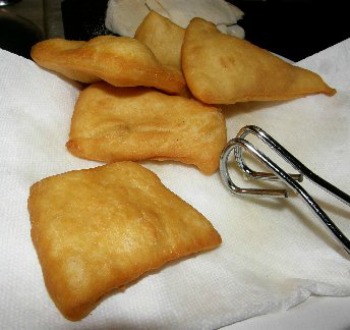
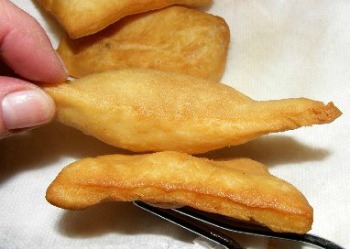
Using a slotted spoon, turn the sopapilla over to brown the other side. Sometimes this can be difficult, as the sopapilla will want to stay on the side it was on. A little coaxing with your slotted spatula will help this. Hold it for only a moment, and it will adjust to the side it is on. Once both sides, approximately 2 minutes per side, are browned, remove the sopapilla to a surface to drain (paper towels or a draining rack will both work).
Sopapillas can be kept warm in a 200 degree F. oven for up to 1 hour. They refrigerate well and can be reheated in a 350 degree F. oven for 10 to 15 minutes before serving.
Makes approximately 2 dozen Sopapillas.
-
-
 n a large bowl, blend together the flour baking powder, and salt.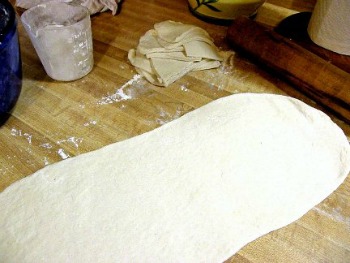
 I get many readers asking what cooking/meat thermometer that I prefer and use in my cooking and baking. I, personally, use the Thermapen Thermometer. Originally designed for professional use, the Super-Fast Thermapen Thermometer is used by chefs all over the world. I only endorse a few products, on my web site, that I like and use regularly.
You can learn more or buy yours at: Super-Fast Thermapen Thermometer.
Sponsored Content
61 Responses to “Sopapillas Recipe”
Sandra Carr
This recipe is not the one my family uses. They have been in New Mexico for centuries. They should be made with yeast and puff up so the insides are actually empty and then outsides are a much lighter brown. You can’t stuff your version based on your pictures and lack of yeast.
Linda Stradley
There are two different ways of making Sopapillas – The baking powder method and the yeast method. This recipe is the family recipe of Cynthia Detterick-Pineda.
Jeannie
Our family recipe is not made with yeast and they are fabulous (and are used to hold food and look similar to the pics here). So, there are apparently 2 ways to make sopapillas. It’s strange that someone would get so worked up about a recipe.
Doc
Like any recipe there are usually dozens of ways to make a dish. My grandma on my dad’s side made hers using baking soda and grandma on mom’s side used yeast. Yes, they were very different in taste and looks – oh lardy, were both great. Oh to have either one right now would be heavenly. You are correct – why get upset over someone’s recipe – just enjoy.
Mekarri Arizal
Completely agree. How rude and disrespectful. Not necessary. Try it or don’t.. No need to be rude.
Mollie
oh you should try them made with baking power, they are more authentic!
Alex
I have travelled the complete south of the Americas, including Argentina, Brasil, Peru etc – if ever you find sopapillas, they are made with baking powder. Why – for the simple reason it works just as well and a lot faster.
Frank Gilbert
I like your recipe with yeast best. Some may not like a yeast flavor but to me it’s like rolls, I don’t want them without yeast because you might as well eat biscuits. I also like them thicker and tougher. Everyone has their own preference and may be just because “that’s the way Mama made them”.
Contagious
Great recepie!!! This is how we do it in new Mexico!! We use water instead of milk however the milk works better!! Lucky me growing up in new mexico I have sopapillas whenever I want lol
ShadowsGathered
@ Sandra Carr – Italians have lived in Italy for centuries, too, and not every family uses the same recipe for spaghetti.
Marcella
That is also the traditional recipe for my family as well. If you use yeast it be more of a fry bread. These are the real sopapilla’s.
Patricia Scott
Great Answer Linda. It’s always funny when someone thinks their way is the only was each family has their own treasured recipes even when living in the same place. I have eaten Sopapillas my entire life made by my Tia’s but have not attempted them to often on my own I made these today and found your recipe easy and the results great!
Shawna
This is the same recipe that I used over
20 years ago when I lived in Albuquerque.
Thank you!!!!
KateLS
Is it possible to bake these with a savory filling (meat & chilis) instead of frying them? I was in a restaurant and they had stuffed sopapillas filled with chili verde and smothered in green sauce. Would I need to pre-fry them a little first?
Joy Bork
Hey,
I just had these recently at a Taco John’s and went back and they are no longer making them.
I was so sad,
but they were Awesome and I wanted more
But they sold the last one an hour and a half before I got there
Charles Putzer
They are better with baking powder yeast is not real good for you and as to stuffed they stuff them after the deep frying. Then stuff then cheese and Mexican red or green sauce bake then serve
MaryR
I grew up in NM eating alot of Mexican food [close to 60 yrs ago] and the traditional/original recipe used baking powder or baking soda [most households didn’t have yeast back then]. You’d fry them, then you can slit them and stuff with whatever you want [guacamole, meat, beans, cheese, etc]… The guy that I used to get the stuffed sopapillas from would make them about the size of half an 8″ circle so you can make them in circles, half-circles, squares, rectangles or triangles… top with powdered sugar, honey, cinnamon & sugar… no limit.
e.g.g.e.
Of all the dozens of sopapilla recipes I have tried, this recipe is the most authentic, the the very best recipe! I was raised in the Southwest and ate authentic Mexican food my entire life. My mother had a coworker who made homemade tortillas, sopapillas, gorditos, posole, mole, etc for my mother’s birthday every year. These sopapillas taste just like the sopapillas my mother’s coworker made. Brings back many memories.
Thank you for sharing the recipe.
Nancy
Thank you very much for this recipe. I’m anxious to try this, as I love sopapillas with butter and honey, and also stuffed or with food on top like Indian frybread.
Laura Loretto
Lol I am a New Mexican and this is how we do it
Elena L Monnereau
My sopapillas will not puff up in So. CA although in Albuquerque higher altitude they do? What gives baking powder or baking soda or both?
Stephanie
I have always loved visiting my Dads mom whenever we were passing through Albuquerque, my Dad was in the Air Force, so we would be restationed from time to time. Anyways we were quite young but I loved her very old kitchen where she always had something cooking on the stove. She didn’t measure just hand and mix. The smells were always yummy. She would send us off with a big paper bag filled with sopapillas. Hot and YES we didn’t get far, ????
Cassandra Mac
I had stuffed sopapillasfor the first time in my life just 2 days ago. Unfortunately I was not in the room when thre dough was made. I am so glad I found this, the hubby and my tummy will be very happy now. 🙂
Penney Nile
Before I moved from Texas, my daughter’s dad (she didn’t show up for a few more years), my son and I took a trip to Shreveport, where we found an all you can eat Mexican buffet called Pancho’s. The chicken and cheese enchiladas were spectacular, the rice, beans and guacamole were equally wonderful, but what really shone were the sopapillas. We were told the way to eat them was to tear them open and pour the honey they were served with inside. I must have eaten a dozen of them!
Since I moved to Southern California, where there is a large Hispanic presence, I have been trying to someplace where I could get sopapillas, but without any luck. Most people think I’m describing empanadas, but I’m not. I definitely know the difference! Luckily, I came across this recipe, and the picture seem to show exactly what I’m looking for. So I am definitely going to be trying it out. Thanks for posting it!
Taylor
I’m from new Orleans and I know exactly which ponchos you’re talking about. Trust and believe to this day most of us miss that place.
Amber
I am in Arizona used to go to ponchos Mexican buffet on a weekly basis and I completely agree the sopapillas were amazing i miss them so now i make them for myself RIP Ponchos
Monica
I tried these last night and they were delicious! I was worried with the first few, because they weren’t puffing up enough, but it turns out I didn’t have the oil hot enough yet. I had better success with smaller shapes, but they all turned out so delicious. THANK YOU!
Sherie
I use self rising flour and water, but will try it with milk the next time I make them.
Carl
I used to get these in a Mexican restaurant in Pecos TX years ago and they would tear the end off and pour honey inside!! Boy do I miss having them
Mary Santistevan
I use Buttermilk and…Wow, does it make them tasty…..try it!
Larry
Around here (Orlando, FL and related) a number of Southwestern/Mexican restaurants have what they call sopapillas. Not a one of them makes actual sopapillas – what they all have is not puffed up . no empty space chunks of fried dough with powdered sugar or diluted syrup on top. I have no idea where the “chefs” learned about these but they did not learn well at all!!!!!
Yvonne B
Hello, these sopapillas look delicious! Does the dough freeze well? I wanted to freeze them in the “cut out” dough stage then fry them the next day. I plan on making them for my nieces birthday party in large batches.
Thanks!
Whats Cooking America
You can seal the dough in plastic freezer bags and freeze. Bring the dough to room temperature before frying.
Doc
Thanks for the recipe – neither of my grandmas – actually used a recipe. So sad that none of my family can reproduce their wonderful dishes.
Mekarri Arizal
I have lived in NM all my life and my parents, their parents and so on.. This is extremely similar to how my family makes sopapillas. None of them have ever used yeast. Everyone is different. Just like if you say taquitos and someone says floutas. Use the recipe or not, but there really is no true recipe. I think it has to do with necessity/accessibility to ingredients. I’ve used this recipe several times and I’m never disappointed. Thank you.
Mekarri Arizal
Same. I’ve always used self rising flour a and water until I tried it with milk. Very good.
alicia lee
I live on gulf coast of Florida and Alabama. “Mexican” restaurants here sell “sopapillas” and agreed!!- they are NOT like home (Dallas) where they were like puffed pastry and we pinched the corner to pour in the honey. I remember getting them at Panchos and either El Chico or El Fenix…it’s been 40 years since I’ve had a real one. I might try this recipe!
Jeff
They look really good to me I am definitely going to whip me up a batch or 2! I just love them drenched in honey!!!! Mmmmmmm making my mouth water as I look at the photos.
William Davis
We are from Albuquerque and we are in Omaha visiting our kids & grand kids. We made them from a pre-mixed package and they were great! Tonight we are making home made red chile flat layered enchiladas & sopapillas (with this recipe) & they came out great! Use it, you will love them!
CHEF David
Ladies: As my mother-in-Law would say…so what, when you are hungry let the food satisfy your tummy…beggars can not be chewsy
James
Look guys, not only is oil temperature extremely important, so is altitude and humidity . You may need to adjust. Do not expect this recipe to work the same in muggy Florida as it does in arid Albuquerque at 4300ft or more. Most non trained cooks don’t consider that water vapor changes your flour, nor do they fluff or sift their flour to areate it so end up with too much flour. 2 cups of aerated flour, which you should be using, is less than 2 cups aerated; thus, the denser doughave. A good way around all this is to measure by weight not volume which will give more consistent results. Sadly, this recipe is by volume and I go by the feel of the dough and do not have one to share.
Lisa
I’m from New Mexico a little town called Questa, NM. My grandma and my great grandma, as well as all my aunts, and mother. We use baking powder to make sopas and they use water instead of milk, this is the way it was taught from generation to generation, it’s a Hispanic, (Mexican) tradition. Some perfer milk others yeast, but back in the days not all families had alot of money for milk and yeast, so tradition was baking powder and water, almost everyone I know from small towns in New Mexico do it this way.
Just a little imput being I am new Mexican born and raised…….
Marcus
Fry them 1st…then slice an opening and stuff them…use plenty cheese and red chile with whatever you decide to stuff them with. ; )
Kat
I use my torilla recipe which is similar to this yeast in a sopa ridiculous
Joanna Mallory
I spent 30 years in NM and to me, a sopapilla is a large puffed pastry….crispy on the outside and bready on the inside that you pull apart and eat half with your food and half with honey. This looks right. Here in South Carolina there is a large Hispanic presence but I can’t find a traditional sopa! Ask for a sopa here and you get something that looks like chips(but sweeter and slightly doughier) covered in cinnamon and sugar and whipped cream, sometimes with chocolate drizzle. Disappointing to say the least.
Cindy jean
I don’t use lard or shortening, in spite of living in Alabama. Do you think you can use cold butter instead or would it be more like pie dough?
Nandi B
The restaurant Engine Co. No 28 in Los Angeles makes great sopapillas.
C.C. Meis
Our family’s absolutely loved this recipe. It was perfect. I followed the directions and measurements exactly. It was what I was looking for. The flavor was amazing and they even puffed up after I rolled the dough thinner. Got to get the temperature and the thickness of the dough just right. I used Crisco for the lard. From now on this will be my go to recipe. Thank you for sharing the history of Sopapillas and for your recipe.
Nancy
I am glad you enjoyed it!
Tony P
Your receipt is the same one my grandmother and mother used for years. Thank you for sharing. My grandmother was born in Las Tables, New Mexico 1899. My father was born in El Rito, New Mexico 1927.
Respectfully,
Tony P
Mya
I don’t have shortening or lard can I use something else ?
Jerrie Crowell
Myra, I saw a recipe that called for oil. Guess you could use that.
Jerrie Crowell
This is exactly how my mom made the sopapillas, but I thought she used water. I saw a gentleman on youtube make them and he said by using milk, the dough turns out softer. The only difference I have seen is that my mom made the shaped just like tortillas, putting a little hole in the middle before frying. I want to stuff mine, so I think I will just cut them in half before frying so I can stuff them afterwards. or maybe smaller and stuff them whole without the little hole in the middle. thanks for the recipe.
Tresa Baker
How are they served? I remember having these at a restaurant in Texas when I was a girl and they were filled with butter and honey and so delicious. I would have guessed they were made with yeast though as they tasted like a fried donut.
Whats Cooking America
They are served on the side with your meal. Use them to sop up the food and sauces.
JR
I have lived in New Mexico my entire life.
This sopapilla recipe is…..the….best…. recipe I have ever tried. These sopalillas are excellent.
Now I need an excellent recipe for gorditas.
Thank you for sharing your sopalilla recipe.
Nancy
JR, thanks for visiting What’s Cooking America!
Nancy
Apryl
I was born in Texas and grew up between Texas and New Mexico. Pochos in El Paso was one place we always went oit to eat eith my grandparents when we were growing up or when we had family come from out of town. I also remember Chico’s tacos being a family favorite. 😍 I miss home. If you ever stop in Belen New Mexico Petes Cafe is delish and if your in the mood for some mouth watering bbq Powdrells. I now live in Florida and my husband is Puerto Rican so Im learning I love Puerto Rican food as much as I love Mexican cooking. I now find myself mixing techniques and styles and it sometimes comes out better. This recipe came out perfect. Thank you.
Melina Nancy
Love this recipe. For me it’s easy and simple to make.
Duncan
I am going to try these. Lived NM during college years and LOVED it! Wonderful food, beautiful landscape and terrific people.
Most people don’t understand that New Mexican cuisine is not the same as Mexican. NM food is more of a fusion between Mexican and American Indian food. New Mexican Green chiles are not we’ll known in Mexico where poblanos reign along with other indigenous peppers. They just don’t have that subtle nutty flavor and heat of the Hatch chilis.
At any rate, the Sopapillas were one of the only things that were consistent throughout NM, and they were like soft, hollow pillows void of any add-ons like cinnamon or powdered sugar but there was always a squeeze dispenser of honey on the table. So good!
I tried several years ago to make Sopapillas but was unsuccessful. They didn’t puff. After reading here, I think the oil may not have been hot enough.
Time to give it another go. Thanks for stirring the pot!
Natasha
I was having the same problem and I realized you have to knead the dough more.