
Poached Egg on Toast is the perfect breakfast. It fills you up and also providers the protein needed for your body. Poached Eggs are a simple and easy-to-make dish that is excellent for breakfast, a snack, or even dinner. Plus a great low calorie way to prepare eggs.
The best eggs for poaching are the freshest eggs you can find. If eggs are more than a week old, the whites thin out. Whites of fresh eggs will gather compactly around the yolk, making a rounder, neater shape. Also remember – To serve best-quality poach eggs, the poached eggs should be served as soon as they are pulled from the water and drained. They cool down quickly and once cold, they’re not as desirable for the diner.
For more great Low Fat Recipes, Low Calorie Recipes, Low Carbohydrate recipes, and Diabetic Recipes, check out my Diet Recipe Index. Also check out my Nutritional Chart for fat grams, fiber grams, and calories for all your favorite foods.
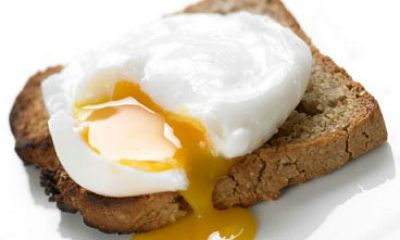
-
While the water is coming to the right temperature, start toasting your bread.
 The best eggs for poaching are the freshest eggs you can find. If eggs are more than a week old, the whites thin out. Whites of fresh eggs will gather compactly around the yolk, making a rounder, neater shape.
(1) Use a pan that is at least 3-inches deep so there is enough water to cover the eggs, and they do not stick to the bottom of the pan. Also make sure your pan is wide enough to hold all the eggs you will be poaching, as you do not want the eggs to stick together. NOTE: I like to use a non-stick pan so the poached eggs will not stick to the bottom of the pan.
(2) Working with the eggs, one by one, break or crack each egg onto a saucer, ramekin, small cups, or bowls. We are doing this for two reasons: So you will not break the yolk and it prevents adding bad eggs. Place all cups of eggs so that they are convenient to the stove.
(3) If the water is too cool, the egg will separate apart before it cooks; if your water is too hot, you will end up with tough whites and an over-cooked yolk. You will want to bring the water to a temperature of about 160 to 180 F. (71-82 C.). Do not place the egg into boiling water (212 F. or 100 C.). This will negatively affect the taste and texture of your eggs.
As a rule of thumb, bring the water to a boil, then reduce it to a simmer before cooking. To obtain the correct temperature, spin the boiling water with a spoon to cool down the water before you drop in the egg. I like to use my instant-read thermometer to test the water temperature (adjust heat to maintain the proper temperature).
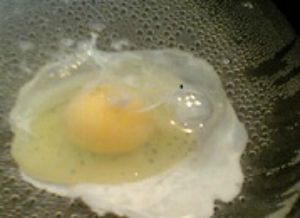
(4) Slip eggs carefully into slowly or gently simmering water by lowering the lip of each egg cup 1/2-inch below the surface of the water.Let the eggs flow out. Do not put too many eggs in the pot at one time. With a spoon, gently nudge the egg whites closer to their yolks. Immediately cover with a lid and turn off the heat. Do not disturb the egg/eggs once you have put it in the water!
(5) Set a timer for exactly 3 minutes for medium-firm yolks. Adjust the time up or down for runnier or firmer yolks. Cook 3 to 5 minutes, depending on firmness desired. You can test for softness/firmness by lifting an egg on a spoon and gently pressing a finger on the yolk.(6) Remove from water with slotted spoon, but hold it over the skillet briefly to let any water clinging to the egg drain off. Remove each egg in succession after they have each cooked for the doneness you want. NOTE: Keep track of which egg went into the water first and remove in the same order. Lift each perfectly poached egg from the water with a slotted spoon, Drain well before serving.
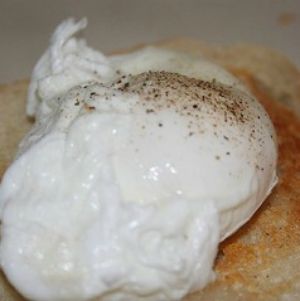
(7) The poached eggs should be served as soon as they are pulled from the water. Place the perfectly poached eggs on one (1) slice of toast. Season with salt and freshly-ground black pepper to taste. Serve and enjoy!Makes 1 serving.
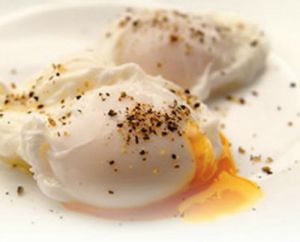
* Learn how to make perfect Poached Eggs.
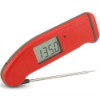 I get many readers asking what cooking/meat thermometer that I prefer and use in my cooking and baking. I, personally, use the Thermapen Thermometer. Originally designed for professional use, the Super-Fast Thermapen Thermometer is used by chefs all over the world. I only endorse a few products, on my web site, that I like and use regularly.
You can learn more or buy yours at: Super-Fast Thermapen Thermometer.
Sponsored Content
Comments and Reviews
Leave a Reply