The Afternoon Tea Gowns and La Belle Epoque
Article and Photos By Ellen Easton ©2020 – All Rights Reserved
Check out more of Ellen Easton’s Tea Travels™ articles and recipes.
Learn about the History of English High Tea and more delicious Afternoon Tea Recipes.
La Belle Epoque (1880-1914) – “The Beautiful Era”
La Belle Epoque,1880-1914,”the beautiful era”, was a gilded age, bringing with it great opulence coinciding with the demise of the old fashioned aristocracy and traditional ways. Dominated by a society indulging in the refinements of luxurious elegance, the era was defined by women unburdened with financial constraints who were able to gratify themselves with extravagant home entertaining and fin-de-siecle esthetics.
The arts, in turn, captured glimpses of these vignettes, depicting fashionable women of the day on canvas. The salons, with artists like Tissot, Boldini, and Tanoux showcased the great couturiers Charles Frederick Worth’s and Jacques Douccet’s wondrous jacquard woven silks, moires, satins, laces, and velvets along with the sophisticated Paul Poiret’s brilliant colors.
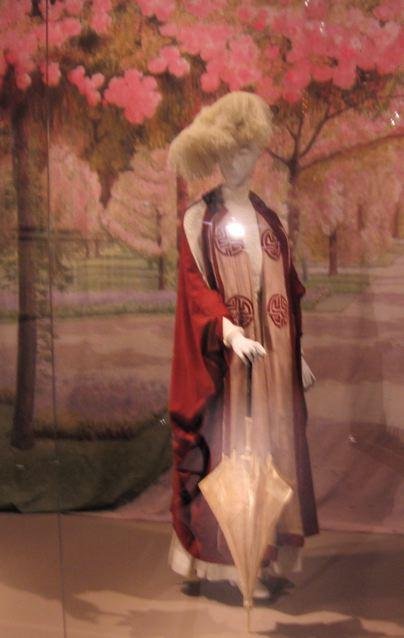
To understand the grandeur of the La Belle oques influence on the Afternoon Tea gown, one must first know the gowns origins.
The Afternoon Tea Gown was first introduced, in the 1840s, by Anna, the seventh Duchess of Bedford. The gowns were fashioned on the styles and times of the day.
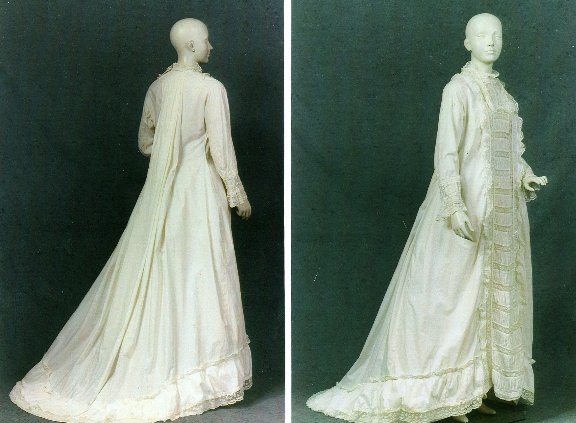
The “Undress” or deshabille robe de chambre, was an unstructured garment of nightgown quality, worn in the morning, inside a lady’s boudoir. Created as an undress garment, this circa 1867 three-piece gown is made of white handkerchief linen featuring a high neck, long sleeves and an inset with rouche and Valencienne lace. The back view of the gown reveals train-like construction. Note the lace detailing at the sleeve’s edge.
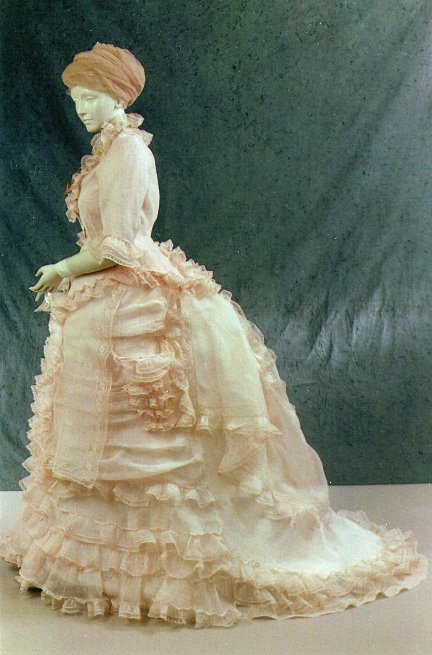
The “half dress” a semi-constructed garment that was worn in the afternoon, in or out of the home, for visiting and receptions. Dating to the early 1870s, this English half dress is a two-piece gown finely crafted of pink handkerchief linen with rouched lace. Considered a corseted afternoon tea walking suit, the garment has a bustle and train. While elaborate in design, the suit was for day wear only.
The “full dress” was a constructed garment fashioned of fanciful fabrics with low necklines and no sleeves; it was designed to be worn in the evening.
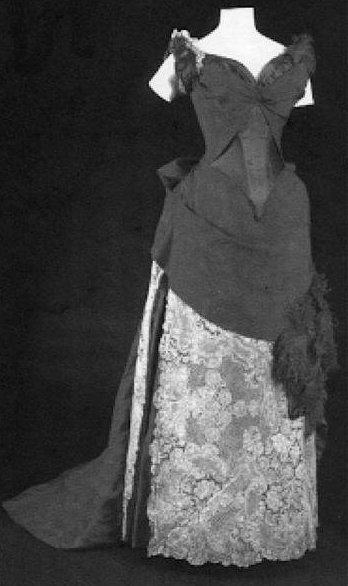
Afternoon Tea provided the perfect setting to demonstrate the new freedom advancing in women’s dress for the sophisticated elite.
Since Afternoon Teas were mostly attended by family and close friends, the hostess’ tea gown was often uncorseted for the first time in centuries, introducing the casual form of dress our society has adopted to the present day.
According to Dr. Valerie Steele, chief curator and director of The Museum at The Fashion Institute of Technology, in her book PARIS FASHION: A Cultural History,“ the tea gown could also be more fanciful or artistic than ordinary dress, and this was another reason for its popularity-as well as its importance in the history of dress.”
Afternoon tea gowns, half dress, were of two categories: le robe d’interior and le robe exterior
Le robe d’interior was worn solely in the home by the hostess or by those in attendance at overnight or weekend house parties. The visiting house guest was afforded the leisure of changing for afternoon tea. Celebrating the enhancement of a woman’s beauty these gowns, derived from the undress, were special garments. The afternoon tea gowns were visual confections. Intimate and often more luxurious than even an evening toilette their construction was loose, floaty, and exotic. Themes of the Orient were influential reflecting in the kimono drapings and classical motifs.
Le robe exterior, worn outside of the home, by invited guests or those who were ”calling”, while poetic in design, remained structured. Beverley Birks, a fashion historian and private dealer in New York City, states “as inner wear became outerwear, corsets once again appeared. The corset did not separate the bust line thus creating a mono-bossom. These picturesque gowns clearly reflected the stature and affluence of those who wore them.”
Tea gowns were constructed in several segments, sometimes allowing the hostess to change from the lingerie-inspired overtops to the more revealing off-the-shoulder, lower cut silhouette for the evening hours. Fabrics ranged from elaborate, with fanciful hand work of embroidery, beading, and smocking, to the delicate white and pastel handkerchief linens accented with ribbons and laces.
The fashions complimented the Victorian era from which they were born. The gowns were accessorized with magnificently embellished gloves, parasols, fans, fabulous hats, and small handbags adorned with fur trims, feathers, and pearls.
According to the folklore of tea, once upon a time a lady was not allowed to socialize unescorted except in her rose garden. It was here women met, unrestricted by social rules of etiquette, to speak freely amongst the roses.
Throughout Europe, during the 1800s, the theme of the rose continued to weave a thread, as afternoon tea flourished in the public gardens, tearooms and private salons.
Designers of fashionable women’s’ tea gowns were no exception, prominently embracing the theme of the rose into the fabrics and bonnets to insure their patrons would once again feel free to gossip under the roses.
Fortunately, some of these beautiful gowns and accessories have been preserved by various museums, private dealers and collectors. With increasing difficulty, more can be found at vintage fairs and shops throughout the United States.
TEA TRAVELS™ – Wishing You Happy TEA TRAVELS!™ Tea is the luxury everyone can afford!™ and Good $ense for $uccess are the trademarked property of Ellen Easton/ RED WAGON PRESS
Ellen Easton, author of Afternoon Tea~Tips, Terms and Traditions (RED WAGON PRESS), a lifestyle and etiquette industry leader, keynote speaker and product spokesperson, is a hospitality, design, and retail consultant whose clients have included The Waldorf=Astoria, Plaza Hotels, and Bergdorf Goodman. Easton’s family traces their tea roots to the early 1800s, when ancestors first introduced tea plants from India and China to the Colony of Ceylon, thus building one of the largest and best cultivated tea estates on the island.
Purchase Ellen Easton’s Tea Books:
Each 5 x 7 book is $20 postpaid Continental USA only. Wholesale and fundraising accounts welcome. Include name, address, zip code, and phone number for shipping. All Sales Final. Check or MO order payable to: RED WAGON PRESS, 45 East 89th Street, STE. 20A, New York, NY 10128-1256. All inquires to teatravels@aol.com
AFTERNOON TEA…TIPS, TERMS and TRADITIONS
72 pages of how to’s, 27 photos, history, etiquette and FAQ about afternoon tea, serving styles and more.
TEA TRAVELS™ – FOR THE HOLIDAYS
64 pages, 21 color photos. A complete holiday menu includes 25 easy to prepare recipes; theme teas, decorating & gift ideas; invitation template and secret sources.
Categories:
Ellen Easton's Tea Travels™ Articles