
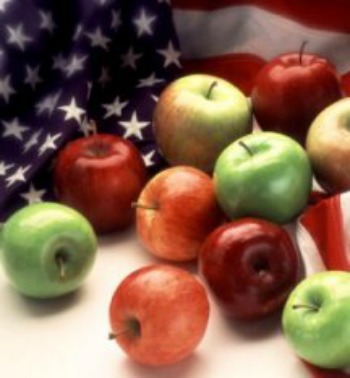
Photo courtesy of U.S. Apple Association
What are cooking apples?
A cooking apple is an apple that is used primarily for cooking rather than eating. While there’s no harm to using an eating apple in a recipe, or to eat a cooking apple, there are some differences that you can see and taste with each of type of apples.
Apples that are best used in cooking or baking have a lower sugar content than eating apples. They are usually tarter than eating apples and as a rule do better in storage than eating apples.
Different types of cooking apples are available depending are the region of the world that you live in. If it is possible in your region, purchase fresh apples from your local grower or farm market. Nothing is better than an apple that hasn’t traveled thousands of miles before ending up in your kitchen.
Best Apples for Baking:
Pippin
Jonagold
Rome
Winesap
Granny Smith
Honeycrisp
Check out Linda’s Favorite Apples Recipes:
Apple Equivalents:
1 large apple = 2 cups sliced or chopped = 1 1/2 cups finely chopped =1 1/4 cups grated = 3/4 cup sauce.
1 medium apple = 1 1/3 cups sliced or chopped = 1 cup finely chopped = 3/4 cup grated = 1/2 cup sauce.
1 small apple = 3/4 cup sliced or chopped = 3/4 cup finely chopped = 1/2 cup grated = 1/3 cup sauce.
1 pound apples = 4 small apples or 3 medium apples or about 2 large apples
1 (9″ or 10″) pie = 2-1/2 pounds (4 to 5 large or 6 to 7 medium or 8 to 9 small apples)
Peck = 10-1/2 pounds
Bushel = 42 pounds (yields 20-24 quarts of applesauce)
Apple Tips:
To prevent discoloration of peeled apples, place peeled slices in a pan of cold water to which a pinch of salt (1/8 teaspoon) has been added (for each whole apple peeled).
When making salads, dip apple slices in fresh lemon juice to prevent slices from turning brown.
Discoloration of aluminum utensils can be removed just as effectively by boiling a number of apple peelings in them as by the old method of boiling a little vinegar in water.
Sprinkling salt on spilled juice from apple pies in a hot oven will cause the juice to burn crisply, making it easier to remove.
To peel apples, dip them quickly in and out of boiling water. The skin will come off much more readily.
Apple Facts:
Greek and Roman mythology referred to apples as symbols of love and beauty. Today we call something we prize as, “The apple of our eye!”
Issac Newton is said to have thought up the law of gravity while sitting under an apple tree, observing the falling of apples.
The expression “an apple a day keeps the doctor away” actually comes from an old English saying, “Ate an apfel avore gwain to bed, makes the doctor beg his bread.” (Eat an apple before going to bed makes the doctor beg his bread.)
Members of the rose family have flower parts in fives (multiples of five). The flowers are white or pink and the fruit is a pome type, derived from the fusion of the ovary and the receptacle which make up the fleshy part of the fruit. Cut the apple in half cross-wise to find a star with five chambers, with two seeds each.
Apple blossom are the state flower of Michigan. April 28, 1997, marked the 100th anniversary of this official designation.
The top apple producing states are Washington, New York, Michigan, California, Pennsylvania and Virginia, which produced over 83 percent of the nation’s 2001 apple supply.
The apple variety ‘Delicious’ is the most widely grown in the United States. Freckles (russet) on Golden Delicious indicate ripeness
Fresh apples float because 25 percent of their volume is air.
Apples harvested from an average tree can fill 20 boxes that weigh 42 pounds each.
The largest apple ever picked from a tree weighed 3 lbs 2 oz, according to The Guiness Book of World Records.
It takes about 36 apples to create one gallon of apple cider.
Apples are sometimes called “nature’s toothbrush,” Apples help clean the teeth and massage the gums.
America’s longest-lived apple tree was reportedly planted in 1647 by Governor Peter Stuyvesant in his Manhattan orchard on the corner of Third Avenue and 13th Street. The tree was still bearing fruit when a derailed train struck it in 1866.
History and Legends of Apples:
The saying “As American as apple pie” is referred to as the symbol of America. The word “apple” comes from the Old English word “aeppel.” there are approximately 10,000 different kinds of varieties of apples grown in the world with more than 7,000 of these varieties grown in the United States. Apples are a member of the rose family of plants and the blossoms are much like wild-rose blossoms.
Native Americans appropriated what they liked, cultivating apples extensively. There are between 25 to 30 kinds of wild apples grown throughout the world with seven kinds in the U.S. Most wild apples are crab apples with small, sour, hard fruit. The crab apple is the ancestor of many of the varieties of apples grown today.
Prehistory:
Carbonized remains of apples have been found by archeologists in prehistoric lake dwellings in Switzerland, dating back to the Iron Age. There is also evidence to show that apples were eaten and preserved by slicing and sun drying during the Stone Age in Europe.
1st Century
In earliest writings of China, Egypt, and Babylon, records were found that mentioned that man understood the art of budding and grafting fruit trees as long as twenty centuries ago.
15th Century
1470 – In the Old Saxon manuscripts there are numerous mentions of apples and cider. Bartholomeus Anglicus, whose Encyclopedia was one of the earliest printed books containing botanical information, gives a chapter on the Apple. He says:
“Malus the Appyll tree is a tree yt bereth apples and is a grete tree in itself. . . it is more short than other trees of the wood wyth knottes and rinelyd Rynde. And makyth shadowe wythe thicke bowes and branches: and fayr with dyurs blossomes, and floures of swetnesse and Iykynge: with goode fruyte and noble . And is gracious in syght and in taste and vertuous in medecyne . . . some beryth sourysh fruyte and harde, and some ryght soure and some ryght swete, with a good savoure and mery.”
16th Century
Dr. John Caius (1510-1573), physician to Edward VI, Mary I, and Queen Elizabeth I, in his Boke of Counseille against the Sweatynge Sicknesse advises the patient to ‘smele to an old swete apple to recover his strengthe.’ Queen Elizabeth called him “the most learned physician of his age.”
In William Shakespeare’s (1564-1616) time, apples when served at dessert were usually accompanied by caraway, as we may read in Henry IV, where Shallow invites Falstaff to ‘a pippin and a dish of caraway,’ In a still earlier Booke of Nurture, it is directed ‘After mete pepyns, caraway in comfyts.’ The custom of serving roast apples with a little saucer of caraways is still kept up at Trinity College, Cambridge, and at some of the old-fashioned London Livery dinners, just as in Shakespeare’s days.
17th Century
When the English colonists arrived in North America they found only crab apples. Crab apple trees are the only native apples to the United States. European settlers arrived and brought with them their English customs and favorite fruits. In colonial time, apples were called winter banana or melt-in-the-mouth.
1622 – Most historians fail to mention that those early orchards produced very few apples because there were no honey bees. Historical information indicates that colonies of honey bees were shipped from England and landed in the Colony of Virginia early in 1622. One or more shipments were made to Massachusetts between 1630 and 1633, others probably between 1633 and 1638. The Indians called the honeybees “English flies” and/or “white man’s flies.” A description of New York in 1670 claimed:
“You shall scarce see a house, but the South side is begirt with Hives of Bees.”
1623 – William Blackstone arrived in Massachusetts fromEurope. Historians write that he carried a bag of apple seeds (also called “pips”) with him and soon planted an orchard on Beacon Hill in Boston. He later moved to Rhode Island and also planted orchards. According to the Biography of Reverend William Blackstone, The Pioneer of Boston and His Ancestors and Descendents by Nathaniel Brewster Blackstone:
“As for the apple seeds he used to develop his orchards, it is probable that he was foresighted enough to retrieve and save every apple core (which naturally contains seeds) he could find, or otherwise come by. Certainly most ships were stocked with apples along with other foodstuffs, therefore, it is doubtful that he brought them with him in 1623 because this kind of living was most likely not his original intention. He would have probably only brought with him his ministerial necessities.”
1628 – John Endicott (1558-1665), one of the early colonial governors of Massachusetts Bay Colony, was commissioned to begin a new colony at Massachusetts Bay by the English chartered company that established the original Massachusetts Bay colony in New England. Early in 1629 the Boston Bay Company placed an order for apple seeds from England. According to historians, among the possessions brought were either apple seeds or seedling apple trees (history is very confused about this).
Among the articles “to provide to be sent to New England” by the Massachusetts Company, in 1629, are the following: “Vine-planters, wheat, rye, barley, oats, a hogshead of each in the ear: beans, pease, stones of all sorts of fruits, as peaches, plums, filberts, cherries: pear, apple, quince kernels: pomegranates, woad seed, saffron heads, liquorice seed, madder roots, potatoes, hop-roots, hemp seed, flax seed, currant plants, and madder seeds.” These seeds and roots were afterwards sent, and, according to accounts, sprung up and flourished. The mode of cultivating and manuring the soil by means of fish, was practiced at first as at Plymouth. Owning, however, to the scarcity of certain kinds, such as cod and bass, it was forbidden in 1639 to use these for that purpose.
1632 – April 2, 1632, Conants Island in Boston Harbor was granted to John Winthrop (1588-1649), the first governor of the Massachusetts Bay Colony. The name of the island was changed to The Governour’s Garden. For this gift, he promised to plant an orchard and a vineyard there, and agreed to pay yearly a fifth of the fruits forever to the governor, whoever he might be. In 1634, the rent was changed by the General Court to:
A hogshead of the best wyne that shall grow there to be paide yearly, after the death of the said John Winthrop and noething before.” A few years afterwards, the rent was changed to “two bushels of apples every yeare one bushel to the Governour & another to the Generall Court in winter, — the same to bee of the best apples there growing.” The records of the General Court in 1640 show that “Mr. Winthrop, Senior, paid in his bushel of apples.”
1640 – By the 1640’s, orchards were well established. Nearly all land owners planted apple trees.
18th Century
1737 – Robert Prince in 1737 established the first commercial apple tree nursery in America called William Prince Nursery in Flushing, New York. The nursery survived under four generations of the Prince family until just after the Civil War. Prince’s Nursery gathered trees and plants from around the world for resale, and became renowned through the American colony for its exotic wares.
1775 – The British who occupied Long Island during the Revolutionary War (1775-1783) had considered the William Prince Nursery so important that they put an armed guard around the nursery to protect it.
1779 – In 1779, Marquis de Lafayette entertained George Washington, general of the Continental Army, for dinner in 1779 under the shade of an old apple tree to map out Revolutionary War strategy against the British. Lafayette returned in 1824, during his tour of the United States, and was presented with a cane carved from this tree. The tree blew down in 1821
1789 – George Washington, six months after he became the new nation’s first president, made a trip by barge to visit the William Prince Nursery. He was accompanied by Vice President John Adams and others. Washington was not overly impressed, perhaps because the nursery had not yet fully recovered from the war or perhaps because his Virginia standards were so high. In his diary for Oct. 10, he notes:
“I set off from New York, about nine oclock in my barge, to visit Mr. Princes fruit gardens and shrubberies at Flushing. These gardens, except in the number of young fruit trees, did not answer my expectations. The shrubs were trifling and the flowers not numerous.”
19th Century
1804-1806 – When Meriwether Lewis and William Clark explored the Northwest during The Lewis & Clark Expedition (1804-1806), many of the botanical treasures they found were sent back to the William Prince Nursery.
1801-1841 – One of America’s fondest legends is that of Johnny Appleseed, a folk hero and pioneer apple farmer in the 1800s. There really was a Johnny Appleseed and his true name was John Chapmen (1774-1845) and he was born in Leominster, Massachusetts. His dream was for the land to produce so many apples that no one would ever go hungry. Most historians today classify him as an eccentric but very smart businessman, who traveled about the new territories of his time, leasing land and developing nurseries of apple trees. It is estimated that he traveled 10,000 square miles of frontier country.
He collected apple seeds from cider mills, dried them, put them up in little bags, and gave them to everyone he met who was headed West. For forty years he traveled through Ohio, Indiana, Illinois, and Iowa (planting seeds every place he considered to be likely spots). He did more than just plant apple seeds. He began nurseries to take care of the apple orchards as well as other fruit, vegetable, and herb plants. He walked alone in the wilderness, without gun or knife. He chopped down no trees and killed no animals. He believed that God wanted him to go around and read his Bible to people and plant apple tree for them. He was respected and appreciated by the native American tribes and the new settlers alike. For the rest of his life, he traveled alone and denied himself the companionship of a wife. He fully expected to be compensated for his celibacy on earth by expecting to have two wives in heaven.
He was considered “funny looking” because of the way he dressed and looked. According to the Ashland County web site, Johnny Appleseed by Marji Hazen:
“John Chapman’s appearance was variously described as humble and bizarre for he was scantily clad summer and winter, without shoes except in the severest weather when he might wear sandals or moccasins as often as the old pair of boots one pioneer writer claimed to have given him out of pity. . . A claim that he was occasionally seen wearing his mush pot as a hat is likely a legend, but it is reliably reported that he would wear someone else’s castoff hat or create for himself a sun hat from cardboard. This writer would expect that he might carry his mush pot on his head if his hands were full, but probably not as a substitute for ‘real’ headgear. Pots of that period were handmade, usually of heavy copper, iron, or enameled iron. Such a burden would not long or comfortably serve the function of headgear. And above all, Johnny Appleseed was a man with a practical sense of function.”
1825 – Apples were introduced to the Pacific Northwest in 1825 by Captain Aemilius Simmons, who planted apple seeds at Fort Vancouver in the state of Washington. Previously, Captain Simmons attended a farewell banquet in h is honor in London. At this party, a young lady slipped some apple seeds into his pocket and bade him plant them in the wilderness. Some time after his arrival at Fort Vancouver, he handed the seeds over to Dr. John McLoughlin (1784-1857), Chief Agent of the Hudson’s Bay Company. Dr. McLoughlin, delighted by the gift, gave the seeds to his gardener to plant His first tree produced only one apple, but the seeds of that single fruit bore future generations of hardier stock.
1843-1869 – When covered wagons traveled over the Oregon Trail westward, they carried apple trees and “scion wood” for grafting as part of their cargo. Often the family orchard was planted before the ground was broken for their log cabin that was to be home.
1837 – Josiah Red Wolf, a Nez Perce leader and last survivor of the Nez Perce War, planted apple trees at Alpowa Creek near the Snake River in southeast Washington. He is probably the first Native American in what is now eastern Washington and Oregon known to have a European-style garden and orchard. Red Wolf’s trees lived for decades.
1847 – Henderson Lewelling (1809-1879), an Iowa nurseryman, traveled the Oregon Trail to Oregon with four wagons, his wife, and eight children. Three yoke of oxen were required to pull the lead wagon in which were the approximately 700 one-year old grafted fruit trees. During most of the trip, the family traveled alone or with small companies as its slow pace irritated those traveling with them. Eliza Lewelling, one of the daughters, late related that a Christian Indian told her father that the nursery saved the lives of the family when they camped near a large band of Indians:
“He said that the Indians believed that the Great Spirit lived in trees, they thought that he must be under the special care of the Great Spirit, and so they did not harm him.”
Along with his future son-in-law, William Meek, form a partnership and planted a nursery in the spring of 1848 near Milwaukie, Oregon. Today, in front of a military building in the city of Vancouver, a historic apple tree with a plaque on it, records the following story:
In 1847, Henderson Lewelling (know for promoting the fruit industry in Iowa, Oregon, and California) came to Oregon in a covered wagon with his wife, children and 350 fruit trees that had survived the long journey. It is said that he took such good care of those trees on the trip that they were watered every day and only water that was left was given to his family. He brought apples, pear, quince, plum and cherry trees. He went into partnership with William Meek, who arrived with a bag of apple seeds and found a nursery. By 1850, their first crop produced 100 apples. It was the time of the Gold Rush in California, and when they rushed to San Francisco with the apple crop, prospectors were so hungry for fresh fruit that he sold them for $5 each. They used the money to build more orchards.
20th Century
1908 – Sydney Babson (1882-1975) traveled around Oregon seeking “just the right spot” to start his apple orchard. He carefully tended his tiny apple seedlings as he traveled with only a small tend and his pack. He believed that when his eyes beheld just the right location for his orchard, he would receive “a sign from God.” Emerging from his tent one morning, he looked towards the beauty of Mt Hood. Sydney took this as the sign he was looking for and began to plant his apple orchard. Sydney devoted his life with single-minded purpose to these orchards for over 60 years. In 1960 he was named “Orchardist of the Year.” Today, the Hood River Valley is one of the major growers of apples.
One Response to “Apples – History and Legends of Apples”
D. Morris
Very informative, but nothing is more recognisably English than the Apple pie. The first known written recipe dates back to 13th century England, although pastry making has evolved in England down the centuries, it’s still most definitely “As English as Apple pie” and here in the UK, we have developed and produced many varieties of fruit and savoury pies down the centuries, that are well recognised here in the British Isles and the world. It seems British settlers took their favourite foods everywhere.