Trifle (TRI-fuhl) – The word “trifle” comes from the old French term “trufle,” and literally means something whimsical or of little consequence. A proper English trifle is made with real egg custard poured over sponge cake soaked in fruit and sherry and topped with whipped cream.
The English call versions of this cake a Tipsy Cake or Pudding, Tipsy Squire, and Tipsy Hedgehog. It was also known as Tipsy Parson and Tipsy Squire in America. The difference between these cakes and the original trifle is that these were all made with dried cake, rather than fresh.
The first trifles were very much like Fools (an old confection of pureed fruit mixed with cream), and the two terms were used almost interchangeably for many years. Many puddings evolved as a way of using up leftovers and trifle originated as a way to use stale cake. According to Trifle history, the English Trifle is a close cousin of an Italian version called “Zuppa Ingles” (English Soup), and also seems distantly related to a Spanish dessert called “Bizcocho Borracho.”
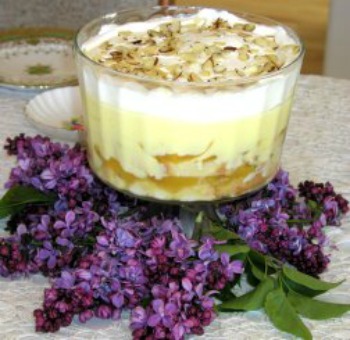
1700s – It was in the mid-1700s that cake (or biscuits), alcohol, and custard were combined in the trifle bowl. The recipe for trifle (and many of its now-heirloom glass dishes) came to America via the British who settled in the coastal South. Its popularity remained firm with Southern planters who loved indulgent desserts. Supposedly, it was called Tipsy Parson because it presumably lured many a Sunday-visiting preacher off the wagon. Southern hostesses prided themselves on their elegant table settings and considered a cut-glass trifle bowl to be mandatory.
1751 – In the 4th edition of Hannah Glasse’s The Art of Cookery Made Plain and Easy, the trifle is recognizable, though there’s still no fruit:
“Cover the bottom of your dish or bowl with Naples biscuits broke in pieces, mackeroons broke in halves, and ratafia cakes; just wet them all through with sack, then make a good boiled custard, not too thick, and when cold pour it over it, then put a syllabub over that. You may garnish it with ratafia cakes, currant jelly, and flowers, and strew different colored nonpareils over it.”
1796 – Prior to the cookbook called American Cookery: Or, The Art of Dressing Viands, Fish, Poultry, and Vegetables, and the Best Modes of Making Pastes, Puffs, Pies, Tarts, Puddings, Custards, and Preserves, and All Kinds of Cakes, from the Imperial Plum to Plain Cake, by Amelia Simmons, colonists in America were still relying on cookery books published and/or written in England. This was the first cookbook authored by an American and published in the United States. Although Simmons had many English recipes in this collection, it is the first book to introduce native resources–cranberries and corn products, for example–into the cooking repertoire. In this cookbook, Amelia Simmons describes a trifle:
A Trifle Fill a difh with bifcuit finely broken, rufk and fpiced cake, wet with wine, then pour a good boild cuftard, (not too thick) over the rufk, and put a fyllabub over that; garnith with jelly and flowers.
1861 – Oliver Wendell Holmes, American author, waxed positively poetic about the dessert, calling it:
“That most wonderful object of domestic art called triflewith its charming confusion of cream and cake and almonds and jam and jelly and wine and cinnamon and froth.”
Some delicious Trifle Recipes:
Categories:
British Recipes Cakes History Dessert Recipes Food History South Central Tea Cakes Trifles
3 Responses to “Trifle History”
Rachel Greenspan
Hi I am using this article for a source for a project, and want to cite it correctly. Who is the author of this article and when was it published? Thank you.
Whats Cooking America
What’s Cooking America is the source for this article. Please reference back to our website. Thanks!
Brie Lauben
Great info, I just wanted to say that the reason your 1796 excerpt seems a little strange is because of the way the recipe was printed. It’s called a Printer’s S, and while it does look like an F it’s still just a regular S. That should make for a little easier reading 🙂