
History of New England Clam Chowder
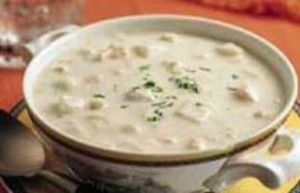
Even in New England, known for the Boston or New England-style chowders, you can find different types of clam chowder. New Englanders use the Native American term quahog. The name quahog derives from the Narragansett Indian name for “poquauhock.” The scientific name, mercenaria, of these clams comes from Latin meaning “wages.” because Native Americans strung the shells like beads and used them as money or “wampum.” Quahogs replace fish in the fish-milk stews of coastal England and France to become New England chowder. Prounounced “chowdah” by people situated north of Connecticut.
In Maine, those living on one side of Penobscot Bay like their clam chowder made with tomatoes, while those living on the other side like it made with milk and no tomatoes. Maine residents often call their region “Down East” and their chowder “Down East Chowder.” The definition of of “Down East” is:
When ships sailed from Boston to ports in Maine (which were to the east of Boston), the wind was at their backs, so they were sailing downwind, hence the term Down East. When they returned to Boston they were sailing upwind; many Mainers still speak of going up to Boston, despite the fact that the city lies approximately fifty miles to the south of Maines southern border.
By 1836, clam chowder was already well-know in Boston and served at Ye Olde Union Oyster House, the nation’s oldest continuously operating restaurant. The building that houses the Union Oyster House is about 250 years old. Daniel Webster, the noted lawyer and orator who served as a Congressman and as Secretary of State, was a regular at the bar, where he was known for downing a tumbler of brandy and water with each half-dozen oysters – and he’d rarely eat less than six plates of the tasty bivalves!
Herman Melville (1819-1891), American novelist, devoted a whole chapter in his famous 1851 book Moby Dick. He writes of the Try Pots, a chowder house in Nantucket, Mass., which served only cod or clam chowder:
However, a warm savory steam from the kitchen served to belie the apparently cheerless prospect before us. But when that smoking chowder came in, the mystery was delightfully explained. Oh, sweet friends! hearken to me. It was made of small juicy clams, scarcely bigger than hazel nuts, mixed with pounded ship biscuit, and salted pork cut up into little flakes; the whole enriched with butter, and plentifully seasoned with pepper and salt. Our appetites being sharpened by the frosty voyage, and in particular, Queequeg seeing his favourite fishing food before him, and the chowder being surpassingly excellent, we despatched it with great expedition: when leaning back a moment and bethinking me of Mrs. Hussey’s clam and cod announcement, I thought I would try a little experiment. Stepping to the kitchen door, I uttered the word “cod” with great emphasis, and resumed my seat. In a few moments the savoury steam came forth again, but with a different flavor, and in good time a fine cod-chowder was placed before us . . . Fishiest of all fishy places was the Try Pots, which well deserved its name; for the pots there were always boiling chowders. Chowder for breakfast, and chowder for dinner, and chowder for supper, till you began to look for fish-bones coming through your clothes. The area before the house was paved with clam-shells.
Western Rhode Islanders prefer clear chowder, while others swear by adding just enough tomatoes to tint it a pretty pink color.
Joseph C. Lincoln (1870-1944), author of 47 books and plays about Cape Cod wrote about New England clam chowder:
A New England clam chowder, made as it should be, is a dish to preach about, to chant praises and sing hymns and burn incense before. To fight for. The Battle of Bunker Hill was fought for–or on–clam chowder; part of it at least, I am sure it was. It is as American as the Stars and Stripes, as patriotic as the national Anthem. It is ‘Yankee Doodle in a kettle.’