
Submarine-Style Sandwiches are known by various names depending on where you live in this country. Some of those names include: Submarine, Heros, Hoagie, Grinder, Po’ Boy, Rocket, Torpedo, Dagwood, Hero, Zepplin, and Italian Sandwich.
These sandwiches are all king-sized on a loaf of bread, approximately 12 inches long and 3 inches wide, filled with various cold cuts and many different trimmings.
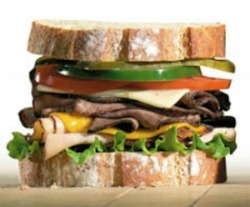 Dagwood Sandwich:
It is a multi-layered sandwich with a variety of fillings. The term Dagwood Sandwich is also used to denote a sandwich of tremendous size and infinite variety of contents to stun the imagination, sight, and stomach of everyone but the original maker.
The term, Dagwood Sandwich, originated in the comic strips in the 1930s named after a comic strip character Dagwood Bumstead. According to the creator of the comic, Murat Bernard “Chic” Young (1901-1973), the only thing that Dagwood could prepare in the kitchen was a mountainous pile of dissimilar leftovers precariously arranged between two slices of bread. Dagwood became know for his huge sandwiches he created on evening forays to the refrigerator.
Hoagie Sandwich:
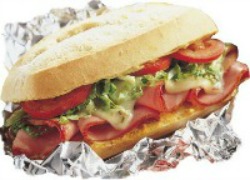 Hoagies are built-to-order sandwiches filled with meat and cheese, as well as lettuce, tomatoes, and onions, topped off with a dash of oregano-vinegar dressing on an Italian roll. A true Italian Hoagie is made with Italian ham, prosciutto, salami, and provolone cheese, and all the works. It was declared the “Official Sandwich of Philadelphia” in 1992.
The Hoagie was originally created in Philadelphia. There are a number of different stories as to how the Hoagie got its name, but no matter what version is right (historians cannot seem to agree on which is the correct version), all agree that it started in Philadelphia or the it’s suburbs.
(1) The most widely accepted story centers on an area of Philadelphia known as Hog Island, which was home to a shipyard during World War I (1914-1918). The Italian immigrants working there would bring giant sandwiches made with cold cuts, spices, oil, lettuce, tomatoes, onions, and peppers for their lunches. These workers were nicknamed “hoggies.” Over the years, the name was attached to the sandwiches, but under a different spelling.
(2) Another version on this story says that workers at Hog Island did bring this type of sandwich for lunch, but it was never called a Hoagie. The story goes, that one day an Irish worker, who brought the same American cheese sandwich everyday, looked enviously at his co-workers’ lunches and said; “If your wife will make me one of those things, I’ll buy it from you.” The man went home and said to his wife “Tomorrow, make two sandwiches, one for me and one for Hogan,” his co-worker’s name. So everyone started calling the sandwich “hogans,” which eventually was shortened to Hoagie.
(3) In 1925, Augustine DiCostanza and his wife, Catherine, opened their grocery store called “A. DiCostanza’s Grocery Store” in Chester, Pennsylvania. According to the family lore, the grocery store stayed open well past midnight to accommodate the late-night gamblers who played card games at the Palermo’s Bar nearby. According to Augie DiCostanza, granddaughter of Augustine and Catherine:
“One summer afternoon back in 1925, one of the men who cut the game decided to take a break and he walked into the store to get a pack of cigarettes. Mom was cooking in the back kitchen and the aroma penetrated throughout the store. The aroma apparently whet the man’s appetite and he asked Mom if she would make him a sandwich. “OK, pick out what kind of lunchmeat you want,” she said. He looked into the case and with an Italian hand waving gesture said: “Put everything you have in the case on it.” Mom took a long loaf of Vienna bread, sliced it lengthwise and proceeded to put on all of the lunchmeat. . . . “What are you cooking that smells so good?” the hungry gambler asked. “I’m frying sweet and hot peppers,” she replied and without asking she put a few pieces of the pepper on the sandwich. He left and an hour later the place was filled with hungry gamblers asking for a sandwich. Mom sold out of everything that night. It was the beginning of a new creation, soon to become know as the Hoagie.”
(4) During the Depression (1929-1939), out-of-work Philadelphian, Al DePalma, went to Hog Island near the naval shipyards to find work. When he saw the workers on lunch break eating their giant sandwiches, his first thought was, “Those fellas look like a bunch of hogs.” Instead of applying for a job at the shipyard, he decided to open a luncheonette that served big sandwiches. He listed them on the menu as “Hoggies” named for the workers that he thought looked like a bunch of hogs eating during their lunch break.
During the late 1930s, DePalma joined forces with Buccelli’s Bakery and developed the perfect Hoagie roll (an eight-inch roll that became the standard for the modern-day Hoagie). During the 1940s, he turned the back room of his restaurant into a Hoagie factory to supply sandwiches to workers at the shipyard who were building ships for the war. DePalma became know as “The King of Hoggies.” At some point after World War II, the “hoggie” became the “hoagie.” It is said that because his customers kept calling them hoagies, he changed the name.
Italian Sandwiches:
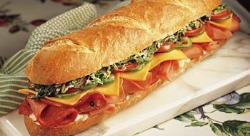 In a world of Hoagies, Heroes, Grinders and Submarines, Portland, Maine is known as the birthplace of the Italian sandwich. It is considered Maine’s signature sandwich. Simply known as “Italians” to the locals.
During the beginning of the 20th century, Italian nationals were emigrating to New England in large numbers. They were employed to lay paving stones on streets, in order to extend railway lines, and work as longshoremen on the waterfront. Giovanni Amato, an Italian immigrant, started selling fresh baked rolls from a pushcart to his fellow countrymen working on the docks of Portland, Maine. At the workers’ request, Giovanni added a little meat, cheese, and fresh vegetables, and the “Italian Sandwich” was born. According to historians, nobody knows the precise date of the first Italian Sandwich, but Amato began selling his sandwiches by 1903. By the 1920s, Amato had opened a sandwich shop on India Street. By the 1950s, people were lining up outside the shop to get their Italians, on Sundays, Amato’s could easily sell 5,000 sandwiches to hungry patrons.
Others may lay claim to inventing the Italian Sandwich, and there are now dozens of imitators selling them. Today, almost every corner grocery store in Southern Maine makes their own version of this regional delight. According to most Italian Sandwich aficionados, the best Italian’s in Maine are ALWAYS made in little Mom and Pop grocery stores. The size of the sandwich making area was relative to the rest of the store and was a very good indication of the quality of product.
The present day sandwich does not include anything remotely Italian. Unlike most sandwiches, the Italian doesn’t have lettuce. Neither does it have mayo or mustard. Instead, it is topped with salt and pepper, and a squirt of oil. The freshly baked buns are soft, not crunchy (the sour pickles and soft rolls are what makes the Italian Sandwich unique), and filled with veggies aplenty. The meat is ham or salami (boiled ham was introduced somewhere in the 1960’s and is as popular today as the original with salami), and American cheese. The sandwich is also a bit messy. The oil on the traditional Italian makes the sandwich a challenge to eat.
Roger Kirk, a former resident of Portland, Maine, who currently resides in Fremont, NH sent me information on the Italian Sandwich to include in this history. According to Roger:
The sandwich is made with a one-foot-long soft roll (not the hard sub roll), sliced 2/3 of the way through lengthwise (like a hot dog roll) and pulled open for ingredient insertion. Wrapped in white waxed paper, the locals unwrap one end and eat directly from the wrap. As it is made today, it has:
American cheese slices
Boiled ham slices (originally was salami) Onions (chopped)
Tomato Green pepper
Sour pickles (hand-sliced long and thin)
Black or Greek olive halves (typically 4 per sandwich)
Oil (mixed olive and vegetable oils)
Salt
Po’ Boy (Poor-Boy) Sandwich:
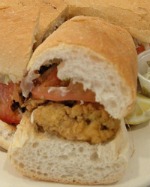
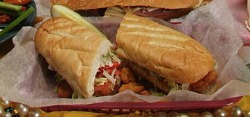 Photo from Po’ Boys Creole Cafe in Gainsville, Fl.
Also know as Oyster Loaves. Po’ Boy is the generic name for the standard New Orleans sandwich made with French bread. They are considered a New Orleans institution. Also called poor boy.
Always made with French bread, Po’ boys can be filled with fried oysters, shrimp, fish, soft-shelled crabs, crawfish, roast beef and gravy, roast pork, meatballs, smoked sausage and more. They are served either “dressed” with a full range of condiments (usually mayonnaise, lettuce, and tomatoes) or “undressed” (plain). This sandwich is purely American in its variety of sauces and condiments. It is uniquely New Orleans because the oysters are local, as is the crisp and airy bread.
 Oyster Loaf – A predecessor was the Peacemaker Sandwich (La Mediatrice). It was a loaf of French bread, split and buttered and filled with fried oysters. The poetic name derives from the fact that 19th-century husbands, coming in late from a carouse or spree, would carry one home to cushion a possible rough reception from the lady of the house.
1838 – The first recorded American recipe for Oyster Loaves was in Mrs. Mary Randolph’s cookbook called The Virginia Housewife or Methodical Cook. This cookbook is considered the first truly American cookbook and the first regional American cookbook:
To Make Oyster Loaves – Take little round loaves, cut off the top, scrape out all the crumbs, then out the oysters into a stew pan with the crumbs that came out of the loaves, a little water, and a good lump of butter; stew them together ten or fifteen minutes, then put in a spoonful of good cream, fill your loaves, lay the bit of crust carefully on again, set them in the oven to crisp. Three are enough for a side dish.
1901 – The Picayune’s Creole Cook Book, 2nd edition, by the Picayune newspaper, also contained a recipe for Oyster Loaf:
Oyster Loaf – La Mediatrice
Delicate French Loaves of Bread
2 Dozen Oyster to a Loaf
1 Tablespoon of Melted Butter
This is called the “famous peacemaker” in New Orleans. Every husband who is detained down town, laughingly carried home an oyster loaf, or Mediatrice, to make “peace” with his anxiously waiting wife. Right justly is the Oyster Loaf called the “Peace-maker,” for, well made, it is enough to bring the smiles to the face of the most disheartened wife.
Take delicate French loaves of bread and cup off, lengthwise, the upper portion. Dip the crumbs out of the center of eaah piece, leaving the sides and bottom like a square box. Brush each corner of the box and the bottom with melted butter, and place in a quick oven to brown. Fill with broiled or creamed oysters. Cover with each other and serve.
1925 – According to New Orleans’ historians, the Po’ Boy sandwich was invented by Clovis and Benjamin Martin, brothers and former streetcar drivers, in 1929 at their Martin Brothers Coffee Stand and Restaurant on St. Claude Avenue in the French Market.
It is said that this sandwich extravaganza began during a local transit worker’s strike. The streetcar motormen and conductors strike begin on July 1,1929. Transit strikes throughout the nation provoked emotional displays of public support, and this 1929 strike ranks among the nation’ most violent. Eighteen hundred trolley men struck in New Orleans as a result of a union contract dispute. During the strike/riot, two strikers were killed, five trolleys were burned to the trucks, a car barn was dynamited, trackage was destroyed, and switches were cemented.
The two brothers, Clovis and Benjamin Martin, took pity on those “poor boys” and began offering sandwiches made from leftovers to any workers who came to their restaurant’s back door at the end of the day. For five cents, a striker could buy a sandwich filled with gravy and trimmings (end pieces from beef roasts) or gravy and sliced potatoes.
According to the Metropolitan News-Enterprise article by Roger M. Grace called Oysters Stuffed in Toast: Po’ Boy, Peacemaker, Oyster Loaf:
“Michael Mizell-Nelson, an assistant professor of English at Delgado Community College has studied the 1929 streetcar strike extensively. His documentary, ‘Streetcar Stories,’ includes a portion on the po-boy’s origins.
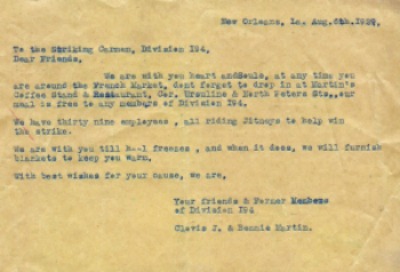
“The strike was particularly bitter, and Mizell-Nelson has a copy of a letter that Martins wrote professing their allegiance to their former colleagues. In a letter addressed to ‘the striking carmen, Division 194,’ the brothers wrote, ‘We are with you till h–l freezes and when it does, we will furnish blankets to keep you warm.’
“They provide free sandwiches to the carmen for the duration of the strike. whenever a strikers would come by, one of the brothers would announce the arrival of another ‘poor boy,’ hence the sandwich’s name.”
New Orleans Po-Boy Preservation Festival’s web site has a photo of the original letter sent by the Martin brothers:
Soon the sandwich, which quickly became known as the po’ boy, was being filled with seafood, most notably fried oysters and fried shrimp. In those distant days, shellfish was abundant and cheap. The affluent joined the crowd because, at lunch or snack time, a po’ boy filled with oysters was quicker to consume and easier to digest than one filled with roast beef.
2007 – The first annual New Orleans Preservation Po-Boy Fest was held in New Orleans on Sunday, November 18th. According to the promoters, “After almost eight decades of being taken for granted and having its history misrepresented, the poor boy sandwich takes center stage.” Descendants of poor boy originators Clovis and Bennie Martin were in attendance to discuss their family history, copies of old menus, photographs, and other memorabilia were on display.
Submarine Sandwich:
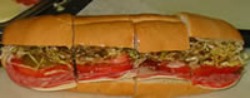 Photo from WAMU 88.5 FM.
Subway SandwichIt is a king-sized sandwich on an Italian loaf of bread approximately 12 inches long an 3 inches wide, filled with boiled ham, hard salami, cheeses, lettuce, tomatoes, onions, and sometimes flavored with garlic and oregano. It is thought that the original concept of these sandwiches came from the Italians who immigrated to New York in the late 1800s and brought with them their favorite Italian Sandwich recipes.
1910 – The family of Dominic Conti (1874-1954) claims he was the first to use the name, submarine sandwich. Angela Zuccaro, granddaughter of Dominic, related the following information:
“My grandfather came to this country circa 1895 from Montella, Italy. Around 1910, he started his grocery store, called Dominic Conti’s Grocery Store, on Mill Street in Paterson, New Jersey where he was selling the traditional Italian sandwiches. His sandwiches were made from a recipe he brought with him from Italy which consisted of a long crust roll, filled with cold cuts, topped with lettuce, tomatoes, peppers, onions, oil, vinegar, Italian spices, salt, and pepper. The sandwich started with a layer of cheese and ended with a layer was cheese (this was so the bread wouldn’t get soggy).
My mother often told me about how my grandfather came to name his sandwich the Submarine. She remembered the incident very well, as she was 16 years old at the time. She related that when grandfather went to see the Holland I* in 1927, the raised submarine hull that was put on display in Westside Park, he said, “It looks like the sandwich I sell at my store.” From that day on, he called his sandwich the “submarine.” People came from miles around to buy one of my Grandfather’s subs.”
* In 1927, the first experimental 14-foot submarine, called Holland I, was recovered and salvaged from the Passaic River. The Holland I was built in 1878 by John Holland (1841-1914). The submarine hull was scuttled in 1878 in the Upper Passaic River after an exhaustive series of test and everything of value was removed. Holland figured that it was cheaper to start afresh rather than take her out of the water and put her in storage. The hull is currently on display at the Paterson Museum in Paterson, New Jersey.
1926 – Many historians claim the first submarine sandwich was served in New London, Connecticut in 1926. During World War II, when soldiers from the nearby submarine base in Groton, ate them by the thousands.
Sources:
DiCostanza’s Italian Sandwiches, by Augie DiCostanza.
I’ll Have What They’re Having – Legendary Local Cuisine, by Linda Stradley, published ThreeForks, Guilford, Connecticut, 2002.
In search of . . . The definition of Italian, by Andy King, The Portland Phoenix, October 2003.
New Orleans Preservation Po-Boy Fest.
Oysters Stuffed in Toast: Po’ Boy, Peacemaker, Oyster Loaf, by Roger M. Grace, Reminiscing Column, Metropolitan News-Enterprise, Thursday, May 20, 2004.
Pursuing the Cascade Model, by Professor William Labov, University of Pennsylvania, November 25, 2002.
Rare Bits – Unusual Origins of Popular Recipes, by Patricia Bunning Stevens, published by Ohio University Press, 1998.
Real Italian Food To Go, The “Real Italian” Explained, Amato’s Sandwich Shop.
Roger Kirk, a former resident of Portland, Maine, who currently resides in Fremont, NH.
Streetcar Stories, byMichael Mizell-Nelson, Assistant Professor of History, University of New Orleans Department of History.
The Foods of Philadelphia, by Mark Glicksman.
The New Orleans Cookbook, by Rima & Richard Collin, published by Alfred A. Knofp, 1975.
The Picayune’s Creole Cook Book, 1901, The Picayune, New Orleans, LA.
The Virginia Housewife or Methodical Cook, By Mrs. Mary Randolph, originally published in 1828; Stereotype Edition, with Amendments and Additions, Baltimore: Published by Plaskitt & Cugle; Antique American Books, 1984.
Truth, or just a lot of baloney? by Ralph Vigoda, Inquirer Staff Writer.