
You can tell you are approaching Monroe, Wisconsin, when cheese factories and dairy cows begin to appear all over the countryside. Just veer off the highways onto Wisconsin’s back roads to discover the dozens of small, quality cheese producers. One cheese in particular stand alone in Monroe. That is Limburger cheese, undoubtedly one of the stinkiest cheeses in the world!
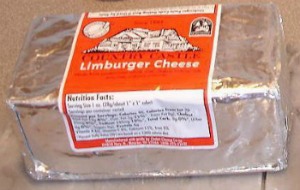
Limburger actually smells worse than it tastes! For many people though, the aroma is both the beginning and the end of the acquaintance. It is a food people either love or love to hate.
The people of Wisconsin have such affection for this strong-smelling Limburger that their state is probably the only place in America where you can go into a tavern and order a Limburger on rye bread with raw onions and brown mustard. The sandwich is usually served on freezer paper and is traditionally washed down with a locally brewed beer. Some places even give you a breath mint.
This cheese gets more pungent with age. But despite its aroma, Limburger cheese has legions of fans.
When the cheese is very young, up to one month old, it is firm, crumbly and salty, much like Feta cheese.
At six weeks, it is softening on the corners but still has a firm center that’s salty and chalky.
At two months, the core is almost gone and the body is smooth and creamy.
At three months or more, it’s developed an intense smell and flavor; it’s spreadable, pungent and almost bitter.
History of Limburger Cheese:
This area of Wisconsin, just outside of Monroe in Green County, used to be home to more than 100 small cheese plants making Limburger, among other Old World varieties.
Cheese-making began in Wisconsin around 1840, when immigrants with cheese-making skills began arriving in the area. A group of Swiss immigrants settled in Green County, around Monroe, and began producing the same cheese they had enjoyed in their homeland. In 1867, Rudolph Benkerts, Green County’s first cheese maker, began making Limburger cheese in his home cellar. By 1880, Limburger was being made a twenty-five cheese factories in Green County, and by 1930, there were more than a hundred companies producing it. Today, only one company in the United States still make it, the Chalet Cheese Cooperative of Monroe, Wisconsin.

My father, Kenneth Stewart, loved Limburger sandwiches! As a young girl, whenever Dad would eat one of his strong smelling sandwiches, my brothers and I would cover our noses and make funny noises as he shooed us off. – Linda Stradley
- 2 slices rye bread (dark, light, or pumpernickel)
- Brown mustard, prepared
- Limburger cheese, sliced
- Sweet onion (thick slices)
-
To assemble sandwich, spread mustard on rye bread slices; layer with limburger cheese and sweet onion slices.
Serve with your favorite beer.
Makes 1 sandwich.
Source: Photo by Barrett Buss from the website Too Many Chefs.
Comments from readers:
I just read your article about Limburger. I have never tried that sandwich, but today I am going to. That cheese is my absolute favorite cheese of all time. My mother used to eat it when I was a child, and she would give me some. I loved it even then. I sent for some a time back and when I got it I was disappointed because it was very tasty on the outside, but not so much on the inside. At last I have a grocery store that stocks it and I am able to buy is regularly. It is almost like I am addicted to it! I am going to see about taking a trip over to Wisconsin and trying to find the place that makes it.
You know, I just have to tell you this… I get a little anxious when I run low on the cheese. I wonder if it is addictive? ha ha ha… Maybe I will have to go to a Limburger rehab place. Also, my little Pomeranian recently had surgery, and the only way I could get her to take her pain medication was by putting it in the Limburger cheese. Of course, with the odor she smells it the minute I take it out of the fridge, and comes running and begs me for some. So, Sassy and myself always enjoy the cheese together. – Mary Borrello
Categories:
Food History Great Lakes Other Cheeses: Cheddar, Gruyere, Fontina, Monterey Jack, Gouda, Manchero, Queso Cheese, etc. Sandwich RecipesComments and Reviews
Leave a Reply
27 Responses to “Limburger Cheese History and Recipe”
Carolyn
I live in Louisville, Kentucky and there is a bar in Germantown that serves Limburger sandwiches.
Ray B
What is the name? I would like to go het one.
corynski
My local Kroger in Crossville, Tn., has pulled the Limburger cheese from display and marked it down for sale. They say it’s finished and they’ve given up on it….. But a larger Kroger in Oak Ridge has it, together with cheeses from around the world. Fortunately, going overseas increased my appetite for the exotic, and that ranged from coffee to beer to baked goods, and especially to cheeses. Port Salut comes to mind….. But in the US of A all the cheeses have been traditionally mild, unless they were imported. Maybe I’ll have to get a direct line to the factory….
SmokyWoodturner
Sorry to here that Corynski , thats where I usually got mine. I did see it at Publix in Chattanooga so I will get some tomorrow since I will be down there
J.P. Nutterville
When I was a kid, my grandfather would take me into one of the older establishments in town. I felt like quite the young man as he ordered a beer and a soda for me and we would eat limburger and crackers. Almost every bar in our small town did back then. When I was older and out by myself the only place that still had it was a bar way out on Black Lake, NY, and now there is no place at all that serves it. The influence of yuppies, I expect. I have to buy it at a local store. It is made in Wisconsin, of course. But, coming up Saturday one can still go to Chippewa Bay, NY, and the fish and game club there has a yearly roast corn and limburger feed. At least I can get my fill there.
Johnny (Big Boy) Parsons
This cheese is the only cheese that took the place of the jar limburger from Mohawk Valley. Once they stopped making the jar of one of the best limburger cheese spreads I ever encountered, I went searching for a limburger that would and hopefully could fill my limburger addiction. And I finally did – it was Country Castle’s limburger and man did that ring my bell. As a young boy my mother was from Frankfort Germany and always had Camunberg / and tillster cheeses on the table at room temperature with the limburger with a large loaf of Vienna rye or pumpernickel bread and we would help ourselves to these marvelious cheeses. Food is an amazing way to bring back beautiful memories of the old days and the addiction that this cheese brings to me is a deliteful way of remembering my mother and siblings. If you truly are a cheese lover, give this cheese a try and once you realize beyond that potent aroma there is a marvelous flavor that will stay with your taste buds for the rest of your life. Believe you, me you not regret falling in love with Limburger – there is no other cheese like it on the planet.
Matt
Hi.
My grandfather used to eat Limburger and onion sandwiches. In his memory, I ordered some for myself for Christmas.
It’s an acquired taste, but I do enjoy the taste of Limburger cheese. However, I HATE raw onion. Do you have any suggestions on what might taste good on a Limburger sandwich besides onion?
Thanks.
Whats Cooking America
What about carmelizing the onion?
Angie
I slice up apple with my sandwich! Marble rye, onion or no onion for you and slices of apple mmmmmm!
Ron Mathews
Although I like my onions I also like Limburger cheese with liverwurst they just go great together. I’ll also use horseradish spread instead of mustard.
Deborah
I found limburger spread at Meijer grocery a few months ago. I was so happy. My Mom and I would fix these sandwiches on rye bread with butter and sliced onion. It brought back memories of something I shared with my Mom. I went back to get more and it was gone. Discontinued and the block style replacing it. So disappointed. I found this recipe that is so close to the jar spread . Mix the room temperature limburger (no rind) with equal amounts of cream cheese and 2 tbsp garlic powder not salt and 2 tbsp butter. Mix it all in food processer. Pretty good
Rosemarie Trent
I grew up in Bavara and my relatives mix it with finally chopped red onion with vinegar poured over it and let it rest for a while then mix the whole thing with unsalted butter and eat it with crusty fresh rye bread. Enjoy. Another thing they fix for me when I visit and it reminds me of my childhood are mashed potatoes mixed with finally cut onion me butter and sour cream. Fattening but oh so good eaten thick on crusty bread
Lo Dees
I’ve wanted to try Limburger for the longest time. I couldn’t find any in stores near me so I gave in and bought it online at https://www.gourmet-food.com/german-cheese/limburger-cheese-100438.aspx. It definitely is an acquired taste. I tried it on a sandwich with caramelized onion and it was quite good.
destro
I love this stuff. I grew up with Pennsylvania Dutch grandparents. They ate all things strong, tart, sour, pickled. You name it. From homemade beet pickled eggs, pigs feet and Braunschweiger. I have learned that it does taste quite a bit different depending on how old it is. The closer or even a little after the use by date is the best time to enjoy this marvelous cheese. The flavor develops more and can become a very complex cheese. I don’t think it is given enough credit. It is culinary delight that is not celebrated enough. It will stand up to some of the best french cheeses out there. BTW my favorite way to eat it buttered pumpernickel, brown mustard, sliced beet eggs and a few healthy slices of limburger.
David Schillinger
And the memories come flooding back. THANK YOU.
Jersey Mike
I eat all kinds of cheeses. While I do love the onion, I also like variety so, once in a while I put a pile of Alfalfa sprouts in place of onion. And, I vary the bread, using everything bagels in place of the rye. For crunch without the strong onion taste, try slicing green (bell) pepper and put it on. Last, but not least, I don’t use mustard on these sandwiches; it masks the flavor in my opinion.
Bon appetit!
Dee Bramhall
I grew up in northwest Ohio, Limburger cheese was sold locally but the only time I had contact with it was for a club “hazing” where we newbies had to wear it around our necks for a full week. After experiencing French “smelly” cheeses as an adult, dang I wish I had tried the Limburger! Basically if it smells like urine or a locker room full of teenaged boys smelly socks, that’s some good cheese!
Karen Stone
Was introduced to an extended family to a new New Years treat a few years ago…Limburger and Red Onion on pumpernickel bread. Never ate the cheese before but I loved it. It’s now an annual treat.
Nathalie Redrova
this has to be a joke this can’t be real
Mark mitchell
I’ve been eating Limburger cheese since 1965. My grandmother and mom loved it and my grandfather and dad couldn’t stand it. I spend over one thousand dollars a year on Limburger cheese and I have ate one sandwich a day for 14 straight years. I hope you know now how much I love it.
Lucinda
I ordered 6 pkgs of Limburger to experiment with as it ripens. A few pieces stirred into a cup of hot beef broth for a different hot drink works. Apple slices on a plate with pieces of fresh Limburger on top then microwaved for 30 seconds…. perfect Limburger addicts treat. It truly is addictive.
MARYANN D RIVAS
i have been trying to find where to purchase this and another brand with foil wrapping but cant find it now. i have been eating this cheese for 50 years, i’m 71 now.
Matty Parks
I’m a sconnie lived here in WI all my life. Braunschweiger, bratwurst and of course limberger. I just spent a week making my own rye sourdough starter. Fresh rye, white onion, tomato and limberger. What a tasty treat, I like mine a couple weeks old, salty and just the right creamy texture. Glad to hear I am not alone, if you haven’t tried it you are missing out!
Paul Radford
When I was a child, my mom & dad used to eat limburger cheese. When they took it out of the frig & opened it the smell was awful. I asked “How can you stand to eat that awful smelling stuff?” Dad said “Because it tastes so good.” He then asked if I wanted to try it. I told him if he could eat it, then I would force myself to try it. He liked it with fried spuds. I took a slice and once I got past the smell it tasted really good. It became one of my favorite cheeses, & I still love it, but it is difficult to find it in the stores but when I do I buy some an I still enjoy the great taste of my favorite cheese.
Bonnie Lukas
I live in Wisconsin our Burlington Gooseberries has small block lamburger cheese I love this cheese.
Bob
I was introduced to limburger by German relatives and have come to enjoy it on sourdough/onion/limburger sandwiches, or with crackers. Williams Cheese in Linwood, Michigan makes a limburger that is excellent in my opinion. I have seen it for sale in Meijer stores, or you can order it directly from the Williams website: https://williamscheese.com/product/limburger-cheese-7-oz/
Darren
Just visited my local Kroger here in Cincinnati and purchase the requisite rye bread, butter, brown mustard, onion and, of course, Limburger cheese. An amazing sandwich!