Indian Fry Bread and Indian Taco Recipe and History
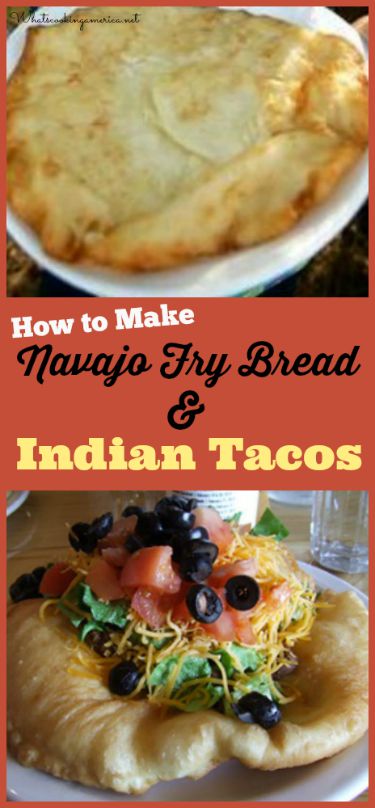
Indian fry bread is the foundation of a popular dish called Indian Tacos. Originally known as Navajo Tacos, they have been adopted by other tribes. The Navajo taco was voted the State Dish of Arizona in a 1995 poll conducted by the Arizona Republic newspaper.
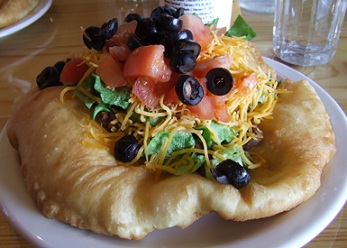
Indian tacos, made with Indian fry bread, are the universal modern powwow food (see below). They are also popular attractions at many fairs, festivals, and outdoor summer shows held in the southwest. People will line up to wait their turn to buy some freshly made tacos. Indian tacos are a combination of beans or ground beef, chopped lettuce, sliced tomato, shredded Cheddar cheese, and optional green chile atop plate-sized rounds of crispy Navajo or Indian fry bread. No plates or silverware are need, as you just fill the fry bread with your desired filling, roll it up, and eat.
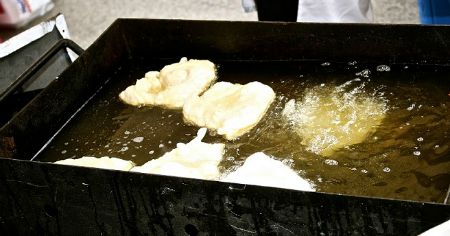

Photos courtesy of the National Indian Taco Championship held in Pawhuska, Oklahoma.
History Indian Fry Bread:
Indian fry bread is tradition to the Navajo, and comes with a story of great pain and suffering. Though the tradition of fry bread is common among many Southwestern Tribes, it is the Navajo who developed this recipe. I do not feel that I can share the recipe without sharing it’s origins and what it means to some today:
The Navajo planters lived from the Earth as their ancestors had for hundreds of years before. They also raised livestock to feed their family. The Navajo dinetah (or homeland) was bordered by the four sacred mountains, from northeastern Arizona, western New Mexico, and north into Utah and Colorado. They planted crops in the fertile valley lands, such as Canyon de Chelly known for Ansazi ruins.
The Navajo traded with the Spanish, Mexican, Pueblos, Apache, Comanche, and even the early American pioneers. Around 1846, large numbers of pioneers moved into the area and the cavalry came with them. This is when troubles began. The troubles escalated with the murder or Narbona (1766-1849), a well-respected Navajo leader on August 31, 1849. On this day, Narbona along with several hundred of his warriors, had come to meet and discuss peace with U.S. Colonel John M. Washington and others of the military stationed in the area. There had been trouble with theNew Men (the New Mexican settlers who had driven Mexican settlers out of the area).
After several hours, it was believed a settlement had been agreed upon. However, a young warrior by the name of Sadoval, had plans of his own. Mounting his horse he began to ride in front of the Navajo party, attempting to have them break the treaty. A U.S. Calvary soldier began to say that one of the horses ridden by a Navajo was his, and what peace there was in the meeting that was disintegrating into battle. Colonel Washington commanded the Navajo to stand down and return the horse to the soldier or he would fire into them. The rider and horse were now gone, and the Navajo party did not comply. A canon was fired, and Narbona was mortally wounded. It is told that he was scalped by a U.S. soldier as he lay dying.
This disastrous attempt at peace led to the Long Walks. In September 1863, Kit Carson (1809-1868) was dispatched into Navajo land to retrieve a surrender. When no Navajo came to meet with him, he ordered the burning of the land. Attempts were made to starve out the Navajo and many were captured and taken to Bosque Redondo near Fort Sumner. Hundreds starved on the 300 mile walk and more would die later in the crowded and disparaging conditions . Navajo were placed with the Mescalero Apache where home peace was often not the case. The camps were meant for 4,000 to 5,000 people, yet there were now over 9,000 people, and supplies were meager.
The government supplies of lard, flour, salt, sugar, baking powder or yeast, and powdered milk were often rancid. Fry bread came from these few foods provided during the 4 years of captivity. Since that time, it has become common food at most all PowWows of numerous tribes
To some, Indian Fry Bread is a sacred tradition. It is to be consumed by the people until the earth has again become purified. Wherever one finds Indian fry bread one finds its taco equivalent, and curiously enough, it’s often named after whichever tribe the reservation belongs to.
1993 – The American Indian Exposition in Anadarko, Oklahoma hosted its first National Fry Bread Contest. The purpose of this exposition is to show off Native American arts and crafts and help preserve their cultural heritage. This event also features one of the largest American Indian parades in Oklahoma.
2005 – South Dakota designated fry bread as the Official State Bread with House Bill Number 1205 on February 25, 2005.
Present Day – Today, fry bread is generally known as a Carnival or State Fair treat to the general public. In some areas of the United States, this sweet treat is known as Elephant Ears. It is a quick bread that’s fried and served as a sweet treat, drizzled with honey and sprinkled with cinnamon sugar.
Fry bread is most often used as the foundation of the famous “Indian Taco with ground beef and other taco ingredients of your choice. Originally known as Navajo Tacos, they have been adopted by other tribes. The Navajo Taco was voted the State Dish of Arizona in a 1995 poll conducted by the Arizona Republic newspaper.
Indian Tacos are the universal modern PowPow Food (see below). They are also popular attractions at many fairs, festivals, and outdoor summer shows held in the southwest. People will line up to wait their turn to buy some freshly made tacos. Indian Tacos are a combination of beans or ground beef, chopped lettuce, sliced tomato, shredded cheddar cheese, and optional green chile atop plate-sized rounds of crispy Navajo or Indian Fry Bread. No plates or silverware are needed, as you just fill the fry bread with your desired filling, roll it up and eat.
The National Indian Taco Championship is a festival held in Pawhuska, Oklahoma on the first Saturday in October.
- 1 cup flour, unbleached
- 1/4 teaspoon salt
- 1 teaspoon powdered milk
- 1 teaspoon baking powder
- 1/2 cup water
- Vegetable oil for frying
- Extra flour to flour your hands
-
Sift together the flour, salt, powdered milk, and baking powder into a large bowl. Pour the water over the flour mixture all at once and stir the dough with a fork until it starts to form one big clump.
-
Flour your hands well. Using your hands, begin to mix the dough, trying to get all the flour into the mixture to form a ball. You want to mix this well, but you do NOT want to knead it. Kneading it will make for a heavy Fry Bread when cooked. The inside of the dough ball should still be sticky after it is formed, while the outside will be well floured. Cut the dough into four (4) pieces. Using your floured hands, shape, stretch, pat, and form a disk of about 5 to 7 inches in diameter. Do not worry about it being round. As Grandma Felipa would say “it doesn’t roll into your mouth.”
-
In a deep heavy pot, heat the vegetable oil to about 350 degrees F. You can check if you oil is hot enough by either dropping a small piece of dough in the hot oil and seeing if it begins to fry, or by dipping the end of a wooden spoon in and seeing if that bubbles. Your oil should be about 1-inch deep in a large cast-iron skillet or other large heavy pot.
-
Take the formed dough and gently place it into the oil, being careful not to splatter the hot oil. Press down on the dough as it fries so the top is submersed into the hot oil. Fry until brown, and then flip to fry the other side. Each side will take approximately 3 to 4 minutes to cook. Place the cooked Fry Bread on a paper towel to absorb excess oil.
-
Indian Fry Bread can be kept warm in a 200 degree F. oven for up to 1 hour. They refrigerate well and can be reheated in a 350 degree F. oven for 10 to 15 minutes before serving.
-
Different ways to eat and serve Indian Fry Bread: -
Eat them as they come out of the fryer
-
Mix softened butter and honey together and spread it on top
-
Sprinkle with a cinnamon sugar mixture
-
Sift powdered sugar on top
-
Make the famous Indian Taco (see below) and stack with your favorite taco ingredients
-
In a large frying pan over medium-high heat, brown ground meat and onions until cooked; remove from heat.
-
Place Fry Bread, cupped side up, on separate plates. Layer ground meat, lettuce, tomatoes, Cheddar cheese, and green chile peppers onto top of each Fry Bread. Top with sour cream, if desired, and either roll up or serve open-faced with a fork.
-
Makes 4 servings.
 I get many readers asking what cooking/meat thermometer that I prefer and use in my cooking and baking. I, personally, use the Thermapen Thermometer. Originally designed for professional use, the Super-Fast Thermapen Thermometer is used by chefs all over the world. I only endorse a few products, on my web site, that I like and use regularly.
You can learn more or buy yours at: Super-Fast Thermapen Thermometer.
Sponsored Content
 PowWows:
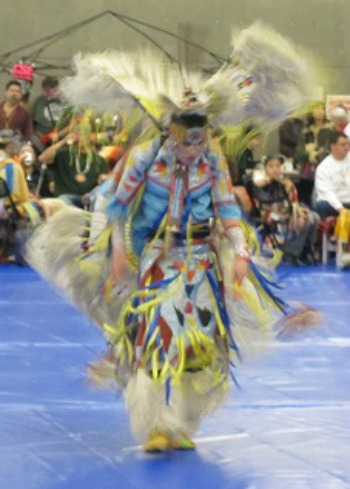
Every weekend from April through October, thousands of Native Americans throughout the United States and Canada pack up their cars and heat to powwows. Some families go “on the circuit” to many large Powwows which are held at different places every weekend. A traditional powwow is a social gathering of Native Americans from many nations. Powwows help maintain cultural identity and attract visiting dancers from all over.
In the late 1800’s and early 1900’s, Indians were not allowed to have dances. Government officials thought the dances were organized to resist federal forces. They did not realize that the dances were held only to honor their elders and warriors, give gifts and recognition to those deserving, sing honor songs, ask questions of the elders, teach by example, dance the sacred circle, and be healed.
In the 1960’s, officials finally realized that these dances and traditions were not dangerous, only important to Native Americans. Native Americans today are developing deep pride in their culture and traditions.

Comments from readers:
Thank you for the Indian Fry Bread recipe and the origin of where they started. I am originally from Oklahoma – very interesting. Again, thank you. – Doris Griggs (11/23/14)
71 Responses to “Indian Fry Bread and Indian Taco Recipe and History”
vicky
Thank you my husband all ways says oh you’ve never tried fryed
bread before have you . So now I can put a plate in front of him and say NO but you can try mine now
jessica
ohhh…. good
JulyeHoskie
You can also leave out the powdered milk . Navajo fry bread is usually best made with Bluebird Flour. Most Navajos prefer to sprinkle only salt on their frybread and also an onion sandwich made with fry bread is very filling.
Ginny
I have to try this because one of my favorite things on the planet is raw onion sandwiches. My entire family thinks I’m strange but I love them. With the fry bread I bet they’ll be even better.
Beth
I like to carmelize the onions for the children. Of course peanut butter holds the onions on. Sounds awful but tastes sweet.
sopha
i like it too much
Donna
Love fry bread
Roger
I make this all the time now. I use a tortilla press. For a meal, desert or a side it’s great and super easy
Carolyn
Am listening to a JA Jance book with a new character (new to me). In the book the tribe cooks “popovers” and “indian tacos”……are popovers the same thing as fry bread?
Kathy Corcoran
Yes, popovers are what they were called when I was growing up in Tucson in the 1970s on the Tohono O’otam (formerly Papago) Reservation to the west of Tucson. I didn’t hear about fry bread until coming to northern Arizona. Same delicious food. If you visit Tucson, you can buy fry bread or popovers at San Xavier Mission at the outdoor market on weekends.
Trudy Mann
They have the best Indian Fry Bread at San Xavier Mission, it would be a shame to not visit that beautiful “Dove of the Desert” in Tucson AZ. and to miss the delicious fry bread tacos and dessert fry bread made the authentic way by a real Native American.
Tammie
Love Indian fry bread n tacos, can put pie fillings in fry bread too for dessert.
Sandra atkins
My grandma makes Indian tacos and my first time trying it. I was wanting more because it was so good and now I can share it with my fiance, our daughter, and our family. I am happy and thank you and I am not going to add the milk.
Dilrukshi
what about the thickness of the pressed Taco?
plasterer bristol
Yummy – can’t beat making this at home. Thanks for sharing.
Simon
Lynda Thomas
In 1993 I lived in Ogden, Utah and met a sweet, young traditional Navajo couple. Their first baby was only about a week old in a straight board papoose. She said he would remain in it until he was a year and would be healthy with a strong straight back. It made perfect sense to me as I suffer from congenital scoliosis. He’d not been named yet they were waiting or his umbilical cord to drop off while on a trip to the Reservation at 4 Corners Nation’s. My memory is a bit sketchy but his name and what his life and future job would focus around wherever it fell off. When they got home she told me the all the were on a horse back ride where it dropped off. Now that’s quite spiritual. She used to bead ratings also.
My comment/question is… She taught me to make fry bread over open fire not in grease. On the gas stove with a silver grate laid over top of a a brick on either side of the flame. She told me the recipe was so easy to remember cuz I just have to remember 2’s. I can’t remember to save my soul and I lost contact with her I sadly regret. Her name was Nadine. Husband? I don’t remember. But if it was 2’s… 2 full cups flour, 2tsp baking powder, 2 tsp salt? 2 cups milk? Maybe she might have measuredout that much milk just in case or added flour to the rolling surface which I can’t actually remember her rolling, more like tossing back and forth like Pizza pies.
Julie
What is the Navajo word for fry bread?
unknown
dah díníilghaazh
toni
Cool story Lynda..Above all others, I would try your yummy version of Indian fry bread.
Margaret
If one is in a hurry, you can roll out a canned biscuit and fry it in oil. I make Indian Tacos this way a lot.
Rebekah Jones
Sounds yummy but also greasy. Has anyone tried the recipe and baked it?
Regina Dauzat
I am white and was married to a STOCKBRIDGE Indian in Wisconsin. The first time I tasted Indian tacos was when my mother-in-law made them. I totally fell in love with them!!! My daughter can make them also. I talked to her about the recipe last night and she just laughed and said it was a secret!! She didn’t think about PINTEREST!!! LOL
Joe
It is NOT greasy if you use enough oil and it is up to temperature before you start. You can boil dumplings without them being soggy from being cooked in water. Likewise you can deep fry foods with out them being greasy just because they were cooked in oil.
I would not recommend baking. It is called Fry Bread for a reason. Baking is just “bread”.
cafenitro
It would be like baking a donut. Not the same.
Rosana
Rebekah Jones really?? Why do you feel like you have to change the tradition fry bread… Dude if it’s too greasy for your tastebuds don’t make it but don’t try and change a recipe that is part of their tradition.. If you want baked bread just go ahead and eat regular Bread it is baked in an oven, no need to try ” baked fry bread” it doesn’t even make sense 😂 it’s in the freaking name.
Cheryl
I was telling some friend’s the other day how I missed these Indian Fry Bread Tacos. I learned of them when I worked for LCO halfway house. Oh my gosh. Then I worked for LCO Casino. And when PowWows came. Couldn’t wait. So delish. Now I can attempt to make them as well.- Ty
CHARMAIN
I have lived in South Dakota for a time and worked with the young Dakota Sioux youth. Anyway, I was a houseparent and one of the young ladies I worked with made Indian tacos. Then a friend took me to the Bad Lands and I was in love! Not with my friend! But with the Indian Tacos! Anyway, I’ve been having a taste for them lately and this looks like a great recipe. I’ll have to try this recipe soon. Thank you for it and the history behind them.
Ginny Hulburt
i am hoping to serve Indian Fry Bread tacos for our Bookclub , (We ready One Thousand White Women). My question is can I make the bread ahead of time??
Linda Stradley
Indian Fry bread is best when first cooked. Do not make the fry bread ahead of time as the oil from frying settles into the bread and it turns tough…it would be better if you at least made the dough and cooked them at the last minute.
mixer roti
this is very good
Lori
Thanks for the history, how to and recipe! I love good fry bread and now can make my own with organic flour.
Christina
Thank you for this recipe and history! I grew up in Arizona and started making Indian Fry Bread for my family when I was 9, after having it at a Navajo event. I wanted to make it for my family and knew I’d find a recipe by doing a Google search and found your history and recipe. Very interesting and meaningful. Thanks again!
Dawn
When I was young my granny made fried bread… she would use a yeast dough (like regular white bread) making balls and flattening them and fried…. We loved them best when they would come right out of the pan adding butter and salt… didn’t that this was something that came from Indians.. especially since they are from a German heritage …
While my children were visiting their father and step-mother (who was full blooded Indian) she had made us a dinner of “Indian Tacos” which in turn my children LOVE today! and of course request them for their birthday dinners and with the WHOLE family, (which after having five children , their spouses and multiplying grandchildren and my 5 siblings and their extended families adds up to a LARGE group). .. I have come to purchasing frozen yeast dinner rolls… after they have risen they are perfect sized to shape and fry making it quicker and easier to make multiples quickly….
Thanks so much for the history behind them.. very interesting
Jeanne
In our family, these fried yeast breads are called “bunny cakes.” Have no idea why, except we used to have them on Easter Sunday, or any time the extended family got together. Perhaps it is a German thing as my Grandmother was from Pennsylvania Dutch country. It was breakfast food, like pancakes, with butter and cinnamon or syrup. We have had Navajo Fry Bread and it is quite different.
S. Bergan
I also had them made (on bread baking day) made with yeast bread dough. I’m also of German origin, they were called Brod Kegla (sp?). Us kyds called them “Broad Casters” as we couldn’t say it right and my Norweign husbands family called them Tista Lumpas. We served them with butter and syrup for breakfast with sausage, or with homemade bean soup. No matter what you call them, they are filling and good.
Village Bakery
I never knew Indian tacos were a thing until my friend sent me this post. What an awesome idea. I’m definitely going to make these for dinner next week.
Lorrie
I am Navajo and grew up on Navajo bread. I make it quite often for family members. Love it.
leona tipton
indian fry bread is super delish as a cheeseburger.. had them at a restaurant in arizona yrs ago. also sugar/cinnamon with coffee.makes me hungry..making some tomorrow
Merlene
I learned to make frybread in 1960 when living at Navajo Mtn trading post.
Have shared the recipe with many friends and family.
My instructions were to knead the dough extensively to make it more tender.
Donna
Can this be baked and not fried?
cafenitro
It wouldn’t be the same at all. You’d be better off going with a flatbread like pita cooked on a griddle if you want less oil. The frying is pretty essential to it being fry-bread.
Kitchen Folks
I had no idea about Navajo fry bread and Indian tacos. Is it the very popular recipe in India? I love Indian recipe. I have a colleague from India. Sometimes he gave Indian food when we eating lunch. I will try it at my home and want to surprise my colleague. Thanks for sharing this recipe.
Sandria Buchanan
Love to have the recipes
Sasha Jamison
I am an American/Puerto Rican and grew up fairly poor just like the rest of America back in the day. My mother and hunger sister made these but we called them Jonni cleats/aka Johnny cakes In St. Thomas and other Islands that’s what they are called. So thank you for taking me down memory lane and the recipe love it!!
Rhonda
Sounds about like the flap jacks we use to cook in the south. Recipe is the same, except we cooked ours like pancakes. I didn’t know what pancakes were until later in my childhood.
Barbre Brunson
Hi – I am trying to find someone, someway, to explain the history of fry bread and serve some at our National American Indian Heritage Month day in November at the Government Publishing Office in Washington, D.C. Do you know of anyone in this area that might help. Virginia, Maryland, or DC. Would appreciate any advice. I know I could buy some and maybe set things up. But, GPO has a limited budget. My father was a Chiricahua Apache and I have been the voice here to teach things about the American Indians to GPO employees. Thanks
Jane
This inspires me alot. Looks yummy and cool. Thanks for your sharing the great recipe. My mouth cannot stop watering.
Sue
I love these. Grew up in ND and my German family made these all the time. The German name Brotkeachla translates roughly to little fried breads. We ate them warm, slathered with butter. Nothing better in this world. I always thought they were a German food, but probably just common on the early Great Plains and adopted by many cultures.
Lucy
I tried this recipe and it came out good. I made small size 4 inch in diameter. Thank you for sharing. 01/03/2019.
Jenny
I am grateful that you shared the history of this dish. From your article, it seems that is was born out of scarcity and displacement with limited resources, a testament to the resilience and creativity of the people.
Dad Life
I gave this recipe a try two nights ago and just had to come back and say the family loved it. This is definitely on our make again list.
Jan Gonzales
I have to make this atleast once a week for the grandkids. Even while on vacation one called and asked if I would make her some as soon as she got home..Yes, yesterday was the day. She loves it with parmesan cheese while others love it with cinnamon and sugar. As for me I will take it anyway I can…….refried beans with bacon is one of my favorite toppings. Thank You for sharing
Joanne thorp
How long can the dough be made before frying it?
Whats Cooking America
You can make the dough ahead refrigerate overnight or freeze the dough. Take out the wrapped frozen dough out the night before and allow to thaw on the counter overnight (at least 10-12 hours before hand).
Devin Sanchez
Wow!
We made this tonight and let me tell you it was amazing!! My husband loved it!! So simple too!!
Nancy
Glad you liked it!
Melissa
This was awesome! Easy and very juicy. I would definitely do it again.
Maria SWilson
I am really impressed to read this article. I am surely going to bookmark your website for future reference.
Thomas
Awesome! Indian Fry Bread is my favorite food. It’s great to be able to make it yourself at home, actually it’s not as difficult as I thought, thanks for your detailed recipe guide. Best regards!
Kim
I was raised in New Mexico, 42 years. Had many Navajo Friends, and had my share of authentic Navajo Fry Bread, the information above is really well done. And the recipes is really close to real fry bread. They do make a well in the middle of the flour etc. but they sprinkle the powder milk over the top (you have to have powder milk!). Then fill the well with Warm water as it spills over then knead, dough will be partly sticky. Then pat and stretch with hands make sure to use your hands with fingers pulled in as to not tear dough and flip on wrists.. fry in LARD. That’s what they actually use but oil will be ok. And Blue Bird flour is a must, it make them crisper and better flavor, you can find it at Walmart usually, it is killed in Cortez CO. Oh and the Navajos make a sour face if you called it Indian tacos or etc.. they only call it (Navajo Tacos or Navajo Fry bread!). Thanks for the post I will have to try it to see how it comes out. Thanks!
Nancy
Thank you for the additional tips!
Willa
Growing up when my mother would make homemade brread she would make us fried bread out of the bread dough. Fried in Crisco or lard when fried spread with butter and jelly. Yummy.
Sarah
I really want to try this recipe, but cannot for the life of me find powdered milk. Can I omit or substitute it?
Nancy
It’s only a teaspoon, so I can’t imagine it would make too much of a difference, try adding liquid milk, and here is a link to powdered milk in the What’s Cooking America Amazon store https://amzn.to/2Wh5R74
Jahnson alberto
Thanks for giving me such a food recipe to try and get smile back on my wife’s face. she thought i can’t make anything delicious for her. but i made her wrong again.
Randall Richards
I am really impressed to read this awesome article. I am surely going to bookmark your website for future reference.
Carolina Arey
I make this recipe all the time now. I use a tortilla press. For a meal, dessert, or a side it’s great and super easy
kitcheniest
It looks wonderful. I was born and raised in Tulsa and always went to the state fair. But I don’t remember ever having a fry bread taco. I have had fry bread tho and love it. I’m going to make this right away.
Thanks for the simple and delicious recipe for the fry bread! Blessings!
Jan Gonzales
make these all the time now. One granddaughter loves them with Parnassian cheese and her brother loves them with cinnamon and sugar. Me I will eat them any way at any time but to treat myself Its with refried beans and bacon.
Daphne Huffman
I worked as a nurse on the OB unit of the Fort Defiance Indian Hospital on the Navajo reservation in 1975-76. The food services staff made excellent Navajo tacos for the patients at least once a week. It was a great day for me if a patient was discharged just before lunch and I got the extra tray! Thanks for the recipe and story.
Marlene
I used to live in Montana, where the Blackfeet tribe are. Every Wednesday was Indian Taco day and they sold them everywhere and I loved them. The past few years I have been trying different recipes for them but have settled on this one. It is SO incredibly easy and delicious! I always double the recipe because my husband wolfs them down! He is East Indian and he says they taste a bit like Naan. The only change I made was that I used powdered coconut milk because I always have that, but never have regular powdered milk. Lately, I have been making them almost every day – I think I need to stop for a while before we gain 500 pounds! (P.S. I use low carb flour because I’m on keto – works amazing!!). I also brush melted butter on both sides when they’re done because it makes them softer. .Thank you for this perfect recipe.