
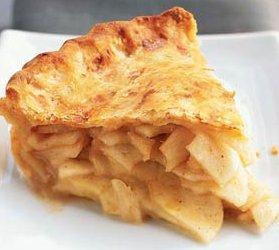
Check out my family’s favorite apple pie recipe, Mom’s Apple Pie.
Apple pies or tarts have shown up, in one form or another, since the Middle Ages.
1381 – 14th century pies were very different from today’s pie, as they didn’t contain sugar and the pastry (coffins) generally were not meant to be eaten. The coffins were meant to be used as a container only. Sugar during the 14th century was available, but was very scarce and extremely expensive.
The following very early apple pie recipe comes by way of The Project Gutenberg EBook of The Forme of Cury, by Samuel Pegge. This cookbook was originally compiled about 1390 A.D. by the master cooks of King Richard II, presented afterwards to Queen Elizabeth, by Edward Lord Stafford. According to historians, this is one of the first records of the modern apple pie.
XXIII. For To Make Tartys in Applis
Tak gode Applys and gode Spryeis and Figys and reyfons and Perys and wan they are wel ybrayed co-lourd wyth Safron wel and do yt in a cofyn and do yt forth to bake well.
1545 – Sugar was more readily available in the 16th century and the pastry (coffins) were meant to be eaten.
A cookbook from the mid 16th century that also includes some account of domestic life, cookery and feasts in Tudor days, called A Proper newe Booke of Cokerye (declarynge what maner of meates be beste in season, for al times in the yere, and how they ought to be dressed, and serued at the table, bothe for fleshe dayes, and fyshe dayes), has a recipe for an apple pie. NOTE: The following spelling and wording are quoted directly from the book):
To make pyes of grene apples – Take your apples and pare them cleane and core them as ye wyll a Quince, then make youre coffyn after this maner, take a lyttle fayre water and half a dyche of butter and a little Saffron, and sette all this upon a chafyngdyshe tyll it be hoate then temper your flower with this sayd licuor, and the whyte of two egges and also make yourcoffyn and ceason your apples with Sinemone,Gynger and Suger ynoughe. Then putte them into your coffin and laye halfe a dyshe of butter above them and so close your coffin, and so bake them.
1590 – Robert Green (1558-1592), English dramatist and poet, he could think of no greater compliment in praise of a lovely lady, wrote the following in his prose called Arcadia: “They breath is like the steame of apple-pyes.”
1620 – When the English colonists arrived in North America they foundonly crab apples. Crab apple trees are the only native apples to the United States. European settlers arrived and brought with them their English customs and favorite fruits. I n colonial time apples were called winter banana or melt-in-the-mouth. Read about the History and Legends of Apples.
1700s – Apple pudding and Marlborough pudding were very similar to apple pie, as they were also baked in a pastry crust. The only difference seems to be the addition of eggs, as both types were baked in a pastry lined pan covered with pastry (either a solid lid or a lattice-type lid).
1713 – The poem called Apple Pye, by William King (1663-1712), English poet appeared in the pamphlet called The Northern Atlantis (York Spy):
Of all the delicates which Britons try
To please the palate of delight the eye,
Of all the sev’ral kings of sumptuous far,
There is none that can with applepie compare.
1759 – The Swedish parson, Dr. Israel Acrelius, author of the A History of New Sweden; or, The Settlements On The River Delaware (an extensive history of the Swedish congregations of New Sweden), writing home to Sweden in 1759 an account of the settlement of Delaware, said:
“Apple pie is used throughout the whole year, and when fresh Apples are no longer to be had, dried ones are used. It is the evening meal of children. House pie, in country places, is made of Apples neither peeled nor freed from their cores, and its crust is not broken if a wagon wheel goes over it.”
1796 – The 1796 cookbook called American Cookery, by Amelia Simmons had two recipes for apple pie and one recipe for Marlborough pudding:
Apple Pie – Stew and ftrain the apples, to every three pints, grate the peel of a frefh lemon, add cinnamon, mace, rofe-water and fugar to yourtafte – and bake in pafte No. 3.
A Buttered Apple Pie
– Pare, quarter and core tart apples, lay in pafte No.3, cover with the fame; bake half an hour, when drawn, gently raise the top cruft, add fugar, butter, cinnamon, mace, wine or rosf-water.
Marlborough Pudding – Take 12 fpoons of ftewed apples, 12 of wine, 12 of fugar, 12 of melted buttter, and 12 of beaten eggs, a little cream, fpice to your tafte; lay in pafte No. 3, in a deep difh; bake one hour and a quarter.
Apple Pie a la Mode In the United States,pie a la mode refers to pie (usually apple pie) served with a scoop of ice cream (usually vanilla) on top.
1890s – According to the historians of the Cambridge Hotel in Washington County New York, Professor Charles Watson Townsend, dined regularly at the Cambridge Hotel during the mid 1890’s. He often ordered ice cream with his apple pie. Mrs. Berry Hall, a diner seated next to him, asked what it was called. He said it didnt have a name, and she promptly dubbed it Pie a la mode. Townsend liked the name so much he asked for it each day by that name. When Townsend visited the famous Delmonico Restaurant in New York City, he asked for pie a la mode. When the waiter proclaimed he never heard of it, Townsend chastised him and the manager, and was quoted as saying; “Do you mean to tell me that so famous an eating place as Delmonico’s has never heard of Pie a la Mode, when the Hotel Cambridge, up in the village of Cambridge, NY serves it every day? Call the manager at once, I demand as good serve here as I get in Cambridge.” The following day it became a regular at Delmonico and a resulting story in the New York Sun (a reporter was listening to the whole conversation) made it a country favorite with the publicity that ensued.
2 Responses to “Apple Pie History”
roger merle
The Northern Spy is rated as the best pie apple by many, but hard to find except the NE and NW parts of the U.S. I find Mac are too soft for use in pies. Don’t forget to make bake apples – just core and add spies etc. in the center hole and bake. Fun project for children !
bowbow
make it shorter