
Hawaiian Ahi Tuna Poke
Poke (pronounced POH-kay) is served in most Hawaiian homes and restaurants as a side dish, and no gathering in Hawaii would be complete without a few bowls of poke.
In Hawaiian, poke means “cut piece” or “small piece.” Poke is bite-size pieces of raw fish doused in seasonings. Poke is actually the Hawaiian version of the elegant Japanese sashimi (a combining of the Hawaiian and Japanese taste for raw fish). The fish for poke is sometimes even lightly seared or fried. Ahi Tuna is a favorite fish used in making Hawaiian Poke.
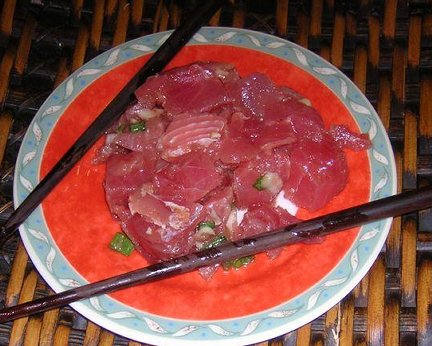
Hawaiian Poke History:
For centuries, Hawaiian fishermen cut their catch of raw fish into cubes and seasoned it with whatever ingredients they had. Modern versions make use of seasonings brought by the many different cultures of the Islands, such as soy sauce, onions, tomatoes, and chilies. Poke is so common in the Hawaiian culture, that you can stop at a local grocery store and choose from several freshly made varieties.
Mention regional foods to Hawaiians, and people think of poke. It is considered a local food or “local grind” – comfort food to the Hawaiians. Normally local food is not the cuisine that is served in upscale hotels and restaurants of Hawaii, but poke has crossed such boundaries. Poke is still evolving in the Hawaiian Islands. It was not until the 1970s that the recipes for poke started appearing in cookbooks.
In September of each year, Sam Choy, one of Hawaii’s most famous chefs, hosts an annual 3-day poke festival. The contest draws over 2,000 entries from Western Canada, the mainland United States, Hawaii, and the South Pacific. From these, 75 entries are selected as finalists, with many wildly inventive variations of the basic poke. The public is invited to taste after the judging, and it does not take long for the poke to disappear amidst a murmur of “mmmms” and “ahhs.”
- 2 pounds Ahi tuna steaks (fresh or sashimi-grade), cut into bit-sized pieces*
- 1/2 cup soy sauce
- 3/4 cup green onions, chopped, tops included
- 2 tablespoons sesame oil
- 1 tablespoon fresh ginger, grated
- 1 to 2 chile peppers, cored, seeded, and finely minced
- Coarse salt to taste
- 1 tablespoon toasted sesame seeds**
- 1 tablespoon toasted macadamia nuts, finely chopped***
- Boy choy or romaine lettuce leaves
-
In a large bowl, combine tuna, soy sauce, green onions, sesame oil, ginger, chile peppers, salt, sesame seeds, and macadamia nuts; mix lightly. Cover and refrigerate at least 2 hours before serving.
-
To serve, tear lettuce leaves into comfortable holding sizes and spoon approximately 3 tablespoons of poke onto each piece.
-
Either eat with your fingers or use a fork or chopsticks.
-
Makes 4 to 6 servings.
* If you cannot buy freshly caught fish, purchase only fresh sashimi or sushi-grade fish. Look for tuna fillets that are bright in color, not dull or darkened or dry looking. Buy loins or thick fillets (at least one-inch thick).
** To toast sesame seeds: Place sesame seeds in a small dry saucepan over medium heat; stirring occasionally, toast 3 minutes or until golden brown (watch closely as seeds burn easily).
*** To toast whole macadamia nuts: spread whole nuts on a baking or cookie sheet and toast in a preheated 300 degree F. oven for 5 to 8 minutes or until lightly browned (watch closely as nuts burn easily).