
The versatility of the tortilla as a wrapper in endless. They are used for tacos and enchiladas, among native Mexicans, tortillas are commonly used as eating utensils, as a plate as in a tostada, and much more. In the United States the tortilla is no longer seen as just an ethnic bread. This is partially due to the increase of the Hispanic population.
Check out What’s Cooking America’s Tortilla Recipe: Tortillas – How To Make Tortillas.
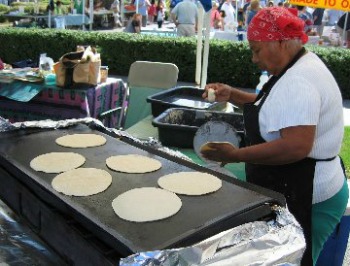
Tortillas History:
In northern Mexico and much of the United States, tortilla means the flour version. Flour tortillas are the foundation of Mexican border cooking and a relatively recent import. Their popularity was driven by the low cost of inferior grades of flour provided to border markets and by their ability to keep and ship well.
3000 B.C. – Excavations in the valley of “Valle de Tehuac”, in the state of Puebla, revealed the use, for more than seven thousand years, of the basic cereal by excellence of the Mesoamerican diet, a little wild cob that along with roots and fruit was a complement for hunting. According to Agust Gayt, chef and Mexican cuisine historian, in a Greeley Tribune newspaper article:
Sometime about 3000 B.C., people of the Sierra Madre mountains in Mexico hybridized wild grasses to produce large, nutritious kernels we know as corn. Mexican anthropologist and maize historian Arturo Warman credits the development of corn with the rise of Mesoamerican civilizations such as the Mayans and the Aztecs, which were advanced in art, architecture, math and astronomy. The significance of corn was not lost on indigenous cultures that viewed it as a foundation of humanity. It is revered as the seed of life. According to legend, human beings were made of corn by the Gods.”
By the time Spaniards reached the shores of what is now Mexico in the 1400s, indigenous Mesoamericans had a sophisticated and flavorful cuisine based on native fruits, game, cultivated beans and corn and domesticated turkeys.
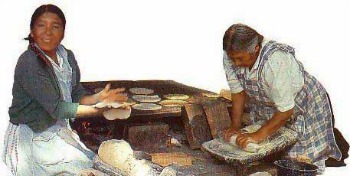 1519 – When Hern Cort (1485-1547), also known as Hernando Cortez, and his conquistadores arrived in the New World on April 22, 1519, they discovered that the inhabitants (Aztecs Mexicas) made flat corn breads. The native Nahuatl name for these was tlaxcalli. The Spanish gave them the name tortilla. In Cort’ 1920 second letter to King Charles V of Spain, he describes the public markets and the selling of maize or Indian corn:
This city has many public squares, in which are situated the markets and other places for buying and selling. . . where are daily assembled more than sixty thousand souls, engaged in buying and selling; and where are found all kinds of merchandise that the world affords, embracing the necessaries of life, as for instance articles of food. . . maize or Indian corn, in the grain and in the form of bread, preferred in the grain for its flavor to that of the other islands and terra-firma.
1529 – In the monumental manuscript books, General History of the Things of New Spain (Historia general de las cosas de Nueva Espana), by the Franciscan friar Bernardino de Sahagun (1450-1590), it is known that the Aztec diet was based on corn and tortillas, tamales and plenty of chilies in many varieties. Considered one of the fathers of culinary history. He compiled and translated testimonies of his culinary informants from the native language Nahuatl into Spanish. His work is the most complete record of Aztec foods and eating habits.
Sahagun was sent to New Spain (Mexico) to compile, in the Aztec language, a compendium of all things relating to the native history and custom that might be useful in the labor of Christianizing the Indians. The work thus undertaken occupied some seven years, in collaboration with the best native authorities, and was expanded into a history and description of the Aztec people and civilization in twelve manuscript books, together with a grammar (Arte) and dictionary of the language.
1940s – In the 1940s and ‘50s, one of the first widespread uses of small scale gas engines and electric motors was to power wet grain grinders for making masa. A hand press or hand patting were used to form the masa into tortillas.
1960s – Early tortillas took hours to make but by the 1960s, small-scale tortilla-making machines could churn out hot, steaming tortillas every two seconds.
Taco History:
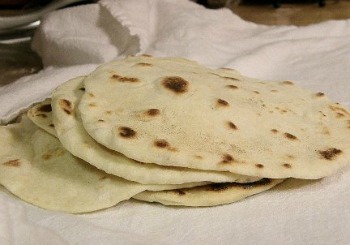
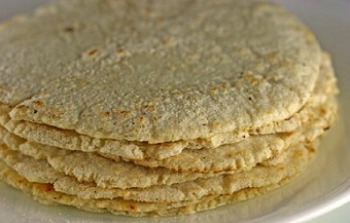
In Mexico, the word taco is a generic term like the English word sandwich. A taco is simply a tortilla wrapped around a filling. Like a sandwich, the filling can be made with almost anything and prepared in many different ways (anything that can be rolled inside a tortilla becomes a taco). The contents of a taco can vary according to the geographical region you are eating them. The taco can be eaten as an entree or snack. They are made with soft corn or fried corn tortillas folded over.
1520 – Bernal Diaz del Castillo (1496-1584), a Spanish soldier who came with Hern Cort to the New World, wrote an intriguing and detailed chronicles called A True History of the Conquest of New Spain. He also chronicled the lavish feasts that were held. From the article by Sophie Avernin called Tackling the taco: A guide to the art of taco eating:
The first “taco bash” in the history of New Spain was documented by none other than Bernal Diaz del Castillo. Hernan Cortes organized this memorable banquet in Coyoacan for his captains, with pigs brought all the way from Cuba. It would, however, be a mistake to think that Cortes invented the taco, since anthropologists have discovered evidence that inhabitants of the lake region of the Valley of Mexico ate tacos filled with small fish, such as acosiles and charales. The fish were replaced by small live insects and ants in the states of Morelos and Guerrero, while locusts and snails were favorite fillings in Puebla and Oaxaca.
1914 – The first-known English-language taco recipes appeared in California cookbooks beginning in 1914. Bertha Haffner-Ginger, in her cookbook California Mexican-Spanish Cook Book said tacos were:
“made by putting chopped cooked beef and chili sauce in a tortilla made of meal and flour; folded, edges sealed together with egg; fried in deep fat, chile sauce served over it.”
1929 – Pauline Wiley-Kleemann in here cookbook Ramona’s Spanish-Mexican Cookery, featured six taco and tacquito recipes. These included recipes for Gorditos that came from Santa Nita or Xochimilco, Pork Tacos composed of snout, ears, jowls, kidneys, and liver, Cream Cheese Tacos, Egg Tacos, Mexican Tacos, and Tacquitos
Taqueria or taco trucks are found throught the West and Southwest of the United States. There are two kinds of taco trucks; traveling trucks that cruise around neighborhoods and business areas, and non-cruising trucks parked permanently in lots.
Karen Hursh Graber in her article Wrap It Up: A Guide to Mexican Street Tacos says the following on the different types of tacos in Mexico:
Many foreigners come to Mexico with the idea that they can get tacos any time, but this is not generally true. Looking for tacos around midday, perhaps at the time of the gringo lunch, will not normally be a successful pursuit. Tacos are either a morning treat or a nighttime snack, pretty much disappearing between the hours of noon and six p.m. This is because the main meal in Mexico is eaten in the afternoon. Not to worry: by about six the smell of meat begins to permeate the air and the taquers are back in business. . .
From noon until about six there are almost no tacos available; morning vendors are closed until the next day. Right around dusk, however, there is a perceptible change in the atmosphere of the street following the afternoon lull. Permanent puestos, stalls and storefront taquers begin opening, and ambulatory taco carts roll into place, usually connecting the wires from their naked light bulbs into overhead lines. . . The most compelling signal of “taco time”, however, is the aroma. Of all the street food in Mexico, the taco is King of the Night, attracting clients with the appetizing scent of grilled, fried or steamed meat. Since the big meal of the day is eaten in the afternoon, many people opt for a late supper, or cena, and taquers usually stay open until about midnight, and later in big cities. On weekends, taquers near discos and clubs stay open until the wee hours of the morning, when they provide welcome sustenance to hungry partygoers.
There are many types of tacos served in Mexico and the United States. The following are the most popular ones served in the United States:
Taco al Pastor – The most popular taco in Mexico. The name means “shepherd’s-style taco.” Here the main ingredient is spiced pork, which is cut, in slivers, from a loaf of meat standing on a vertical spit in front of an open flame. These tacos are a Mexican adaptation of the spit-grilled meat brought by immigrants from Lebanon.
Breakfast Tacos – Breakfast tacos or burritos are available at many restaurants across the Southwest (especially New Mexico and Texas). It is a fried corn or flour tortilla that is rolled and stuffed with a mixture of seasoned meat, eggs, or cheese, and other ingredients such as onions and salsa. Much like sandwiches, these tacos can be as simple or complex as imagination allows. They are served for breakfast, lunch, or dinner, and they have gone mainstream to meet demands.
Fish Tacos – Ensenada, Mexico claims to be the birth place of the fish taco, and they are advertised at restaurants throughout the city where many claim that their taco is the original. The best place to sample them is at any of the small food stands that line the streets around the Mercado Negro, Ensenada’s incredible fish market. The fish tacos served are simply small pieces of batter-coated, fried fish in a hot corn or wheat tortilla.
People in the coastal areas of Mexico have been eating fish tacos for a long time. The history of fish tacos could seemly go back thousands of years to when indigenous North American peoples first wrapped the plentiful offshore catch into stone-ground-corn tortillas. The people of Ensenada say their port town is the fish taco’s true home, dating at least from the opening of the Ensenada mercado, in 1958.
The people of San Diego, California, have been hooked on fish tacos since 1983. In fact, fish tacos are the fast-food signature dish of San Diego: they’re cheap to buy and fast to make.
Fish tacos were popularized in the United States by Ralph Rubio, who first tasted them while on spring break in Baja, Mexico. According to the story he tells, there was one Baja vendor he especially liked, a man named Carlos, who ran a hole-in-the-wall taco stand with a 10-foot counter and a few stools. Carlos fried fish to order and put it on a warm tortilla. Customers added their own condiments. Rubio tried to persuade Carlos to move to San Diego, but Carlos was happy where he was and would not budge. He did agree, however, to share his recipe, which Rubio scrawled on a piece of paper pulled from his wallet. Several years later, Rubio opened his own restaurant in San Diego, called Rubio’s – Home of the Fish Taco. Today, fish tacos are legendary and are sole throughout San Diego and the Southwest.
SOURCES:
California Mexican-Spanish Cook Book; Selected Mexican and Spanish Recipes, by Bertha Haffner-Ginger, Citizen Print Shop, Los Angeles, 1914.
Bernardino de Sahag, by James Mooney, Transcribed by Joseph E. O’Connor, The Catholic Encyclopedia, Volume XIII.
Growing Corn in Mexico, Pan-American Adventure: Tepotzotl, Mexico, by Don Lotter, August 3, 2004.
Hernam Cortes: From Second Letter to Charles V, 1520, From: Oliver J. Thatcher, ed., The Library of Original Sources (Milwaukee: University Research Extension Co., 1907), Vol. V: 9th to 16th Centuries, pp. 317-326.
Ramona’s Spanish-Mexican Cookery; The First Complete and Authentic Spanish-Mexican Cook Book in English, by Pauline Wiley-Kleemann, Editor, West Coast Publishing Co., Los Angeles, 1929.
Rubios, Fresh Mexican Grill.
Tackling the taco: A guide to the art of taco eating, by Sophie Avernin, Vuelo Mexicana
Tacos, Enchiladas and Refried Beans: The Invention of Mexican-American Cookery, by Andrew F. Smith, Presented at the at Oregon State University, 1999.
The real taste of Mexico, by Jesse Fanciulli, Greeley Tribune, November 24, 2002.
Toward a Recipe File and Manuals on “How to Collect” Edible Wild Insects in North America, by Gene R. DeFollart, The Food Insects Newsletter, Volume 4, Issue 3, November 1991.
Wrap It Up: A Guide to Mexican Street Tacos, by Karen Hursh Graber, Mexico Connect.
3 Responses to “Tortilla and Taco History”
Jim dean
Yo new taco so good fam I love the crunch
Betty Maire
I remember the original taco stand at the fish market. I only. No salsa. Just cabbage. White sauce warm tortilla and fish white. Sometimes shark. They offered something else can’t remember what. Anyone out there who remembers the 1 only fish taco stand. Fabulous.
gavin sanchez
hmm yummy yummy tacos