
Techniques for Restoring an old Cast Iron Skillet
Sanding Cast Iron Pots
Learn how to restore old cast iron pots and pans with this unique technique. Breathe new life into second hand cookware and try sanding cast iron pots.
My existing cast iron pans came to me in bad condition (they were very old frying pans from my mother and one from a rummage sale). My husband hand sanded them until smooth and removed the burnt coating and rust. I then seasoned the pans. They are now my favorite frying pans and I would not trade or loan them to anyone! They are especially great for “searing” meats and seafood. – Linda Stradley
Using a wire wheel brush on a drill to clean cast iron pans from Wes Chitwood of Atlanta, GA.
Just a quick note about cleaning cast iron frying pans. Using a wire wheel brush on a drill or other tool will clean rust and other “nastys” of the skillet very well. I use a bronze wire wheel, but brass works just as well. You cannot damage the pan as with sand paper or sand blasting. The wire wheel will flex if you attempt to put too much pressure on it and brass or bronze is softer than the iron. Of course, the pan will need to be re-seasoned.
I found some very old iron skillets in a barn at a friends farm. They were hanging on nails for who knows how long and were pretty rusty. He said they were there he bought the place and I could have them as they were no good anymore. ( I just grinned and took the “junk” off his hands.) Trial and error led me to the bronze wire wheel on my grinder. Those pans, one 18-inch, one square 12-inch, and one 10-inch looked like new ones when I finished with the wheel.
Question:
I have a cast iron skillet that was looking pretty rough. The black coating on the inside was beginning to flake off. My husband took it to work and sandblasted it. It now looks like aluminum!! Is this normal or has it been ruined? I have put in the oven coated with lard to try and re-season it at 200 degrees for an hour. Is this the right method? Thanks for your help!!- Judy (12/17/05)
Answer:
Your pan is still ok. It takes repeated cooking to obtain the black color again. When you re-season your pan, you need to use high heat. Check out some of the different ways to season your pan on my cast iron web page.
Question:
I have a couple questions pertaining to seasoning cast iron pans. First I was wondering if it would be a good idea to use oils with a higher smoking point than Crisco shortening? For example avocado oil has a smoking point almost 200 degrees higher than Crisco. I am not entirely sure what the advantage to using a fat with a higher smoking point would be, but I was thinking maybe if you were baking with your pan or cooking with it, it would be less likely to smoke then and add unwanted bitterness to the food.
Then again, I came across another site where somebody claimed to have called Lodge and gotten a recommendation for using a 500 degree oven to season their pans. The smoke is actually said to help in the seasoning process. If this is true, could you just use a bbq outside to prevent having to vent your kitchen? Do you know what exactly the seasoning process consists of? Is it fat, or the smoke and cooked fat that helps make a pan non stick?
About the bottom of the inside of the skillet, is it unwise to sand it smooth with 80 grit sandpaper before seasoning? I just cannot help but feel that a smoother surface would be more beneficial for cooking things like eggs. Anyways, thank you very much for your time. I appreciate any answers you can offer. – Rick (12/7/05)
Answer:
I see no reason you could not use avocado oil when seasoning your cast iron pan. I have even used coconut oil. Let me know how your pan turns out.
The seasoning process is a combination of the fat and the high heat. I have never tried using my barbecue, but since some people season their cast iron pans in a wood fire, I would think a bbq would also work. My husband sanded my old cast iron pans with 80 grit sandpaper to remove the crud and make it smooth. It worked wonderfully!
Question:
I recently acquired a small cast iron skillet from my husbands grandmother. UNFORTUNATELY, I put it in the dishwasher, now I know I should not have done that. Is there anything I can do to correct the error I made? It is “brown color” inside and out. There are a few spots with black. This is a Wagner 6-inch skillet. – Julie (11/16/05)
Answer:
It sounds like you need to sand your cast iron pan and then season it a couple of times. Y our pan will turn black with use.
Feedback:
THANK YOU FOR THE SUGGESTION! I WILL TRY THIS. I am just hoping I haven’t ruined it!
Question:
Your website is one of the most comprehensive I have found on cast iron cookware. I recently purchased a new pan that came “pre-seasoned.” I washed it with soap and hot water and seasoned it anyway but have found that it has developed several pits on the inside. My only explanation is that I cooked with something too acidic (soy sauce) before it was fully seasoned. Should I leave the pits, or do I need to sand the entire pan and re-season? Is there any hope for this pan? – Katharine Spear (11/13/05)
Answer:
Are the pits causing food to stick? Try re-seasoning your pan a couple of times first. If that does not help, then I would suggest sanding.
Feedback:
Thanks for your reply. Actually, I am having general sticking problems so I guess more seasoning is needed. I am more worried the pits are caused by rust so I have sanded lightly with steel wool and am now re-seasoning with lard. I am going to try cooking only bacon and other fatty meats in the pan until it is good and seasoned. 🙂
Suggestions from Readers:
She might try using PAM cooking spray when using this particular pan. The various cooking sprays on the market tend to help to fill the pits a little better than say Wesson or Crisco. If it is very fine pitting, this could have come from the quality of the original casting. Newer cast iron is some bit rougher than the polished iron of say 40-50 years ago. Hope this helps…
Also, caution should used in sand blasting any cast iron. I have heard of some using walnut hulls to sandblast cast iron with. – Duke Gilleland, Wagner And Griswold Society (WAGS) (1/15/06)
Question:
I found your site while desperately trying to figure out what to do with my newly acquired (grandmother’s) cast iron. Let me explain:
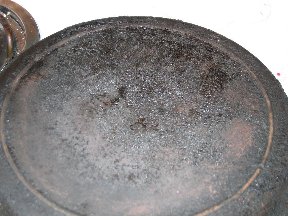 I remember she and my mother cooking on these kinds of pans, but I have no idea for life of me, what to do with them. The bottom/sides are caked with a carbon looking substance – even the handle has a little bit of it. I used a non-scratch utensil to scrape most of it off, but a good bit of it remains. There are what appears to be knife marks in the middle of the pan, almost as if a knife cut through the seasoning. The inside edges seem to hold a lot more oil/seasoning than the cooking surface. I have cooked in it one time (on an electric stove) and the bottom caught on fire! Of course my husband says “why would you want 50 years of baked on food to seep into your food?” – Bless his heart, he’s just a man!
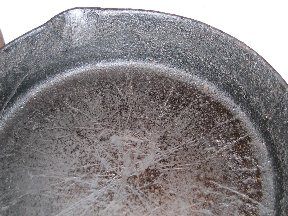 Can you tell me what my best options are. I have carpel tunnel, so scrubbing a lot is not really my answer. Unless of course I can “persuade” my husband. I read the part on your site about a self cleaning oven. Do you think that is safe? I would hate to ruin it after
she had it forever. Thank you so much for your help. – Julia Hoeschle
Answer:
Your pans look just like how mine did when I first got them, Have your husband help you and do what my husband did: My husband hand sanded them until smooth and removed the burnt coating and rust. I then seasoned the pans. They are now my favorite frying pans and I wouldn’t trade or loan them to anyone!
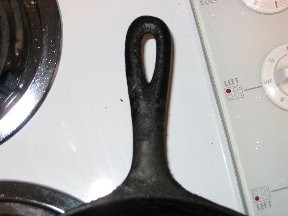 I have never tried the method of cleaning in them in the self cleaning oven. It would not hurt to give it a try. Please let me know how your pans turn out. Just remind your husband that if these were his grandmother’s pans, how would he feel.
Feedback:
Thanks for your help. I was almost so scared I would ruin them that I didn’t want to do anything to them. I will let you know!
Question:
Just found your site and have read quite a few similar tales. I dove into rust removal before thinking.. and was wondering, you buy a skillet and it is black. Is there a coating on it that is required to be there?? I pulled out the angle grinder and 100 grit sanding wheel and sanded off the rust… and black. Now I have this shiny silver skillet. Will seasoning take care of it from here or do I need to have it recoated?? I am about to throw it in the oven now.. what do you think? – Kent (10/31/05)
Answer:
When you purchase a “new” cast iron skittle, they are not black. They are a gray or silver color. The black comes from using your pan over and over. I would suggest that you season your pan “several” times to help get the coating back. It might take awhile, but the pan is still ok to cook in. the more you use it, the quicker it should start turning black.
Question:
I found your website and it has sort of answered my questions but not quite. I recently ‘found’ one of my grandmothers old skillets, it is quite large and I have to use both hands to lift it (it’s about the size of a round BBQ grill). It is no wonder it has been packed away for at least 30 years and she has had it probably at least 30 years before that. Of course it’s severely rusted now, inside and out. My questions are what is the safest method of cleaning the layers of rust off? Would it be safe to use an air pressure sander? What grade of sandpaper?
I have three iron skillets, the other 2 are 9 inch and I use them all the time. The big one and one of my small ones have a ring around the bottom of the pan, grandma used them on her old wood burning stove when mom was little (60 years ago) and it would break my heart for anything to happen to them. Mom cracked one of my other ones, it was a 12 inch, when she put pine sol in it instead of vegetable oil.. My pans are safe now, she is not allowed to cook! Thank you for any advice, it’s greatly appreciated. – Lora (9/20/05)
Answer:
I would not use an air pressure sander, as it might do too much sanding. My husband used a hand orbital sander, because he had more control that way. He thinks he used sandpaper of 70 or 80.
Question:
My cousin asked that I bring my 2 cast iron frying pans to our family reunion–one is still OK, but she scraped even some of the black finish off the one I inherited from my mother. What to do? Thanks in advance for your help! Here is a picture of the pan, hope you have some ideas. – Linda (8/5/05)
Answer:
Your cast iron pan does not look that great! My favorite cast iron pans that I use all the time looked a lot like yours at first. My husband hand sanded them until smooth and removed the burnt coating and rust. I then seasoned the pans. Give this a try.
Question:
Hello…. I just purchased some cast iron fry pans and I an having a problem seasoning them. No matter what I use to apply the solid shortening to the pan… it leaves lint with the shortening. Any suggestions? Do I have to smooth them out first?
They are brand new… I tried “seasoning” them like you suggested but everything I used from a paper towel to a dish towel (lint free supposedly) left lint in with the shortening. The pans feel a little “rough” (very slightly) but I thought that would be “normal” with your description of the “rough” portion that needs to fill in with seasoning. I was wondering if I need to use a scouring pad on them to see if that would “smooth” them out a bit but I don’t want to harm them. I did put the Crisco on with just my fingers but I think I put too much on… the grease turned kind of golden… maybe I had it too hot?… or baked them too long?….and they got sticky. Thank for all you help! Thanks for your interest… I LOVE your web site! – Diane (7/13/05)
Answer:
If you pans feel a little rough, how about sanding them a little? The roughness is my you are getting the lint. I always want my pans to be smooth. My husband used a his electric sander to smooth mine out. If the grease turned golden, just use some paper towels and wipe it out. If it is sticky, try washing the pan with soapy water, but do not leave the pan in the water. Repeat seasoning steps.
Feedback:
Thanks again so much Linda… I will try a little light sanding then. It has been YEARS since I have had to deal with new cast iron pans. These are for my 27 year old son. He wanted mine but I said “No way!”. I wish you great success in your web site. It was a good feeling to know the information was out there. I will give my son your site for the maintenance of the pans. Again Thanks so much!
Hints and Tips from Stephanie (4/19/10):
My hint is to either wash and dry her hands and then use her hands to apply the oil or to place the liquid oil of her choice into a small spray bottle (the kind they sell for a travel sprayer in the drugstore) and just spray it on. Either of those methods will apply a nice thin layer of oil to the pan.
She can have the oven door open and ready to just pop the pans into it just prior to this process, and a paper towel sitting nearby to grab after putting the pans into the oven and that way she will not get grease on the oven door handle nor will she have lint in her pan.
Question:
I read your article about restoring cast iron skillets. I recently found one very badly rusted in one area of the pan. Water had been sitting in it with the pan at an angle. After removing the rust at work with a bead blasting unit, I have found an area is pitted quite badly. Is it necessary to sand the bottom of the pan smooth in this area? This would cause a low spot in the pan where a fair amount of the metal would have to be removed. Your help will be appreciated. – Stanley Coleman (10/20/02)
Answer:
Because my husband is the one who sand-blasted my cast iron pan for me, I asked him your question. He said: “Because the pits are on the bottom of your pan and not inside, and you have removed the rust on the pan, the pits will not hurt.” I hope this helps you and I am understanding your question correctly.
Question:
I read the segment on cast iron skillets. I acquired a cast iron skillet that has rust inside and outside. My question is after I scrub off all of the rust do I season the outside of the skillet as well as the inside to protect the outside for rusting again? The skillet is entirely covered with rust, top to bottom, inside and outside. Thank You. – Kendra Simmons (7/31/03)
Answer:
Season both the inside and outside of your cleaned cast iron pan. Do it several times.
Question:
Hi! I just stumbled across this website as I was looking for help with my cast iron skillet. I left my much-loved, used-daily skillet on a hot burner and threw a plastic microwave lid in it. The plastic melted to the surface of the skillet. I was able to scrape most of the plastic out while the skillet was still hot, but now I have a fine layer of plastic on the bottom of the skillet. Have I ruined the skillet forever? Help! Thanks, Sarah Steen (8/26/05)
Answer:
I would do some more sanding to remove the layer of thin plastic. Once sanded, re-season your cast iron pan.
Feedback:
Thanks so much! I reheated the pan, then wiped and wiped as much as I could then sanded lightly. I did not actually end up losing too much of the carbonization, so when I re-seasoned it looked great. -Thanks again, Sarah
Check out all my web pages on cast iron pots, kettles, and Dutch ovens:
Main Page:
The Irreplaceable Cast Iron Skillet
Question & Answer Pages:
Ceramic Top (Flat Top) Electric Range and Cast Iron Pots
Hot Fire for Curing & Cleaning
Iron and Carcinogens in Cast Iron
Self-Cleaning Oven for Cleaning & Seasoning
Warped or Cracked Cast Iron Pots
16 Responses to “Sanding Cast Iron Pots”
Terry
I have two Lodge camp dutch ovens, 10″ & 12″. I bought both at the same place and time and have treated them the same. When I coat each of them with olive oil and a paper towel, the towel picks up a black residue on one and not the other. I have cooked with them often and cleaned them both repeatedly by boiling water and scrubbing them with a Lodge brush designed for cleaning cast iron. They look like they should and the food doesn’t have any off flavors, but I can’t seem to get rid of the black residue on the 12″ DO. Suggestions?
Linda Stradley
It sounds like you need to sand your cast iron pan and then reseason.
Tim Walsh
no need to sand!! the “black goo” is carbonization from the cooking oil when it polymerizes. Simply wipe it out.
you should -never- have to sand, wire-wheel, or grind your cast iron unless you find a piece that has been sitting, and the cooking surface has started pitting. otherwise there is no need to resurface any cast iron pan!
Whats Cooking America
Sanding is recommended for old pans to remove rust.
Joy
Hello… I have my Great Grandmother’s cast iron skillet, it is great on the inside, no rust, however, it is increasingly becoming rough on the outside. Almost as if oil has spilt over and burnt on. Although, I don’t recall that ever happening. My question is, I do not have a power sander, or drill type tool, can I sand my skillet by hand? If so, what gauge paper should I use? I am familiar with the seasoning and re-seasoning process, so I know that I will need to re-season.
If I could just also, add some input.. one of the previous comments said that her pan got sticky after oiling with Crisco and baking… this has happened to me if I used any oil product with butter, i.e.: Butter flavored Crisco, or Butter flavored cooking spray… just a thought…
Linda Stradley
My husband used a his electric sander to smooth my cast iron pan out. If the grease turnes golden, just use some paper towels and wipe it out. If it is sticky, try washing the pan with soapy water, but do not leave the pan in the water. Repeat seasoning steps.
Because the pits are on the bottom of your pan and not inside, and you have removed the rust on the pan, the pits will not hurt. Please check out my article on cast iron pans:
Jay
We’ve resurfaced our Lodge Cast Iron griddle with wire brushes using a drill followed by sanding down to a smooth surface. Then seasoned it with Avocado oil (because of its 500 degree smoking point). The problem is that following all of this whenever I wipe the griddle with a paper towel, I repeatedly get residue coming off the griddle. So much so, I don’t want to use it for food. Any advice would be so appreciated.
Linda Stradley
I always get a small amount of residue when I reheat my cast-iron griddle and lightly coat with oil before using. I just wipe it off with the oiled towel. Once the pan is hot, I have no residue coming off on my food. Basically, I am re-seasoning my pan before each time I use it.
Kathy Smith
Good work! Thanks for sharing this content. I know Cast Iron Skillet Question and Answer. This content helping for others. I think next time we want more interesting content from you. I am waiting for your next content.
Marge Liesenfeld
I recently purchased an old Wagner skillet. I have cleaned off the built up residue and rust. There is some pitting and rough spots on the inside that are below the level of the surface of pan if that makes sense. Is using a wire wheel the best way to address this? I’m confused on whether you should only use sanding etc if it is for build up. Will it damage the pan further trying to sand these areas?
Samantha Kurilo
I have two Lodge pans that belonged to my mother who passed away a few years ago. The seasoning is shoddy and uneven/flaky but they are black as night caked with 40+ years of seasoning. I really want to strip them down, sand them to remove the pits and re-season them but am terrified of ruining her pans. I would love to pay someone to do it professionally but apparently that doesn’t exist. What is the best way to remove such a thick layer of seasoning? the more hands off the better. I have a drill, what kind of sanding attachment could I buy/use? What oil is the best for creating a completely new layer of seasoning?
Robin
Hello Cast iron guru,
I purchased a second hand cast iron pot/Dutch oven. It was very black, so I thought it was seasoned. I tried to cook with it & it smelled like burning plastic. I washed it really well & soaked it & the inside got rusty, but I thought I had it… I tried cooking with it again. I think they spray painted it, so it would look better.
Anyway, I bought paint stripper & was going to use that, but then thought of sand blasting. I called a Autobody shop & they said it would be $40… so, I got a circular wire brush & remover a lot of the black- under is a nice shiny grey. I did this twice to try & get rid of it all… but, when I boiled a bit of water, it still smelled. What do you suggest?
I was going to try a fire (trying to avoid chemicals), but this site says it isn’t good…
I really want to use it, as I have chronic low iron & get lots of iron fm my cast iron pans.
I look forward to your suggestions,
Robin
Nancy
It sounds like you have tried everything to refurbish this pan, it may be time to give up on it and buy yourself a good quality cast iron pan. I don’t know what brand you have, but there are a lot of knock offs made with other materials and poor quality. I bought one once at a discount store, cleaned it and started to season it and it just started to crumble. I learned my lesson and I only stick with tried and true brands.
Thank you for taking the time to write and for visiting What’s Cooking America.
Nancy
David
Nancy, Thank you for your good advice. We got an old Findlay skillet from a neighbor’s estate that was in good shape but needed to be cleaned. After trying several approaches I used a combination of an electric disc sander with #80 paper and a wire wheel brush drill bit for the details. I seasoned it five times with vegetable oil at 500 degrees for 30 minutes. I put in a drip pan in the oven but nothing came off the skillet. I haven’t cooked with it yet but it looks great.
Susan K Leekley
I got a brand new cast griddle for Christmas i forgot the brand… but I came and it’s all pitted! I seasoned it right away although it was supposed to already be seasoned…I just tried cooking hash browns on it and they stuck! Can I sand it down to get rid of the pits?
yt1S
Great tips on restoring cast iron pots! I never realized sanding could make such a difference in the cooking surface and overall appearance. I can’t wait to try this technique on my grandmother’s old skillet. Thanks for sharing!