
Brining is the secret that chefs use for a perfect juicy chicken and turkey every time
How to Brine Turkey: It is very easy and economical, and requires no special cookware to end up with the perfect turkey.
Why Should You Brine Turkey? Brining is like a marinade – It is a salt water solution that changes the structure of the muscle tissue in the meat which allows it to absorb water, and your choice of spices, flavorings and aromatics, which results in a tender turkey or chicken once cooked. By nature, turkey is a lean meat. Brining gives the turkey the extra moisture during cooking and extra flavor that will make it your best turkey dinner ever.
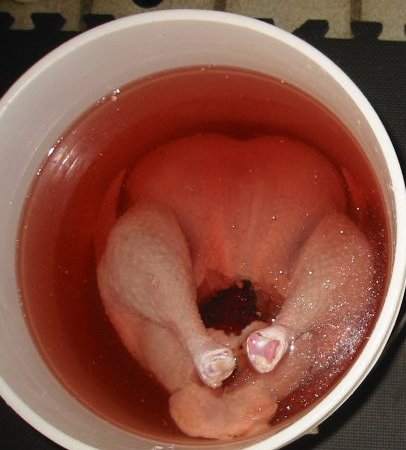
Everyone wants to eat a tender, moist, and flavorful turkey for their Thanksgiving dinner – Give it a try; I will tell you exactly what steps to take and you can experiment with the spices and flavors.
How to Brine Turkey in 5 Easy Steps
1. Selecting Your Turkey
2. Brining Recipe
3. Flavoring Options
4. How to Brine-Technique
5. How Long to Brine
Selecting the Turkey for Brining:
When purchasing a turkey for brining, choose a natural turkey (not a self-basted bird that has been injected with a solution of salt and other flavorings). Look for the words “natural” or “no additives added.” Choose a 12- to 20-pound turkey. If the turkey is frozen, thaw according to the package directions before brining.
Remove the giblets from the neck cavity and the neck from the body cavity (save in the refrigerator or freezer for making Perfect Turkey Giblet Gravy). Blot the turkey with paper towels, trim away any large areas of fat or excess skin around the body cavity. Per USDA Guidelines do not wash your turkey. Washing your turkey can cause cross contamination in your kitchen. Be sure to wash your hands with warm soapy water before and after handling the turkey.
Choose a container large enough to hold your turkey and brine mixture, plus it must be able to fit either in your refrigerator or a large cooler.
Your turkey is now ready for brining.
- 3/4 cup coarse salt or kosher salt
- 3/4 cup granulated sugar
- 1 cup boiling water
- 1 gallon cold water
- 1 tablespoon black pepper
- Apple juice or cider
- Bay leaves
- Favorite dried herbs and spices (sage, oregano, thyme, basil, cloves, cinnamon, etc.)
- Black peppercorns, cracked
- Lemon or orange slices
- Cloves of garlic, crushed
- Beer
- Sugar (granulated, brown sugar, or maple syrup)
- Whole Turkey: A heavy-duty large food-grade plastic, stainless steel, or glass container 5- to 6-gallon. Large brining bags may also be used. Weight with a plate, if necessary, to keep the meat fully covered by the brine. See above How To Refrigerate Poultry During Brining.
- Chicken: Stainless-steel bowl or resealable plastic bag can work as a brining container, as long as the poultry is fully submerged. Weight with a plate, if necessary, to keep the meat fully covered by the brine.
-
Determine How Much Brine Is Needed:
To determine how much brine you will need, place the poultry (chicken or turkey) to be brined in your chosen container. Add water to cover. Remove the poultry and measure the water.
Brining Directions - How To Make Poultry Brine:
One of the great things about brining is that there are so few rules. Most brines start with water and salt — traditionally, 3/4 pound of salt per gallon of water, but since we are not concerned with the brine as a preservative, you can cut back on the salt. The amount of brining time is likewise not set in stone. Even a little brining is better than none.
Dissolve salt and sugar in the boiling water. Add it to the cold water; add pepper and stir to combine.
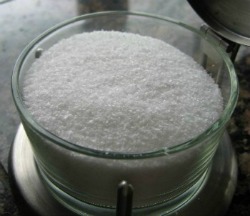 What type of salt to use in brine: Kosher salt and table salt (without iodine) are the most common salts used in brining. Sea salt can be used, but it tends to be quite expensive. I usually use coarse kosher salt.
A cup of table salt and a cup of kosher salt are NOT equal. Table salt weighs approximately 10 ounces per cup and kosher salt weighs approximately 5 to 8 ounces per cup (depending on the brand). If using kosher salt in a brine, you must use more than 1 cup to achieve the same "saltiness" you would get from 1 cup of table salt.
To learn about different types of salt and how to use them, check out the article Salt - The Spice of Life.
Table Salt (without iodine) - use 1 cup
Diamond Crystal Kosher Salt - use 2 cups
Morton Kosher Salt - use 1 1/2 cups
What flavorings to add to brine – You can add flavor in all sorts of forms such as herbs and spices.
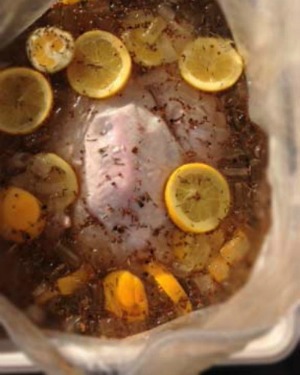
Flavoring Options:
Use brown sugar, honey, or molasses in place of the sugar (some sweetness tends to offset a saltiness the brine might otherwise impart).
You can also use apple juice, cider, orange juice, beer, wine, rice wine vinegar, apple cider vinegar, stock, tea, or other liquids to replace some or all of the water.
You can also put together decidedly Oriental flavorings with soy sauce or the Japanese rice wine mirin. In other words, be creative with the flavorings!
How To Brine Turkey:
Refrigerate Turkey While Brining – Refrigeration is absolutely required during brining:
The main logistical problem with brining is that you need a container that is large enough to submerge your turkey in the brine, but will fit in your refrigerator or cooler. The meat and brine solution must be kept below 40 degrees F. at all times. Since brining does not preserve meat, the turkey and brine must be kept refrigerated at all times.
Refrigerator – If storing the poultry in the refrigerator during brining, check to make sure that the container will fit in your refrigerator first! A container large enough to hold a whole turkey might be too big for your refrigerator.
Picnic Cooler – First, choose a cooler that is large enough to keep the turkey completely submerged during the brining process. It is important to thoroughly clean and sanitize the cooler before and after use.
You must keep the poultry and brine cold without diluting the mixture when using a cooler. Put the meat and brine directly in the cooler, then place Ziploc bags filled with ice or reusable gel packs into the brine solution.
Another approach is to put the turkey and brine into a turkey oven roasting bag or brining bags inside the cooler, and then pack ice or gel packs around the bag.
Monitor the temperature of the cooler (using a Digital Thermometer) to make sure it stays below 40 degrees F. at all times.
Turkey Brining Bags:
Use large brining bags. These brining bags are very easy to use and take up less room in your refrigerator or cooler. Bags are sold large enough to hold a 20-pound turkey. Every now and then, turn the bag around and upside down to ensure even brining.
For brining chicken, I use either small brining bags or regular resealable plastic bags.
How Long To Brine Poultry:
It is possible to end up with meat that’s too salty for your taste. To avoid this, brine on the low end of the time range on your first attempt. You can always brine longer next time, but there is no way to salvage a piece of meat that hass been brined too long.
Whole Chicken (4 pounds) – 4 to 12 hours
Chicken Pieces – 1 to 1 1/2 hours
Whole Turkey – 1 to 2 days
Turkey Breast – 5 to 8 hours
Cornish Game Hens – 1 to 2 hours
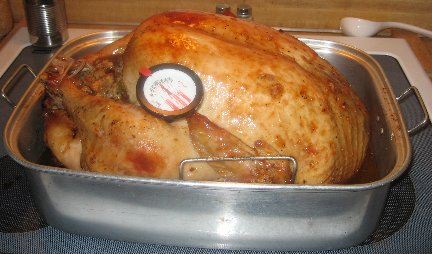
Do not salt brined poultry before cooking. Cook poultry according to your favorite recipe. Do not overcook your brined poultry. Once brined, the poultry cooks faster, so be careful and use a Meat Thermometer inserted into the thickest part of the meat.
Turkey Cooking Techniques:
 Guidelines For Roasting a Whole Turkey – Learn how to safely and easily prepare and roast your turkey.
Cajun Fried Turkey – This way of cooking your turkey is anything but greasy as the deep-frying process seals the outside and the turkey remains incredibly juicy, while the skin gets wonderfully crispy.
Barbecued Turkey – Avoid the mess in your oven and use your barbecue.
Outdoor Turkey Pit Cooking Recipe – Turkey In the Hole Recipe – This style of pit cooking is also know as “Bean Hold Cooking.” If you have the time and place to cook your holiday turkey in an outdoor pit, wouldn’t this make a great Thanksgiving or Christmas turkey dinner.
Smoked Turkey – Enjoy the delicious smell and taste of the smoked turkey.
Planning your Thanksgiving dinner:
Thanksgiving Day is the time to gather with your friends and family, turn on some football, and enjoy your Thanksgiving meal. Plan ahead and have a wonderful stress-free Thanksgiving dinner:
Thanksgiving Turkey – Do you know that a frozen turkey is fresher than a fresh turkey? Hints and tips on preparing your Thanksgiving turkey.
Thanksgiving Planning – Have a Stress-Free Thanksgiving – The Thanksgiving dinner is a simple meal to prepare. All it takes to pull it off is some advance planning. The best advice is to write down everything you will do and then prioritize according to your needs and schedule. And, above all, give yourself ample time to prepare everything; do not “rush things.”
Thanksgiving Turkey Dinner Menu (with recipes) – Check out some ideas and recipe for your Thanksgiving dinner menu.
Categories:
Brining Cooking Lessons - Cooking 101 Holiday Turkey Dinners Holidays & Events Turkey Turkey Hints & TipsComments and Reviews
Leave a Reply
27 Responses to “How to Brine Turkey”
Karen
Extremely helpful and easy to follow. I will most definitely brining my turkey.
Mandy
I brine my turkey every year! No more dry turkey sooo good
Cecilie
Why remove cut/remove so many things from the turkey before brining? Is brining useless if that’s not done first?
Linda Stradley
You are just trimming away any large areas of fat or excess skin around the body cavity, and cutting off the tail. That is all!
Patty Pugh
I brined a turkey once. It was too salty for me. Can you rinse it after you brine it?
Linda Stradley
You could lightly rinse the skin of the turkey, if you so desire.
Joyce Fotis
You HAVE to rinse the turkey thoroughly after brining and then pat dry with paper towels after.
Brenda
Tried this method last year for the 1st time and it was the most rewarding. The turkey was juicy and delicious. The family enjoyed ever single piece whether you like light or dark meat it was boosting with flavor. Great Recipe will try again this year!!!! ENJOY!!!
Mike
If I pat dry the turkey can I deep fry it afterwards
Linda Stradley
Remove the turkey from the brine, rinse and pat completely dry. Allow to sit at room temperature for at least 30 minutes prior to deep frying.
Susan
Can I substitute stevia for the sugar in the brining recipe? I’m on a ketogenic lifestyle
Linda Stradley
I have never tried doing this, so I can not be certain. I do not see why it would not work. If you trying doing this, please let me know how it turns out. – Linda Stradley
Brandi Wright
I would not recommend using stevia in place of sugar, stevia has a weird flavor plus the bird is not cooked in the brine so little sugar will be left in the cooked bird. I use maple syrup and honey instead of sugar which works well and is sweeter so you do not need as much and apple cider.
Michael S
I’ve brined whole turkeys for the past 6 years, playing with the amount of salt used, and using something different than water. My favorite combo is brown sugar, 2/3s the listed salt, and apple cider. Always imparts a fantastic flavor throughout the meat, right down to the bone, and comes out so tender. I usually slow smoke the meat using a gas grill, and apple-wood chips. Yum!
Greg H
Will injecting turkey after brining help or hurt the turkey’s flavor/moistness?
Rachel
Can I spatchcock cut the turkey before brining?
Lynn
I left my brine out on the stove to cool for 24 hours, is it still ok to use?
Nancy
The brine should be good
Vonnie
One is never to old to learn something new! Thoroughly enjoyed the turkey this year, as did my family. Thank you so much!
Jane Smith
I cooked a brined 28 pound turkey recently at 350 degrees for 4 and an half hours, It was completely over done! How could this have happened? Every chart said 5, 6 or 7 hours of cooking time was needed, My meat thermometer registered the correct temperature at 2 hours but I couldn’t believe that it was correct. I cooked the bird breast side down.
Lisa
I tried this method except for the boiling part since I thought it was unnecessary. First time brining and I would do it again. Used a brining bag which was a great idea. We also had a large soup pot and the 20 1/2 lb turkey fit perfectly. I would add a few herbs next time.
Susan H.
Why not iodized salt for brining?
Kelly D
Best bringing guideline ever. Been using it now for 5 years…and trying different flavors every year
Nancy
Kelly, glad you like it, and thank you for visiting What’s Cooking America, Merry Christmas!
Nancy
Kathleen Gutierrez
A timeless article that is so helpful. This is the second year using these guidelines. Thank you for sharing!
Nancy
Glad we could be of help. Happy Thanks giving!
Paul
Are you supposed to rinse the Turkey when taking out of the brine before roasting ?