
Questions and Answers – What is an Satsuma Orange
Question:
Can you tell me what a “satsuma orange” is? Is it a type of orange? I find it listed as Satsuma Orange Butter Sauce. Thank you for your help. – Dee Nixon (3/12/02)
Answer:
Information below from Florida Cooperative Extension Service, Institute of Food and Agricultural Sciences, University of Florida.
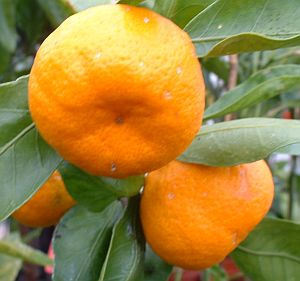 Satsuma [sat-SOO-muh] – A loose-skinned orange, it is a type of seedless mandarin orange with thin skin. In most citrus producing areas, satsuma mandarin is the preferred name, but satsuma tangerine is also used.
Grown in cool subtropical regions of Japan, Spain, central China, Korea, Turkey, along the Black Sea in Russia, southern South Africa, South America, and on a small scale in central California and northern Florida. The world’s largest satsuma industry is located in southern Japan where climatic conditions are favorable for the production of early ripening satsuma tangerines of high quality. In the United States, it is grown mostly in the southernmost parishes of Louisiana.
The fruit from a young tree averages 1.8 inches in diameter, approximately three-quarters the size of a tennis ball. With its smooth, thin, lightly attached skin, satsumas have become known as the “kid-glove or zipper-skin citrus” due to the ease with which the skin can be removed and internal segments separated.
Depending on the weather and climate conditions, the fruit is harvested in the early to mid-fall. The fruit is juicy and very sweet, low in acid, and almost seedless, with an average of only 1.5 seeds per orange
History: Satsuma mandarin may have originated in China but it was first reported in Japan more than 700 years ago where it is now the major cultivar grown. It was first introduced in the 1800’s by early settlers along the banks of the Mississippi River near New Orleans.
The ‘Owari’ Satsuma arrived from Japan, first in 1876 and next in 1878. During the period 1908-1911, nearly a million budded trees from 1908 to 1911 for planting in the Gulf States. The first recorded introduction into the United States was in Florida by George R. Hall in 1876. The name “satsuma” is credited to the wife of a United States minister to Japan, General Van Valkenberg, who sent trees home in 1878 from Satsuma, the name of a former province, now Kagoshima Prefecture, on the southern tip of Kyushu Island, where it is believed to have originated.
12 Responses to “Satsuma Oranges”
cindy mechir
I am interested in growing a Satsuma tree. is it possible in my area – northern Ohio – during our harsh winters?
where do I find the tree – thank you
Linda Stradley
I’m sorry but I do not know about growing the Satsuma tree.
Julie B.
Cindy,
Unfortunately, Satsuma trees do not survive hard freezes well. Northern Ohio would be too cold for growing this type outdoors.
Orangerie
This is why they had glass houses called , incidentally , in France Orangerie , the place where oranges are grown . You can plant your tree in a medium large pot and move it into a glass house for the winter months and back out for the warmer months . Another alternative , move south ! I personally prefer to live in cold climates , so understand your dilemma . Good luck.
Eileen Nevermind
Ha! Noooo
stephen prince
I have a satsuma tree which was planted about 3 years ago. Last season it produced 3 fruits. This season it produced 5 fruits 2 – of which were satsuma the other 3 were larger than normal and when opened they tasted like a lemon. Could it be that when the tree was in the nursery they used the root of a lemon tree to attach to a cutting?? Causing the tree to produce the orange and the lemon to grow together?? Confused.
Anthony cire
Sounds like a cocktail tree
P Lamb
large fruit on a satsuma is called ‘puffy’ and it’s caused by erratic late season fruiting and usually only happens to younger trees. As the tree ages you’ll get less unless there happens to be a dry early season and then a wet late summer, which can cause the tree to fruit later.
Karen L. Calanchini
. The pomelo is one of the original citrus species from which the rest of cultivated citrus have been hybridized. The Satsuma is a hybrid .
Mark Lurie
Are satsuma mandarins similar time sumos?
Anne
Cindi Merchir I live in Florida and can grow the satsuma tangerine but I want my lilacs from Ohio !! Cindy we need to grow for each other !! Lol We left OHIO in 1980 and I miss my spring flowers so much :(( MY HUSBAND LOVES FLA. I MISS OHIO !!
Sincerely,
Anne Shepherd
brando n calaguio
will satsuma arrange grow in the philippines? aye planted one last year now its already one year old and about 5ft tall. grafted how many years could bear fruit.