
Types of Avocados
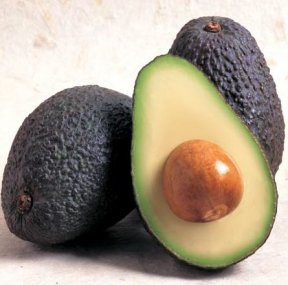
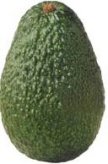
The two most widely marketed avocado varieties are the rough-skinned, almost black Hass and the smooth, thin-skinned green Fuerte. The Hass has a smaller pit and a more buttery texture than the Fuerte.
Purchasing and Using Avocados
Avocados must be used when fully ripe. They do not ripen on the tree and are rarely found ripe in markets. Fresh avocados are almost always shipped in an unripe condition.
To test for ripeness by cradling an avocado gently in your hand. Ripe fruit will yield will be firm, yet will yield to gentle pressure. If pressing leaves a dent, the avocado is very ripe and suitable for mashing. They are best served at room temperature.
To avoid choosing an avocado that is brown inside, check the stem end of the fruit. Look beneath the edge of the brown button left from the stem. If it is bright green beneath, that avocado is a pretty green inside. If it is brown, do not buy it.
Wash your avocados first. Even though you will not use the skin, when you cut through the skin with a knife germs and bacteria can transfer onto the knife which can go through to the meat of the fruit and contaminate it.
When the avocado is cut, the flesh turns brown because of oxidation. You can counteract the brown by adding an acidic substance, such as lemon, lime juice, vinegar, or tomatoes.
Refrigerating Avocados – Tips on ripening avocados:
 To ripen avocados slowly, put them in the fruit bin of your refrigerator.
Avocados can be kept in your refrigerator for up to two weeks this way. They will ripening very slowly, so when you take them out of the refrigerator they will be ready to eat in a couple of days.
Once avocados are at a desired stage of ripeness, they may be refrigerated for up to 2 to 3 days.
Yes – You Can Freeze Avocados!
Avocados are best frozen as puree. You can freeze mashed fresh, ripe avocados if you want to have an “emergency supply” of avocados on hand for guacamole.
Now you can buy them in bulk and FREEZE them! So stock up on avocado when you see a sale at your grocery store.
The texture of the avocado is the same as a fresh avocado once it thaws. Eating slices of once frozen avocado probably will not be your favorite way, but they work great for making guacamole, smoothies, salad dressings, and spreads.
To freeze, mash the avocados with a fork or your blender. Add some lime or lemon juice and mix well (this will prevent the flesh of the avocado from turning brown. For every avocado you need about 1 tablespoon of lime or lemon juice.
The best way to freeze the prepared mashed avocados is to use a freeze-weight zip lock bag. Fill the bag with the mashed avocado. Remove the air from the bag and then zip closed and freeze. You could also freeze the avocado puree in ice cube trays.
Thaw the frozen avocados in the refrigerator or place the container in a bowl of cool water to accelerate thawing.
Each avocado = 3/4 cup puree (12 tablespoons).
NOTE: Frozen avocado puree must be used within 4 to 5 months of freezing.
Did You Know?
An avocado is a fruit and not a vegetable! It is actually a member of the berry family.
In the past, the avocado had a well-entrenched reputation for inducing sexual prowess and wasn’t purchased or consumed by any person wishing to protect their image from slanderous assault. Growers had to sponsor a public relations campaign to dispel the ill-founded reputation before avocados became popular.
Avocados got their name from the Spanish explorers. They couldn’t pronounce the Aztec word for the fruit, know as ahuacatl, “testicle,” because of its shape. The Spanish called the aguacate, leading to the guacamole we know today.
Avocados must reach full maturity before they are picked, however, they do not soften on the tree. The tree can actually be used as a storage unit by keeping the fruit on the tree for many months after maturing.
Avocados are not just for guacamole. Although the yummy dip is probably one of their most popular uses, and my guacamole recipes (featured below) are fantastic, there are other reasons to love avocados.
Seeding, Peeling, and Cutting Avocados
Wash the outside (skin) of avocados! Even though you will not use the skin, when you cut through the skin with a knife germs and bacteria can transfer onto the knife which can go through to the meat of the fruit and contaminate it.
Start by cutting the avocado lengthwise around the seed with a sharp knife with a blade at least 2 inches longer than the avocado.
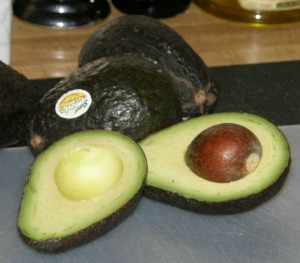
Place the avocado in the palm of your hand and insert the knife. Without moving the knife, roll the avocado around, slicing it top to bottom and back to the top. A gentle twist will separate the two halves of the avocado, exposing the meat and the seed inside. To remove the seed, carefully “hit” the seed with the knife so it pierces it about 1/4 inch or so. Turn the knife with the seed, and it will come loose from the inner flesh so you can easily lift it up and out of the avocado.
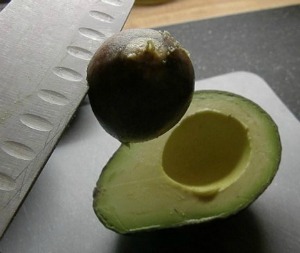
To remove the seed from your knife, pinch the seed by placing your fingers over the knife blade (blunt side) and squeeze as though you are pinching the end of the avocado. It should pop off from the knife and fall freely.
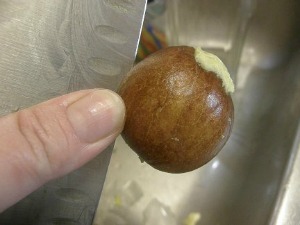
Avocados are easy to peel when ripe. Peel the fruit by placing the cut side down and removing the skin with a knife or your fingers (start at the small end and remove the skin), or simply scoop out the avocado meat with a spoon.
Score the inner meat with a small knife both horizontally and laterally. These will be the cubes when the skin is turned towards inside out.
If the avocado is ripe, flesh should fall out as the skin is turned. Repeat this with the remaining avocados. Place the cubes into a medium sized bowl.
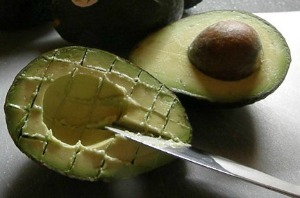
When the avocado is cut, the flesh turns brown because of oxidation. You can counteract the brown by adding an acidic substance, such as lemon, lime juice, vinegar, or tomatoes.
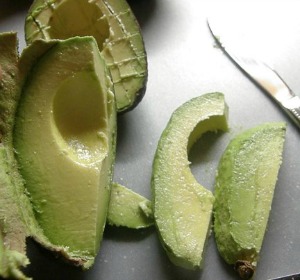
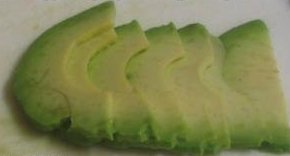
To slice, use your knife and make slices instead of scoring for cubes.
History of Avocados:
It is evident from miscellaneous reports by Spanish Conquistadores that, at the time of the Spanish conquest, avocados were grown from northern Mexico south through Central America into north-western South America and south in the Andean region as far as Peru (where the avocado had been introduced shortly before the conquest), as well as into the Andean region of Venezuela.
The Aztecs used the avocado as a sex stimulant and the Aztec name for avocado was ahuacatl, meaning “testicle.” In the pre-Incan city of Chanchan, archaeologists have unearthed a large water jar, dated around 900 A.D., in the shape of an avocado.
1518 – Martin Fernandez de Enciso (1470-1528), Spanish conquistador and cosmographer, wrote the first published record that describes the avocado in his book, Suma De Geografia Que Trata De Todas Las Partidas Del Mundo, as commonly grown near Santa Marta, Colombia. This was the first account in Spanish of the discoveries in the New World.
1519 -Spanish soldier of fortune Hernando Cortez (1485-1547) set foot in Mexico City, the first white man to do so. Cortez found that the avocado was a staple in the native diet
1526 – Fernandez de Oviedo (1478-1557), historian to the conquistadores, wrote the following on avocados trees he saw along the north coast of Colombia:”In the center of the fruit is a seed like a peeled chestnut. And between this and the rind is the part which is eaten, which is abundant, and is a paste similar to butter and of very good taste.”
1550 – The Spanish name, Aguacate, was first used by Pedro de Cieza de Leon (1518-1554), Spanish conquistador and historian, in a journal of his travels written in 1550. He noted that at that time the avocado grew in Panama, Ecuador, Colombia, and Peru.
1554 – The first mention of the avocado as growing in Mexico, was made by Francisco Cervantes Salazar in 1554. In his book Crica de la Nueva Espa (Chronicles of New Spain), he listed the avocado among fruits sold in the market of Tenochtitlan (the name for Mexico City at that time).
The Spanish conquistadors also discovered a unique use for the avocado seed. The seed yields a milky liquid that becomes red when exposed to air. The Spaniards found they could use this reddish brown or even blackish indelible liquid as ink to be used on documents. Some of these documents are still in existence today.
1672 -W. Hughes, physician to King Charles II of England, in his visit to Jamaica, wrote that the avocado was “One of the most rare and pleasant fruits of the island. It nourisheth and strengtheneth the body, corroborating the spirits and procuring lust exceedingly.”
1700s – European sailors in the 1700s called it midshipman’s butter because they liked to spread it on hardtack biscuits
1833 – Judge Henry Perrine planted the first avocado tree in Florida.
1856 -.The California State Agricultural Society Report for 1856 stated that Thomas J. White grew the avocado in Los Angeles.
1871 – In California, the first successful introduction of avocado trees was planted by Judge R. B. Ord of Santa Barbara, who secured the trees from Mexico in 1871.
1879 – The oldest living tree is found on the University of California, Berkeley campus and was planted in 1879.
1892 – In other southern California locations, avocados were planted by various people who introduced and planted seed from Mexico and Guatemala. In the early 1890’s, Juan Murrieta of Los Angeles became interested in the avocado and imported a large amount of thick-skinned fruit from Atlixco, Mexico. He distributed some of the seeds of these fruits among his friends and planted the others. From this group of seedling trees, came a number of the varieties that first attracted attention as promising commercial fruits.
1895 – In 1895, Young Charles Delmonico and Ranhofer introduced New York to the “alligator pear.” or avocado, which had been newly imported from South America. Ranhofer had known of the avocado — he mentions the avocado in his book, The Epicurean, which he published the previous year — but until 1895 he had been unable to secure a supply of the buttery fruit.
1911 – Frederick O. Popenoe, owner of the West Indian Gardens of Altadena, California, sent Carl Schmidt to Mexico (Mexico City, Puebla, and Atlixco) to search for avocados of outstanding quality and to locate the trees from which they came. Schmidt, who located what turned out to be the Fuerte as a dooryard tree in Atlixco, Mexico. Only one of the trees he brought back survived the great freeze of 1913 in California. This surviving tree was given the name Fuerte, Spanish for “vigorous.” Schmidt said, “Two years later came the big freeze. In the spring when we began to take stock of damage, it was the Fuerte that came through and it was the only avocado that survived. It thus proved itself adaptable to our temperatures.”
The Fuerte tree created California’s avocado industry.Carl Schmidt was compelled to tell and retell the story of his fortuitous discovery of the Fuerte avocado. “Popenoe was a nut — an imaginative, idealistic nut without which our nation would suffer and certainly make little progress.”
History of Hass Avocados:
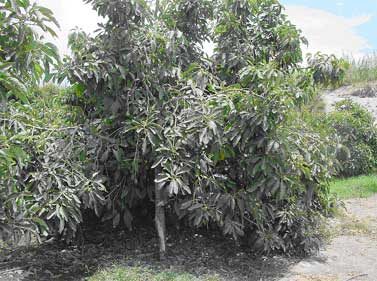 1926 – The most popular California avocado is the Hass (frequently mispronounced and misspelled as Haas), which weights about half a pound and has a pebbly black skin when ripe. Hass avocadoes are unique because they are the only avocado variety that is produced year-round. According to the California Avocado Commission:
The tree began life as a mistake – a lucky-chance seedling planted by A.R. Rideout of Whittier. Rideout, an innovator and pioneer in avocados, was always searching for new varieties and tended to plant whatever seeds he could find, often along streets or in neighbors’ yards. In the late 1920s, Mr. Rudolph Hass, a postman, purchased the seedling tree from Rideout, and planted it in his yard.
According to Paul Wilkes, son-in-law of Rudolph Hass, the California Avocado Commission’s statement is misleading:
“Rudolph Hass did buy the avocado seeds from Mr Rideout, but he planted them himself. Rudy had used all of the money he had to buy the land for his grove. He was only earning 25 cents an hour working as a postman so he couldn’t afford trees.
Mr. Rideout was noted for using any seeds he could get his hands on, including the garbage from restaurants. His selection process occurred when the seedlings were ready to graft. He would then destroy any weak seedlings. Rudolph Hass knew nothing about raising trees, but Mr. Rideout was very helpful to him and instructed him to plant three seeds in a cluster where ever he wanted a tree, and then pull up the two weakest seedlings and graft the strongest. For this reason, no one knows what kind of seed produced the Hass tree.”
Following are excerpts from 2004 article, How The Hass Avocado Came To Be, by Cindy Miller, granddaughter of Rudolph Hass:
My mom, Faith (Hass) Wilkes knows how the Hass avocado came to be, so I will share it with you . . . After reading a magazine article illustrated with an Avocado Tree with dollar bills hanging from it, Grandpa bought a small 1 1/2 acre grove in La Habra Heights in 1925. There were a few Fuerte avocado trees.
He planted the rest of the grove on 12 foot centers with three seeds in each hole. He hired a professional grafter named Mr. Caulkins, to graft cuttings from the existing Fuerte trees onto the strongest of the three trees from each hole. All but three “took”. The next year Mr. Caulkins re-grafted those three trees. The following year Mr. Caulkins re-grafted the one tree that had rejected the graft again. Again it didn’t take. Grandpa was ready to give up and chop the tree down, but Mr. Caulkins said it was a good strong tree. He advised Grandpa to just let it grow and see what happens. So he did. The Hass avocado happened. Grandpa Hass only planted the seed, Mr. Caulkins did the grafting, and God gave the increase.
Grandpa patented the Hass Avocado in 1935 but, since it was the first patent ever issued on a tree, it got no respect. Growers would buy one tree from Mr. Brokaw who had the exclusive right to produce the nursery trees. They would then re-graft their whole grove with the bud wood from that one tree. For that reason Rudolph Hass made only $5,000 royalties on his patent. However, he was the first to have a producing grove of Hass Avocados, all be it a very small grove. He found a ready market for the fruit at the Model Grocery Store in Pasadena where the chefs for wealthy people who lived on South Orange Grove Street shopped. Once they sampled the Hass variety, they insisted on it. My mom, her sister, and three brothers worked with Grandma and Grandpa harvesting and also sold avocados from a roadside stand by the grove at 430 West Road in La Habra, California.
Every Hass avocado tree today is descended from that original tree. There is a plaque commemorating the location of the parent tree but the tree died of root rot and was cut down on 9/11/2002 at the ripe old age of 76 (It was planted in 1926). That is very old for an avocado tree. The wood from the tree is stored at the nursery run by Mr. Brokaw’s nephew. Some of the wood has been made into jewelry, gifts, and keepsakes by Mr. Hass’s Nephew, Richard Stewart. He gave them to members of the Hass family and some members of the Avocado Growers Association.
Grandpa expanded to Fallbrook with an 80 acre orchard which bore its’ first crop in 1952 just as Grandpa Hass died of heart failure in the Fallbrook Hospital. However, Grandma Hass lived to the ripe old age of 98 after a lifetime of eating a half piece of wheat toast with avocado slices on it with breakfast just about every morning.
Patents expire after 17 years. When Grandpa filed for his patent in 1935 he prayed and asked the Lord to let him live as long as the patent was good. As a young man he had been rejected from service in WWI because of a congenital heart condition. He knew his ticker was not too good, yet he worked hauling those heavy mail sacks all those years. He passed away in 1952 a few months after his 17-year patent on the Hass avocado expired. Grandma Hass lived the rest of her life on the pension from Grandpa’s mailman job. Others saw the profit potential in the Hass avocado and have developed it into the industry it is today. Now we all enjoy its fruit.