
How To Make Fruit and Cheese Platters
Best Fruit and Cheese Platters – Entertaining frequently includes some kind of cheese tray, often with fruit or vegetables or meat or a combination of these foods.
If you are short on time you can, of course, buy a fruit and cheese tray at most good quality grocery stores or online. But if you do have the time, this is an opportunity to be creative and introduce your guests to some new cheeses. It is great fun!
This article on Fruit and Cheese Boards is courtesy of Donna Hager. Donna Hager has owned and operated a successful American-style restaurant for well over two decades.
Check out Linda’s Appetizer Main Index for more great appetizer ideas and lot of Cheese Recipes using different types of cheese.
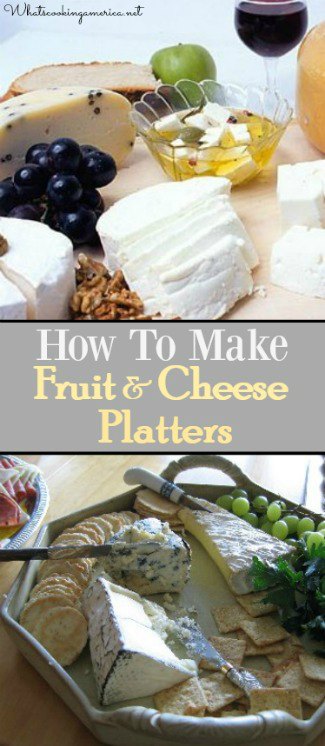
Serve at least three (3) and as many as five (5) cheeses. Having at least 3 to 5 cheeses allows me to offer an interesting variety without being too extravagant. Allow about 3 ounces of cheese per guest if we are just tasting or it’s an appetizer plate before a meal. If I want these as a main course I allow 6 to 7 ounces per person.
The other thing I like to do is select ones that combine styles, textures and colors (see “pairings” below). I like to offer different looks, tastes, and feels such as one soft-ripened, one hard and probably a blue. And if I am serving more than three cheeses, I like to add one or two with different flavor and color. Occasionally I will have a theme tray, such as all blues or all local ones.
When I have guests coming, I realize some are great cheese lovers and some are “beginners.” I try to offer a variety of flavors, with enough mild ones available so everyone can be accommodated. If my tray offered all “stinky” selections, some of my guests would have to stop at a fast food place on the way home.
I usually have a couple kinds of artisan breads or baguettes and interesting crackers, as well as apples, pears, nuts and dried fruit as part of the tray.
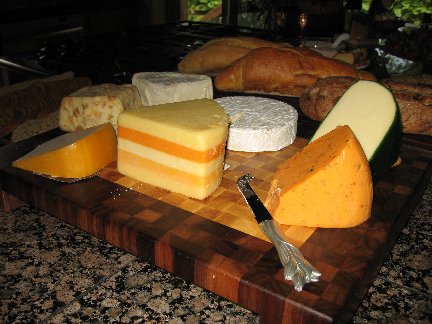
Arrange your cheese tray at least an hour or two before guests arrive, as all cheeses needs to sit at room temperature for full flavors to be enjoyed.
Provide one (1) knife for each selection so flavors don’t mingle.
Serve all soft ripened cheeses in wedges
Serve fresh soft cheeses like Brie, in the entire form and have a knife to cut and spread it onto crackers or bread
Semi-soft cheeses should be served precut in the size you desire
Semi-hard cheeses should be cut into wedges or cubes that expose the cheese to the air
Hard cheeses should be precut into pieces
Bleu cheeses should be served in chunks created by your cheese knife
Arrange cheeses with seasonal fruits cut into bit size pieces (this is also an opportunity to have a few nuts as part of your Fruit and Cheese Tray as well).
Don’t forget your tongs, cheese knives, cheese forks, utensils and/or wooden picks and serving plates and.
Don’t forget to have a great time!
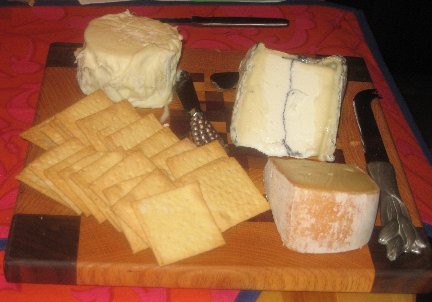
What Cheese types should you use and how much?
The number of cheeses you will need (or want to have) for your party tray depends on how elaborate you wish to make it and this often depends on what occasion it is for, who your guests will be and how many of them.
Only you can decide; I almost always have thee (3) cheeses on the tray:
 One (1) soft ripened such as Brie cheese that spread easily on a cracker and goes well with most fruits.
The term “soft-ripened” describes those that are ripened from the outside in, very soft and even runny at room temperature. The most common soft-ripened ones have a white, bloomy rind that is sometimes flecked with red or brown . The rind is edible and is produced by spraying the surface with a special mold, called penicillium candidum, before the brief aging period. Examples include brie and camembert styles and triple crèmes.
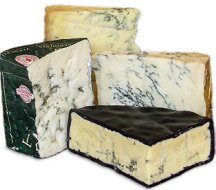 One (1) semi-soft such as a Bleu cheese (I like Stilton cheese) or introduce your guests to a smoked cheese variety.cheese
“Semi-soft” describes selections that have a smooth, generally, creamy interior with little or no rind. These are generally high in moisture content and range from very mild in flavor to very pungent. Examples include blue, colby, fontina styles, havarti, and Monterey Jack. Also, a lot of washed rinds fall into this category but are described separately below.
Bleu cheese have a distinctive blue/green veining, created when the penicillium roqueforti mold, added during the cheese making process is exposed to air. This mold provides a distinct flavor, ranging from fairly mild to strong and pungent. Blues are found in all of the categories above, except for Fresh. Common examples are the French (roquefort), the Italian (gorgonzola) and the Danish blues.
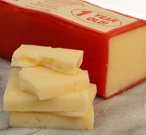
One (1) harder cheese such as a quality Cheddar or Gouda cheese.
This is a very broad category. Their taste profiles range from very mild to sharp and pungent. They generally have a texture profile that ranges from elastic, at room temperature, to the hard ones that can be grated. This category includes gouda styles, most cheddars, dry jack, Swiss (Emmenthaler) styles, Gruyere styles, many “tomme” styles and Parmesan styles.
Having three (3) different cheese types on a cheese platter is pretty standard. Five (5) cheeses is great for a large group and is considered more elaborate. Buy small amounts of different cheeses. This will allow you to introduce your guests to a variety of cheeses but will also ensure you do not have large amounts left over.
I like to select cheeses that combine styles, textures and colors. I like to offer different looks, tastes, and feels. And if I am serving more than three, I like to add one or two with different flavor and color. Occasionally I’ll have a theme tray, such all local cheese.
When I have guests coming, I realize some are great cheese lovers and some are “beginners.” I try to offer a variety of flavors, with enough mild ones available so everyone can be accommodated.
Cheese – Try new ones for fun – It is a fabulous gift!
Trying new types can really be fun …honest. You can try the products the way I like to. Find a gourmet shop and ask to sample some. It really is that easy!
Like wines and other fine foods, the best way to decide on your favorites is to taste them, and any good wine seller or cheese monger will be happy to provide a sample before you buy. You don’t have such a shop nearby, or sampling that way is not something you like to do, go to “Plan B.” You can join a monthly club. Try it. You’ll love it.
Another way to try different types (Plan “C”) is to invite a few friends over and ask each one to bring one they want to try and share.
Make up a tray or “tasting table” and have several wines or beers available to try with the product. You might want to set a theme for each time you do this. Have some fun!
Is there a Farmer’s Market nearby? You will often find local cheese makers there. This is really a fabulous way to learn. Most small cheese makers sell organic products. I am a believer in buying such product whenever I can find it. I am also fortunate in having several organic cheese makers near my home.
There are hundreds of types produced all over the world. But until recently it seems most Americans settled into buying the same four or five every time they went to the store. I believe this is just a habit developed as a result of not knowing what else to try. Cheddar, Mozzarella, Swiss, Parmesan and some Blues are “known” and “safe.”
Some time ago, even before I started the restaurant, I began trying different selections and found a number I really liked . I also discovered some that I really did not care for.
Often the ones I personally didn’t like were pungent or very strong-flavored. But then I learned something else. Some of these need to be eaten with certain other kinds of food or with certain kinds of beverages to be enjoyed.
Remember to take the cheeses you are using out of the refrigerator 30 to 45 minutes prior to serving so that they may reach room temperature.
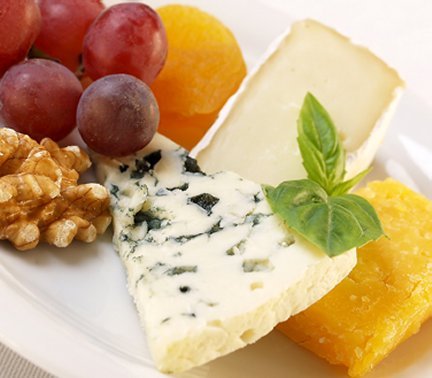
What Fruit To Serve?
Try for seasonal fruits, local fruit if available, and again have 3 to 5 different kinds of fruit. I frequently have grapes (sometimes two varieties), strawberries, honeydew melon and cantaloupe, kiwi, apples (usually two different kinds) and pears.
Something else to remember, especially if fresh quality fruits are not readily available: add some quality dried specialty fruits.
Cheese and Wine: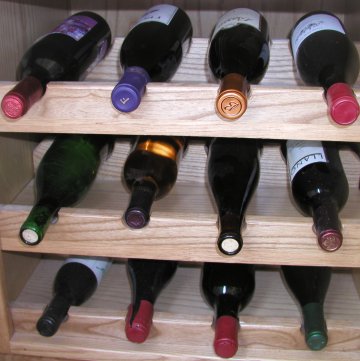
wine in wine rack Don’t worry about “rules.” There is only one as far as I am concerned: “try …try …try.” It is primarily a matter of personal tastes. Keep it simple. Remember, the goal of tasting with wine is to find a balance between the two and not “allow” one to overpower the other.
Serve full-flavored cheese selections, such as creamy washed rinds with medium to full-bodied wines, such as Merlot, Zinfandel, or Syrahs.
Pair lighter cheeses with light wines such as Rieslings, Pinot Gris, or Pinot Noirs.
Blue cheeses go well with dessert wines such as late harvest Viogniers and Rieslings and Muscat wines. Creamy blue cheeses pair well with sparkling wines and Champagne.
Fresh goat cheeses are mild and lemony in flavor and creamy in texture. They go well with white wines, such as a Sauvignon Blanc, Chenin Blanc, Pinot Gris, and Rieslings.
Aged sheep milk cheeses pair well with Gewürztraminers and fruity Zinfandels.
Remember that wines aren’t the only beverages that go well with cheese!
There is a growing number of artisan and craft beers, as well as craft ciders available that provide interesting and fresh flavor combinations.
Source: This article on Fruit and Cheese Boards is courtesy of Donna Hager and her website Real Restaurant Recipes. More articles and hundreds of recipes can be found on her website that features real restaurant recipes, menus, cooking tips, and much more.
4 Responses to “Best Fruit and Cheese Platters”
luna
this is a wonderful website
Nancy
Thank you Luna! We are glad that you like us and hope that you come back often.
Carroll Kyle
Great suggestions
nadine
I am having a wine tasting event for a happy hour after the wedding and before the reception. The information provided was so informative that I’m excited that I found it. I have a better idea of what I’m looking for and how to pair the cheeses with the wines. Thank you