
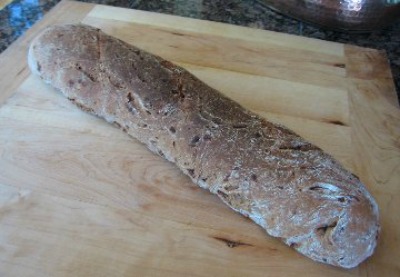
The sourdough starter gives moisture to this dark, dense Sourdough Raisin Pumpernickel Bread. This bread is delicious anytime of day. It is so good, that it has become one of my favorite bread recipes. I make a loaf every week.
Some people will say this is not true sourdough bread because I add some instant yeast. I add the yeast to speed up the rising time. This Sourdough Raisin Pumpernickel Bread still has the sourdough taste, and no one has ever seemed to know the difference.
Bread Making Hints: Secrets to using the bread machine, About yeast in bread making, and Sourdough Starter – How to make a Sourdough Starter.
More great Bread Recipes, Sourdough Bread Recipes, and Quick Bread Recipes for all your bread making.
- 1 cup sourdough starter, room temperature*
- 1/2 cup strong coffee, lukewarm (110 degrees F.)
- 1/2 cup water or milk, lukewarm (110 degrees F.)
- 1 tablespoon olive oil or vegetable oil
- 1 tablespoon molasses
- 2 teaspoons salt
- 1 tablespoon Dutch process cocoa
- 1 tablespoon caraway seeds
- 2 cups bread flour or unbleached all-purpose flour**
- 1 cup light rye flour
- 3/4 cup pumpernickel dark rye meal
- 2 teaspoons instant active dry yeast
- 1 to 1 1/2 cups raisins (according to your preferences)
-
Bread Machine Instructions:
-
Add all the ingredients in the bread pan of bread machine except raisins. Process according to manufacturer's instructions for a dough setting. Do not be afraid to open the lid and check the dough. It should form a nice elastic ball. If you think the dough is too moist, add additional flour (a tablespoon at a time). The same is true if the dough is looking dry and gnarly. Add warm water (a tablespoon at a time). During the last part of the kneading cycle, add the raisins; close lid and continue kneading process.
-
If you can not judge your dough by looking, stick your finger in and feel the dough. It should be slightly tacky to the touch. When the bread machine has completed the dough cycle, remove the dough from the pan to a lightly floured surface. Knead the dough several times and form the dough into an oval; cover with plastic wrap and let rest for 10 to 15 minutes.
-
Stand Up Mixer Instructions:
-
In a large bowl or in the bowl of a 5-quart stand mixer, add all the ingredients except the raisins. Using a dough hook, mix all the ingredients together into a uniform dough. It should form a nice elastic ball. If you think the dough is too moist, add additional flour (a tablespoon at a time). The same is true if the dough is looking dry and gnarly. Add warm water (a tablespoon at a time).
-
Turn the dough out onto a floured surface and knead until elastic, adding drained raisins, about 15 minutes. In an electric mixer, it should take about 9 minutes. Cover the bowl with plastic wrap and let rest for 10 to 15 minutes.
-
After resting, knead dough (see kneading tips below) on a lightly-floured board by pulling the dough towards you and then pushing down and forward with the palms of your hands (kneading gives the bread the elasticity and lets it rise).
-
Lightly dust your work surface with all-purpose flour or bread flour. Place a small mound or a measuring cup of flour near the work surface as you will use this flour to sprinkle over the dough as you knead to prevent sticking. Also dust your hands with flour to keep the dough from sticking to you.
-
Gather the dough into a rough ball and place on your floured work surface.
-
When you knead, you will use only the heels of your hands. Push down on dough with your hand heels.
-
Fold the dough in half. Turn the dough about 45 degrees and knead with your hand heels again. Continue to knead, fold and turn the dough for the required length of time or to the consistency suggested. I usually knead the dough around 5 minutes. Well-kneaded dough should feel smooth and elastic. Press your fingertip into the dough; it should spring back.
-
Place the dough in a lightly-oiled large bowl. Place a damp towel over the bowl and then cover with plastic wrap (the humidity in the bowl helps in the rising process). Let rise until it doubles in volume (when you can put your finger in the dough and it leaves and indentation and does not spring back out) approximately 4 to 8 hours (depending on the temperature and the starter used, the rising time can vary as much as 2 hours).
-
Oven Rising: Sometimes I use my oven for the rising. Turn the oven on for a minute or so, then turn it off again. This will warm the oven and make it a great environment for rising bread. If you can nott comfortably press your hand against the inside of the oven door, the oven is too hot. Let it stand open to cool a bit.
-
Cool or Refrigerator Rise: If I don't have the time to wait for the rise to finish or I know that I will be interrupted before the completed rise, I do a cool rise. A cool rise is when the dough is place in the refrigerator and left to rise slowly over night approximately 8 to 12 hours. I usually do this after the first rise and the dough has been shaped into a loaf.
-
After kneading, shape dough into a into a one-inch high circle and place on a jelly roll pan or cookie sheet that is dusted with cornmeal (I use the Silicone Baking Mats instead of cornmeal). Press sesame seeds into the surface of the dough and brush with olive oil. Cover with plastic wrap and place in a warm spot to rise until doubled in size, approximately 1 to 3 hours.
-
Preheat oven to 425 degrees F. After rising is completed, bake for 10 minutes. Reduce heat to 375 degrees F. and bake and additional 15 minutes or until loaf sounds hollow when tapped. (A good check is to use an instant digital thermometer to test your bread. The internal temperature should be between 200 and 210 degrees F.) Remove from oven and place the bread on a wire rack to cool.
-
When the bread is cooked, remove from oven and place the bread on a wire cooling rack to cool. Let baked loaf cool for 30 minutes before cutting (this is because the bread is still cooking while it is cooling).
-
Makes 1 large round loaf.
* If you don't presently have a sourdough starter, either make your own sourdough starter or purchase Packaged Sourdough Starter Mix by mail-order.
** The thickness of your sourdough starter can determine how much flour needs to be used. If you think the dough is too moist, add additional flour (a tablespoon at a time). The same is true if the dough is looking dry and gnarly. Add warm water (a tablespoon at a time).
 I get many readers asking what cooking/meat thermometer that I prefer and use in my cooking and baking. I, personally, use the Thermapen Thermometer. Originally designed for professional use, the Super-Fast Thermapen Thermometer is used by chefs all over the world. I only endorse a few products, on my web site, that I like and use regularly.
You can learn more or buy yours at: Super-Fast Thermapen Thermometer.
Sponsored Content
Did you know that the name sourdough comes from San Francisco and their famous sourdough breads? It is thought that French bakers brought sourdough techniques to Northern California during the California Gold Rush in the late 1800s. If you don’t want to make your own sourdough starter, you can buy a San Francisco sourdough starter from Amazon.
sponsored content
Categories:
Sourdough Bread
5 Responses to “Sourdough Raisin Pumpernickel Bread Recipe”
Karen T.
LOVE this recipe. It was a big, big hit in our house. I think there may be a misprint in the cooking times. Fifteen minutes at 375 does not get the job done. The instant read thermometer got to 200 degrees after about 40 minutes at 375. Thanks for this one; it’s a keeper!
Linda Stradley
After rising is completed, bake for 10 minutes. Reduce heat to 375 degrees F. and bake and additional 15 minutes or until loaf sounds hollow when tapped. (A good check is to use an instant digital thermometer to test your bread. The internal temperature should be between 200 and 210 degrees F.) Remove from oven and place the bread on a wire rack to cool.
Sadie
I find the directions a bit confusing. They read, “After kneading, shape dough into a into a one-inch high circle and place on a jelly roll pan or cookie sheet that is dusted with cornmeal.” Shouldn’t that read “after the first rise”? The dough has already been mixed, rested, kneaded, and risen till doubled.
Whats Cooking America
No the instructions have already been provided before this statement to mix, knead and let the dough rest for the first rising. This next step is for the 2nd rising.
Sadie
Excellent bread! The crumb is tender, moist and moderately open. Great flavor. I used a combination of unfed rye and white sourdough starters. The rise times were shorter than those noted in the recipe, and my bread was out of the oven 4 hours after mixing the dough. I baked it in a covered clay baker to an internal temperature of 206°. Wonderful toasted and plain.