
Finally there is a drink that is fun to eat – Bubble Tea!
Move over trendy coffee drinks and make way for the Bubble Tea craze!
Southerners have always known that nothing beats the heat quite like sweet tea. To the rest of America, drinking sweet tea is still a concept that is relatively new. Bubble Tea is a sweet tea that has moved beyond it’s roots in the predominately Asian community, gaining in popularity across the United States. It is especially popular with young adults along the west coast of The U.S. A., Canadian cities of Vancouver and Toronto, The Hawaiian Islands and New York City.
What is Bubble Tea?
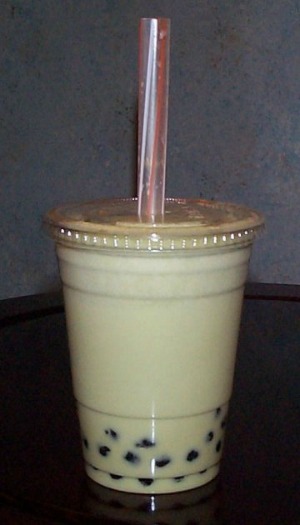 Bubble Tea is the known name for a beverage that has many unusual names. Other names include; tapioca pearl drink, tapioca ball drink, pearl shake, pearl tea, black pearl tea, big pearl, boba tea, boba ice tea, boba nai cha, milk tea, bubble drink, zhen zhu nai cha, momi, momi milk tea, QQ, BBT, PT, and many other names.
This drink is far from the sweet tea that you may be familiar with. It is hard to explain to the uninitiated just what they are about to drink. It is a non-alcoholic, non-carbonated cold tea beverage that is sweet, though it has less sugar than a typical soft drink. Bubble tea comes in a variety of flavors depending on the tea house or stand you visit. The drink contains a blend of tea, milk, sugar, and giant black tapioca balls. The “bubble” refers to the foam created by shaking the freshly brewed tea with ice (the drink must always be shaken and not stirred).
Give it a try
Ordering a Bubble Tea for the first time can be an event. When served the tea is often a pastel color, of pink, green or yellow. The unique ingredient nestled at the bottom of Bubble Tea is the tapioca pearls. The pearls are about the size of small marbles, and have a consistency similar to gummy candy (soft and chewy). The tapioca pearls are heavier than the drink so they tend to always stay near the bottom of the glass. These drinks are usually served in large see-through plastic containers with an extra-wide straw used to sip the jumbo tapioca pearls up through. Your first sip of the translucent straw draws the pearls up in succession from the bottom of the glass to your waiting mouth. Watch your children, they like to blow the balls out of the straw to shoot at each other or other nearby targets.
Bubble tea can be made at home, but preparing tapioca pearls can be quite labor intensive as the tapioca pearls must be consumed immediately to maintain freshness and not lose their soft gummy texture. It is easier to skip making it yourself and head down to the various Bubble Tea shops which have sprung up.
Some people find the tapioca balls bizarre and repelling. If you try it and like it – you will crave the drink and never look at coffee the same way again!
Bubble Tea History:
The Bubble Tea craze has been huge in Taiwan, and other parts of Southeast Asia for the last 15 years. The drink originally started as a childhood treat in Taiwan in the late 1980’s at small tea stands in front of the schoolhouses. Someone came up with the idea of adding tapioca pearls to the flavored teas as a a novelty, and the idea took hold. School children looked forward to their after school tea.
The tapioca pearls are made mostly from tapioca starch which comes from tapioca or bitter-cassava plant, sometimes called manioca or yuca. The bitter-cassava plant is native to South America and was introduced into Asia sometime during the 19th century.
Someone came up with the idea of adding tapioca pearls to the flavored teas as a a novelty, and the idea took hold. This created a new fad of adding tapioca pearls into the children’s favorite tea drinks.
- 1/2 cup large tapioca pearls, cooked then chilled (if substituting smaller tapioca, use 1/3 cup)*
- 1 cup ice, crushed
- 1 cup very strong black tea, chilled (or orange pekoe tea or Lichee tea)
- 1 cup milk or to taste
- Honey or granulated sugar to taste
- 6 to 8 cups water (the ration is a minimum 7:1 water to tapioca pearls)
- 1 cup tapioca
-
Place the Tapioca Pearls in a large drinking glass.
-
Combine all remaining ingredients in a cocktail shaker, and shake vigorously until the mixture is frothy.
-
Pour into the glass, and serve with extra-thick straws.
-
Yields one (16-ounce) drink.
-
-
In a large pot (Make sure the pot is big enough so boiling tapioca water will not spill over) over high heat, add water and bring to a boil.
-
Slowly stir in the tapioca pearls so that they do not stick together (after 1 minute, the tapioca pearls should float).
-
Reduce heat to medium and let boil, covered, for approximately 15 minutes; turn the heat off and let the tapioca pearls sit, covered, for an additional 15 minutes. After 15 minutes, remove from heat, rinse the tapioca pearls in cold water, and drain.
-
NOTE: The cooking time above is a general guideline. If you shorten the cooking time, you will get chewier tapioca balls. Cook longer and you will get less elastic tapioca balls.
-
Add the cooked tapioca pearl to your favorite Bubble Tea recipe.
* Learn How To Cook Tapioca Pearls below.
One Response to “Bubble Tea Recipe”
Joe Bob
Bruh boba tea is da bomb