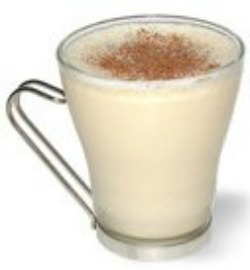
 Eggnog literally means eggs inside a small cup. It is used as a toast to ones health. Nog is an old English dialect word (from East Anglia) of obscure origins that was used to describe a kind of strong beer (hence noggin). It is first recorded in the seventeenth century. Eggnog, however, is first mentioned in the early nineteenth century but seems to have been popular on both sides of the Atlantic at that time. An alternative British name was egg flip.
Egg Nog History:
This history of Eggnog is by Nanna Rognvaldardottir of Iceland
It all began in England, where eggnog was the trademark drink of the upper class.
“You have to remember, the average Londoner rarely saw a glass of milk,” says author/historian James Humes (July 1997, “To Humes It May Concern”), former speech writer and adviser to four presidents.”
There was no refrigeration, and the farms belonged to the big estates. Those who could get milk and eggs to make eggnog mixed it with brandy or Madeira or even sherry.” But it became most popular in America, where farms and dairy products were plentiful, as was rum. Rum came to these shores via the Triangular Trade from the Caribbean; thus it was far more affordable than the heavily taxed brandy or other European spirits that it replaced at our forefather’s holiday revels.”
An English creation, it descended from a hot British drink called posset, which consists of eggs, milk, and ale or wine. The recipe for eggnog (eggs beaten with sugar, milk or cream, and some kind of spirit) has traveled well, adapting to local tastes wherever it has landed:
In the American South, bourbon replaced ale (though nog, the British slang for strong ale, stuck). Rich, strong eggnog — the richer and stronger, the better — is no stranger to holiday celebrations in New Orleans, and at this time of year the drink takes its place alongside syllabubs on the traditional southern table.
Syllabub is a less potent mixture than eggnog but just as rich. Made with milk, sugar and wine, it straddles the line between drink and liquid dessert.
Eggnog goes by the name coquito in Puerto Rico, where, not surprisingly, rum is the liquor of choice (as it is these days for many eggnog lovers in the U.S.). There the drink has the added appeal of being made with fresh coconut juice or coconut milk.
Mexican eggnog, known as rompope, was created in the convent of Santa Clara in the state of Puebla. The basic recipe is augmented with a heavy dose of Mexican cinnamon and rum or grain alcohol, and the resulting drink is sipped as a liqueur.
In Peru, holidays are celebrated with a biblia con pisco, an eggnog made with the Peruvian pomace brandy called pisco.
The Germans make a eggnog or rather egg soup with beer (Biersuppe).
Here in Iceland, we do have a soup here that resembles eggnog somewhat but there is no alcohol in it. It is served hot as a dessert. Other than that, we have nothing that resembles eggnog and no eggnog traditions.
3 Responses to “Egg Nog History”
JR
Yum! Nice article!!
Theodocious
I do declare egg nog is best with a chigger of brandy!
Carlos T.
In Venezuela we have Ponche Crema, it has a low dose of rum. It is a common drink by Christmas and End of Year Celebrations.