
Making Perfect Scrambled Eggs and Omelets
“There are few things as magnificent as scrambled eggs, pure and simple, perfectly cooked and perfectly seasoned.” – James Beard, from his book, Beard on Food.
Perfect Scrambled Eggs:
Scrambled eggs make a delicious and quick meal, but there is some simple science to getting them just right. The secret to successfully scrambling eggs is slow cooking (you need low, gentle heat).
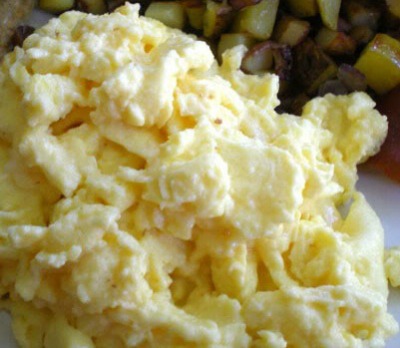
Beating the eggs: The American Egg Board describes well-beaten eggs as “frothy and evenly colored.” This generally takes about 20 to 35 seconds of beating – do not over beat. You want to get them to a uniform color and texture with minimal amounts egg white showing.
A fork works as well as a wire whisk but requires a slight bit more time and more energy. Use a bowl that is deep enough to support vigorous whisking. Do NOT add salt yet, as the salt will cause the eggs to toughen.
Melting the butter: Heat a medium-sized non-stick frying pan over a medium-low heat to warm it up. Do not use a pan that is too large, as the eggs will spread out too thinly and cook too quickly.
Melt some butter (approximately 1 teaspoon butter per egg) in the frying pan. When all the butter is melted, reduce heat to low and add the beaten egg mixture.
Cooking the scrambled eggs: Cook eggs at a low temperature.
The biggest mistake people make is turning the heat too high. Using a high heat to cook the eggs will cause them to will turn out to be quite rubbery and dry.
Stirring eggs while cooking: Do not stir immediately. Wait until the first hint of setting begins.Using a silicone spatula or a flat wooden spoon, push eggs toward center while tilting skillet to distribute runny parts.
Some people like really soft scrambled eggs and other people like really dry scrambled eggs. Just keep gently stirring the eggs until they look like what you desire.
Adding other ingredients: When the eggs are cooked enough for your taste, season lightly with salt and pepper.
Now is the time to add any other ingredients (such as herbs, shredded cheese, chopped scallions, sauteed mushrooms, chopped tomato, or anything else you desire).
IMPORTANT – Stop the cooking process – Residual Heat or “Carry Over Heat.”Always remove scrambled eggs from the heat when they are almost set but still appear shiny and a bit underdone, approximately 1 minute before you think the eggs are done.The eggs will continue to cook even though they have been taken away from the heat, due to the heat from the pan and the “carry over heat.”
Serving scrambled eggs: After the scrambled eggs are done to your liking, immediately transfer them to the individual serving plates and serve immediately.
Scramble Eggs Hints and Tips:
Adding Cream of Tartar (optional): 1/8 teaspoon cream of tartar for every two (2) whole eggs.
Add cream (optional): After removing the pan with the scrambled eggs from the heat, add a teaspoon of cold light cream for each four eggs and stir fast for a second. This is to stop the cooking, which would otherwise continue for a few minutes by the internal heat retained by the eggs. Without this last step, the eggs would be overcooked and dry.
Holding cooked scrambled eggs: If it is necessary to hold scrambled eggs for a short time before serving, it helps to avoid direct heat. Place a pan of hot water between the pan of eggs and the heat source.
Scrambled Eggs Turning Green: Sometimes a large batch of scrambled eggs may turn green. Although not pretty, the color change is harmless. It is due to a chemical change, the formation of ferrous sulfide from iron in the yolks and sulfur in the whites, brought on by heat and occurs when eggs are cooked in an iron skillet, cooked at too high a temperature, or held for too long. Using stainless steel equipment, using a low cooking temperature, cooking in small batches, and serving as soon as possible after cooking will help to prevent this.
Perfect Omelets:
The definition of an omelette is beaten eggs cooked in a pan into a flat round and then rolled or folded. Today, an omelette may hold, or be topped with, any savory or sweet food as desired. The fillings and topping possibilities are endless and limited only the the cook’s imagination.
Pan Size: The proper pan is important for successful omelette making. For a 2- or 3- egg omelette, an 8-inch non-stick skillet is the best size. It should be shallow with slopping sides to make it easy to slide the finished omelet out. If too large a pan is used, the high heat necessary cannot be maintained and cooking will be prolonged, resulting in a tough omelet.
Heating the pan: Preheat a non-stick pan over medium-high heat. It is important that the pan be hot. To test, sprinkle a few drops of water to the pan – it should sizzle.
Melting the butter: Reduce heat to medium-low. Melt some butter (approximately 1 teaspoon butter per egg) in the hot frying pan. NOTE: Can use cooking spray but the taste will be different. There is nothing that can compare to real butter.
Beating the eggs: The American Egg Board describes well-beaten eggs as “frothy and evenly colored.” This generally takes about 20 to 30 seconds of beating – do not over beat. You want to get them to a uniform color and texture with minimal amounts egg white showing. A fork works as well as a whisk but requires a slight bit more time and more energy. Use a bowl that is deep enough to support vigorous whisking. Do NOT add salt yet, as the salt will cause the eggs to toughen.
Cooking the omelet: Use a medium-low heat.
Add beaten eggs (mixture should set immediately at edges) and scramble the eggs with a soft silicone spatula, scraping the bottom and sides of the pan (tilt pan and move cooked portions as necessary).
The eggs will cook quickly and curds will form (carefully push cooked portions at edges toward center so uncooked portions can reach hot pan surface).
When the eggs obtain the consistency of cottage cheese with mostly solids but some liquid egg, stop stirring. Use the spatula to pat the eggs down into an even layer. Let the eggs continue cooking until the liquids is almost set but still creamy and moist on top.
Add filling ingredients: Have all fillings selected and prepared before starting the eggs.
When top is thickened and no visible liquid egg remains, add fillings.
Place the fillings (of your choice) in a row across the omelet just off to one side.
Finish cooking the Omelet: The omelette should slip around in the pan without sticking to the pan.
Move the pan to a serving plate, tip the pan over the serving plate, and gently shake the omelette onto the plate filling side first. When the omelette is about half onto the plate, twist the pan with your wrist folding the remaining omelette over the top. The omelette should be folded over with the bottom edge protruding about one-half inch.
Omelet Hints and Tips:
Always prepare several individual omelets, rather than one large omelet. You will find each will be lighter, fluffier, and easier to handle. Individual omelets can be quickly made in succession and held on serving plates in a warm oven.
Water, not milk or cream, is recommended for omelet egg mixtures. The water turns to steam, producing a light, airy omelet. Cream is great for creamy scrambled eggs but omelets require water to give them their lightness.
Omelet, like scrambled eggs, cook very quickly. Always have your filling ingredients chopped, cooked, and ready before you begin cooking the eggs. This is called Mise en Place.
Additional Egg Cooking Techniques:
Baked (Shirred) Eggs
In France, this basic methods of baked eggs is called oeufs en cocotte.
Boiling Eggs
According to the American Egg Board, the terms “hard-boiled” and “soft-boiled” eggs are really misnomers, because boiling eggs makes them tough and rubbery. Instead, these eggs should be “hard-” or “soft-cooked” in hot (still) water.
Coddled Eggs
Coddled eggs are made by very briefly immersing an egg in the shell in boiling water (to cook in water just below the boiling point) to slightly cook or coddle them.
Deviled Eggs
Deviled eggs have their roots in ancient Roman recipes. In the 17th century, this was a common way to prepare eggs. They were not called “deviled” until the 18th Century, in England.
Fried Eggs – Perfect Fried Egg
A French technique that very slowly cooks the eggs in butter.
Microwave Eggs
How to microwave poached eggs, fried eggs, scrambled eggs, and boiled eggs.
Poached Eggs
The best eggs for poaching are the freshest eggs you can find. If eggs are more than a week old, the whites thin out. Whites of fresh eggs will gather compactly around the yolk, making a rounder, neater shape.
Scrambled Eggs/Omelettes
Scrambled eggs make a delicious and quick meal, but there is a little science to getting them just right. The secret to successfully scrambling eggs is slow cooking.
Categories:
Cooking Lessons - Cooking 101 Egg Hints and Tips Egg Recipes Omelets Scrambled Egg Dishes
3 Responses to “Scrambled Eggs – Omelets”
Chelsea
Hello there I am so grateful I found your blog, I have bookmarked it.
Nancy Hartman
Thank you!
camisetas tailandia
mixture should set immediately at edges