Prime Rib Roast – Tips From The Butcher’s Block
By Eric Turner
From my years as a retail butcher, I can report that the beef bone-in rib roast is a cut that often draws from shoppers the kind of careful consideration one normally associates with buying a car. Understandably so! You could think of it as an investment piece; a chunk of money goes into it, but if chosen and prepared wisely, the returns can be great indeed at the dinner table. So come with me for a bit, and I will pull from my pocket of experience a handful of insider tips & tricks I think may help you when investing a hard-earned chunk of change in your next rib roast.
First of all, let’s dispel a common myth: The term ‘prime’ rib does not necessarily indicate a rib roast is prime grade, and in most cases, it probably is not. ‘Prime’ is an official USDA designation of grade and few supermarkets display this elite grade of beef because of its high cost relative to other grades.
Prime Rib has become more a style of cooking the piece than of the quality of the cut. This is also why you rarely see this cut labeled as Prime Rib at the supermarket but rather as ‘Beef Bone-In Rib Roast’ because the USDA requires that a cut of beef must be officially graded as Prime before it can be so labeled.
Important Tip:
Insisting you get a rib roast that is actually Prime grade is well worth the effort. Less than 2% of all industry beef merits this designation from the USDA. You will likely have to ask your butcher to special order a true Prime grade rib roast for your occasion, but when the forks hit the plate, your family and guests will notice the difference and then some!
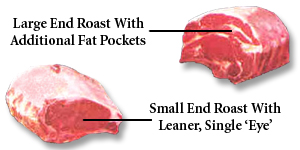
One universal truth of the meat world is that fat means flavor! But of course, many prefer a leaner cut, and the whole beef rib (where rib roasts are portioned) was kind enough to offer both. The whole piece is divided roughly in half, a large end and a small end. The large end is defined by the presence of more fat pockets throughout the meat, while small end rib roasts contain a single, intact muscle and are leaner.
Whether one is better than the other is really never more than a matter of personal taste and how much fat your diet will tolerate. I n choosing between them and determining which will better suit your palate, it may help some of you to know that the small end is where a butcher produces boneless rib eye steaks, and the large end yields Delmonico steaks.
Mashability Test!
It can often be difficult to tell just how much fat is contained in a large and thick cut such as a beef rib roast. The overall fat content in a given cut cannot always be determined by looking at the exposed ends of the piece, and some rib roasts can contain a thick and dense ‘kernel’ of fat near the middle, not necessarily visible to the shopper’s eye. If fat content is indeed a big issue for you in selecting your next roast, try this little test of mine I like to call the mashability test:
Try laying 3 or 4 fingers flatly on the surface of the meat and mashing firmly (though not with full strength so as to force blood from the piece) to judge the softness or firmness of the roast. A softer, more ‘mashable’ piece indicates a leaner one, whereas a very firm piece that won’t mash much is likely to have a larger and denser fat kernel running through the middle as well as other areas of thick fat.
This is also helpful when picking out a whole, uncut beef rib that is still in the bag and affords very little visibility to judge the fat content. I have many times helped customers to judge their rib roasts and whole pieces in this manner and had great results reported back to me.
Butcher’s Help:
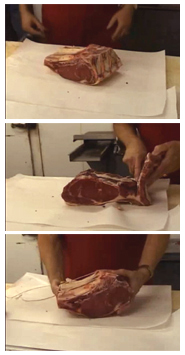 Finally, a great idea, that is not often requested in supermarkets, is to ask the butcher to loosen the bones on your rib roast before taking it home.
What on earth am I talking about? Well many of you prime rib aficionados will testify that carving your rib roast when it’s fresh out of the oven or smoker can be a daunting task because this large piece hold its heat well and can be powerfully hot when just done cooking and a little awkward to hold still, even with a carving fork.
Ask your butcher to make a cut along the bones (as if removing them), but not all the way through, and then tie them back in place with butcher twine. This will allow the roast to still reap all the added flavor imparted by the bones but will make carving the hot piece at home a snap!
So there you go – a few tips from inside the butcher shop that I hope will remove some of the guesswork from picking out your next beef bone-in rib roast. After many years in the trade, even on my last day as a butcher, I am sure that I learned something new. It is a pleasure to pass these tips along because an informed consumer is a happy one, and the fruits of our learning can look awfully good on our dinner tables!
Check out What’s Cooking America’s Tutorial on Cooking A Perfect Prime Rib Roast.