
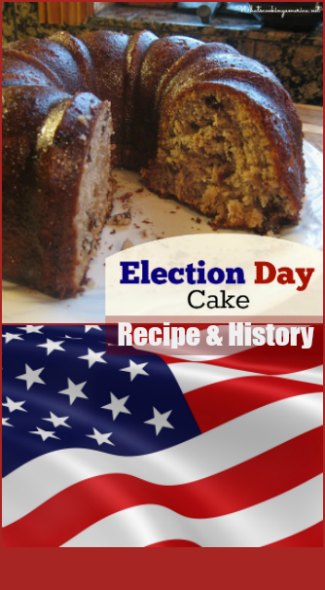
Election Day Cake is actually a classic English fruitcake or plum cake. The original Election Day Cake included molasses, spice, raisins, and currants were used in this cake. Later brandy was added. Also known as Oak Cake, Hartford Election Cake, and Training Cakes, because another name for Election Day was Training Day.
Election Day was considered an important holiday in early New England. In importance, it ranked second only to Thanksgiving. As our Puritan ancestors were denied the joys of Christmas and Easter, Election Day with its festivities of parades, religious ceremonies, balls, and fine foods helped compensate for the loss. Because of this, they made Election Day into a holiday in which everything broke loose, people gathered in town and visited each others’ houses.
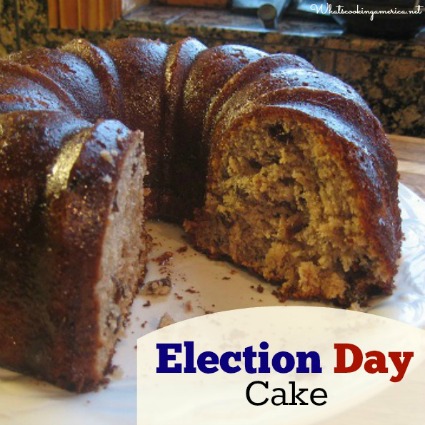
History: Ruled by the English, colonial American farmers were called to military practice for days of training sessions (know as mustering) to the nearest designated towns. Alice Ross, in her article on Election Cakes for the Journal of Antiques and Collectibles states:
They traveled (sometimes for days) and descended on the nearest designated towns for days of training sessions (mustering) and nights of socializing, carousing, and partaking of what become know as “Muster Cake.” Townsfolk, of necessity, had prepared for the onslaught by baking and cooking for the numbers that would fill every bed in homes, taverns, and inns.
The Yankee Magazine Cookbook says the cake was “served either at the church supper preceding the town meeting, or sold outside the polling place, like a one-cake bake sale, to help sustain voters.”
1771 – These cakes were baked to celebrate Election Days at least as early as 1771 in Connecticut, before the American Revolution of 1775. The Election Cake, as all cakes baked in colonial homes, was yeast-leavened, as there was no commercial baking powder, and they were baked in brick fireplace ovens. Colonial women vied with each other as to who baked the best cakes as families exchanged visits and treated their guest with slices of this cake. Historians feel that the recipe for Election Cake was adapted from popular period English yeast breads.
According to a Washington Post newspaper article called, Election Day Cake Is a Piece of Americana, But Not Everyone’s Choice, By Bonnie S. Benwick, Wednesday, October 27, 2004:
All involved had to keep up their strength, and Election Day Cake filled the bill. After three dough risings, “cider and delectable cake was served at Connecticut’s expense.” We know this because the Society of the Descendants of the Founders of Hartford has found references to the state’s 1771 General Assembly reimbursing one Ezekial Williams for the ingredients of an Election Day Cake (which certainly had to include nutmeg, since Connecticut’s known as the Nutmeg State. But that’s another story). A “huge election cake” was made for the members of the First Company Governor’s Foot Guard in 1775.
According to the Culinary Historians of New York article, Fall 2004, Volume 18, No. 1, called From Great Cake to Curiosity: On the Trail of the Hartford Election Cake, by Stephen Schmidt:
The itemized record of Connecticut’s election Day expenditures for the year 1771 certainly point toward a cake in the bushel range. All told, the Connecticut colony spent a little over 23 on “sundries,” including “cake,” for it Election Day festivities in that year. The materials of “the great election cake” itself cost 3, and a certain Mrs. Ledlie was paid a littler over 2 for making it. In 1771, 5 was a hefty sum to pay for a cake!
1796 – Amelia Simmons published a recipe for this cake in her cookbook American Cookery, 2nd Edition, in 1796:
Election cake – Thirty quarts of flour, 10 pound butter, 14 pound sugar, 12 pound raisins, 3 doz eggs, one pint wine, one quart brandy, 4 ounces cinnamon, 4 ounces fine colander seed, 3 ounces ground allspice; wet flour with milk to the consistence of bread over night, adding one quart yeast; the next morning work the butter and sugar together for half an hour, which will render the cake much lighter and whiter; when it has rise light work in every other ingredient except the plumbs, which work in when going into the oven.
1830 – The cake became known as Hartford Election Cake when politicians there served it to men who voted a straight party ticket. While waiting for election result, it was a New England tradition to serve these huge Election Cakes (each cake weighing approximately 12 pounds each). Housewives established their reputations as socialites and hostesses on the quality of their cakes. Connecticut historian, J. Hammond Trumbell, in1886 wrote about it this way:
“Election Day (the first Thursday in May), the reddest letter in our calendar, brightened the whole year. Good housekeepers were expected to have finished their spring cleaning long before…election cake was rising to make ready for the oven: and few homes were too poor to offer these refreshments to visitors.”
An article in the New York Times on November 2, 1988 called Election Cake: A Noble Tradition, by Marian Burros states the following:
“So what then is the how, when, where, what and why of Election Cakes? The Connecticut Historical Society provided some answers, but…said…that some conflicts cannot be resolved. “What you can say…is that this is cake traditionally made in connection with elections in Hartford form pre-Revolutionary times…the Colonial Records of Connecticut from May 1771 show that one Ezekial Williams Esq. submitted a bill to the Connecticut General Assembly for the cost of making the cake for the election’.” To understand why the government of the colony of Connecticut would pay for such a cake, along with other food, you have to know how the Governor of the colony, and later the state, was elected. In early spring, elections were held in Connecticut towns, and in May representatives of the towns gathered in Hartford, the capitol, for the formal counting of the votes, first for Governor, then for Lieutenant Governor and then for other officials. The counting often went on into the night . The representatives came the day before and stayed overnight in Hartford…in every Hartford home, Election Cakes were made to serve the out-of-town lodgers. According to… [The Connecticut Historical Society], housewives planned for Election Day well in advance and made cakes that would keep. By the mid-1800’s Election Day had declined as a major festival and around 1875 the date for election of the Governor shifted to January from May…”
1900s – Alice Ross, in her article on Election Cakes for the Journal of Antiques and Collectibles states:
“After 1900, Election Day in the cities lost a good deal of this tradition. Large influxes of non-English immigrants kept different holiday customs, and the restitution and commercialization of Christmas and Easter probably weakened its appeal. We were no longer the only democracy, and such things as popular elections may not have seemed as uniquely American.”
I created this wonderful modern version of the old-fashioned Election Day Cake after reading many older and a few more modern recipes. My husband actually help me make this cake, which is very unusual for him, as he was excited to try it. He loved it!
- 1 cup raisins or currants
- 4 tablespoons brandy
- 1 3/4 cups flour (all-purpose), sifted
- 1 teaspoon salt
- 1 teaspoon ground cinnamon
- 1/4 teaspoon ground cloves
- 1/2 teaspoon ground mace
- 1/2 teaspoon ground nutmeg
- 3/4 cup butter, room temperature
- 1 cup sugar (granulated)
- 3 eggs, room temperature
- 3/4 cup nuts of your choice, chopped (I used pecans)
- 1 cup powdered sugar (confectioners' sugar), sifted
- 1/4 cup lemon juice, freshly-squeezed
- 1 cup powdered sugar (confectioners' sugar), sifted
- 3 tablespoons milk or light cream
- 1/2 teaspoon pure vanilla extract
-
Grease and flour a 10-inch Bundt or tube pan or a 9- x 5-inch loaf pan.
-
In a small bowl, combine raisins or currants and the brandy. Let sit at least 1 hour or overnight to let the raisins plump up. Strain the brandy and the raisins; set the brandy and raisin aside in separate bowls until needed.
-
Prepare Sponge (yeast mixture). See below.
-
Prepare cake batter while the Sponge is rising for 30 minutes.
-
Sift together the flour, salt, cinnamon, cloves, mace, and nutmeg; set aside.
-
In a large bowl of your electric mixer, cream butter and sugar until light and fluffy. Add eggs, adding one at a time and beating well after each addition. Beat in the brandy. Add the Sponge (yeast mixture) and continue to beat. Add the flour mixture, a little at a time, beating well after each addition, until smooth (the batter will be soft and sticky). With the electric mixer on low, blend in raisins or currants and nuts.
-
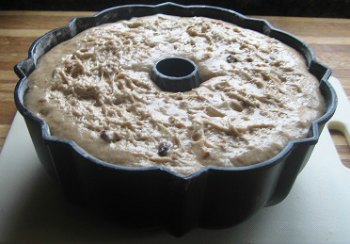
Pour batter into prepared pan, smooth top with a rubber spatula, cover lightly with plastic wrap, and let rise in a warm place (away from drafts) until doubled in size, approximately 2 to 3 hours. This batter rises very slowly and the rising time may take as long as 4 to 6 hours, depending on the temperature of your room. Your batter should be at least 1-1/4″ below the rim of the pan before rising.
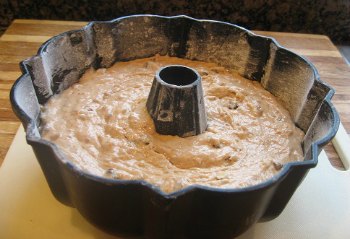
-
NOTE: If you let the batter rise over the top of the pan during the rise, the cake will collapse. Baking this cake is like baking bread.
-
Oven Bread Rising: Sometimes I use my oven for the rising. Turn the oven on for a minute or so, then turn it off again. This will warm the oven and make it a great environment for rising bread. If you can't comfortably press your hand against the inside of the oven door, the oven is too hot. Let it stand open to cool a bit.
-
Cool or Refrigerator Rise: If I don't have the time to wait for the rise to finish or I know that I will be interrupted before the completed rise, I do a cool rise. A cool rise is when the dough is place in the refrigerator and left to rise slowly over night approximately 8 to 12 hours.
-
Preheat oven to 375 degrees F. Place oven rack in center of oven.
-
After the cake has risen, bake 40 to 45 minutes or until a toothpick inserted into the cakes comes out clean or the internal temperature on an instant-read digital thermometer registers 190 degrees F.
-
Remove from oven and let cool on a wire cooling rack for 30 minutes. Remove from pan and let cool completely.
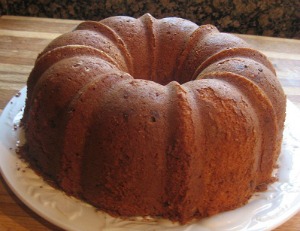
-
Prepare either Lemon Glaze or Milk Glaze (your choice) and brush on the top and sides of the cooled cake.
-
Aging and Storage: Election Cake was always considered better if left to ripen for a day or two in a covered crock at room temperature. Nowadays we prefer to slip it into a plastic bag and let it age. These loaves freeze well, but will not age or mellow in the freezer.
-
In a large bowl, sprinkle yeast over the water; stir to dissolve. Add sugar and flour; beat 2 minutes either by hand or with your electric hand mixer at medium speed. Cover and let rise in a warm place until bubbly, approximately 30 to 40 minutes.
-
In a small saucepan over low heat. Heat the powdered sugar and lemon juice until the sugar is dissolved and slight thickened, about 1 minute. Remove from heat and brush the prepared glaze over the top and sides of the cooled cake.
-
In a small saucepan over low heat. Heat the powdered sugar and milk until the sugar is dissolved and slight thickened, about 1 minute. Remove from heat and brush the prepared glaze over the top and sides of the cooled cake.
 I get many readers asking what cooking/meat thermometer that I prefer and use in my cooking and baking. I, personally, use the Thermapen Thermometer. Originally designed for professional use, the Super-Fast Thermapen Thermometer is used by chefs all over the world. I only endorse a few products, on my web site, that I like and use regularly.
You can learn more or buy yours at: Super-Fast Thermapen Thermometer.
Sponsored Content
17 Responses to “Election Day Cake History and Recipe”
Robin in NJ
I gave this cake a trial run ahead of election day and I’m really glad I did. I made this recipe and during the rise it almost overflowing my Bundt pan (a standard 10-cup pan) and then collapsed when I baked it, looking awful on the underside and creating a total mess. However, it came out of the pan just fine and the taste is OK. I’m not sure what went wrong.
Linda Stradley
I am very sorry you had problems, as this is a wonderful cake.
It sounds like you let the cake rise too much (too high in the baking pan). A Bundt pan is typically 10 by 3 1/4 inches and holds 12 cups of batter. That being said, it’s bakeable capacity is more like 6 cups as you need room for the rising. Your batter should be at least 1-1/4″ below the rim of the pan before rising. If your batter rises over the top of the pan during the rise, the cake will collapse when baked. Baking this cake is like baking bread.
Tanya
Hello! I’m super excited to make this cake for Election Day. I’d like to bringing it into my coworkers however I live in Utah and many are Mormon and wont eat anything with alcohol (even thought I assure them it has cooked off). Is there any thing I can use in place of the brandy? Thanks.
Linda Stradley
Please check out What’s Cooking America’s Alcohol Substitution Chart. This chart should help you. Let me know how you cake turns out.
Cindy G (A Mormon)
I made it and the alcohol cooks off. I think it will taste better with the brandy. Just my opinion.
Jo
Hi, I’m making this cake today so that it can age a couple of days. Would you recommend glazing the cake before or after letting it rest? Thanks!
Linda Stradley
Per Recipe: Prepare either Lemon Glaze or Milk Glaze (your choice) and brush on the top and sides of the cooled cake.
Jo
In the end, I opted to brush on the lemon glaze shortly before serving the cake. I’m glad I did – I think it might have become soggy and strange if I let it sit with the glaze for two days. My cake turned out a fair bit shorter than the one in the photo, likely the result of the very rapid rise from using too must yeast, before the recipe was corrected. Overall, a pretty good cake.
Marcee Chipman
SO, I made this and it was fairly easy, but three issues.
1)you said a soft, sticky dough. I had a gooey batter. I double checked and had measured correctly, but added 1/2 cup more flour. It still was the consistency of a batter, not a ‘dough’.
2) my sponge bubble over in about 15 minutes – -I transferred to a huge bowl. The cake batter rose to the edge of the pan within 45 minutes. Did you really mean TWO packs of Yeast? (I used regular, not instant)
3) Finally do you glaze before you store this cake. while it is still warm???
Linda Stradley
I used Instant Yeast when making the cake. I use instant yeast in most of my bread making. I must of been “asleep” when I typed up this recipe. I am so sorry for the error!
Per Recipe: Prepare either Lemon Glaze or Milk Glaze (your choice) and brush on the top and sides of the cooled cake.
Salli Slaughter
So is 3 1/3 tsp correct for amount of instant yeast?
Linda Stradley
Yes it is.
Kim
Do you let it age on the counter or in the fridge.? Should you glaze it before you age it? Thanks!
Linda Stradley
Aging and Storage: Election Cake was always considered better if left to ripen for a day or two in a covered crock at room temperature. Nowadays we prefer to slip it into a plastic bag and let it age. These loaves freeze well, but will not age or mellow in the freezer.
Lynda Salings
Could this cake be made with a sourdough sponge? I bake with sourdough on a regular basis, and always hate wasting that bit that gets tossed. How much could be substituted, do you suppose?
Linda Stradley
I have not tried making this cake with sourdough. Give it a try and let me know how it turns out. _ Linda
Carole
Made it for 2020 Election night. Amazing! Delicious! Used red wine, cause thats what I had. Dried cranberry, raisins, and walnuts. I probably won’t wait another 4 years to made it again. Thanks!