
Eggs Benedict make any meal an elegant special occasion.
This egg dish is specially great for weekend breakfast or brunch, or a unique evening meal. To be honest with eveyone, I often cheat on making the Hollandaise Sauce and use the Knorr Hollandaise Sauce mix (no ones seems to notice).
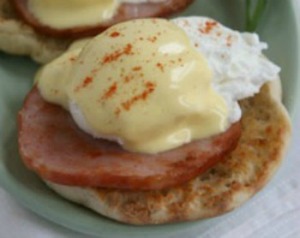
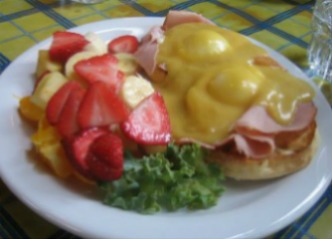
Learn all about Eggs and how to cook them, and for more great brunch ideas, check out my Brunch Recipes.
Eggs Benedict History:
Historians give credit to two versions of the origin of Eggs Benedict:
1860s – Credit is given to Delmonico’s Restaurant, the very first restaurant or public dining room ever opened in the United States. In the 1860’s, a regular patron of the restaurant, Mrs. LeGrand Benedict, finding nothing to her liking and wanting something new to eat for lunch, discussed this with Delmonico’s Chef Charles Ranhofer (1936-1899), Ranhofer came up with Eggs Benedict. He has a recipe called Eggs a’ la Benedick (Eufa a’ la Benedick) in his cookbook called The Epicurean published in 1894:
Eggs la Benedick – Cut some muffins in halves crosswise, toast them without allowing to brown, thn place a round of cooked ham an eighth of an inch thick and of the same diameter as the muffins one each half. Heat in a moderate oven and put a poached egg on each toast. Cover the whole with Hollandaise sauce.
1894 – The following story appeared in the December 19,1942 issue of the weekly New Yorker Magazine “Talk of the Town” column and is based on an interview with Lemuel Benedict the year before he died.
In 1894, Lemuel Benedict, a Wall Street broker, who was suffering from a hangover, ordered“some buttered toast, crisp bacon, two poached eggs, and a hooker of hollandaise sauce” at the Waldorf Hotel in New York. The Waldorf’s legendary chef, Oscar Tschirky, was so impressed that he put the dish on his breakfast and luncheon menus after substituting Canadian bacon for crisp bacon and a toasted English muffin for toasted bread.
1896 – Fannie Merritt Farmer’s (1857-1915) revised, edited, and reissued Mary J. Lincoln’s cookbook called The Boston Cooking-School Cook Book. In it is a recipe for Eggs la Benedict. The recipe is as follows:
Eggs la Benedict – Split and toast English muffins. Sautcircular pieces of cold boiled ham, place these over the halves of muffins, arrange on each a dropped egg, and pour around Hollandaise Sauce II, diluted with cream to make of such consistency to pour easily.
- 2 English muffins, halved horizontally
- 4 slices ham, baked or Canadian bacon
- 4 whole eggs for poaching*
- 2 tablespoons distilled white vinegar
- 2 teaspoons coarse salt or Fleur de Sel Salt**
- Parsley or chives (for garnish)
- 3 egg yolks
- 1 tablespoon lemon juice, freshly squeezed
- 1/4 pound (1/2 cup) butter, unsalted, cut into pieces***
- 1/2 cup white wine
- 1 tablespoon white vinegar
- Coarse salt and pepper to taste
-
Prepare Hollandaise Sauce (see recipe below). Keep warm until ready to serve. HINT: I put my Hollandaise Sauce in a small thermos to keep warm.
-
If I am in a hurry and do not have time to make homemade Hollandaise Sauce, I use Knorr Hollandaise Sauce mix found in most local grocery markets. Make it ahead of time and put in a small thermos to keep warm.
-
Toast English muffin slices under the broiler or in the oven for approximately 3 minutes or until golden brown. Remove from broiler, spread with 1 teaspoon butter. In a large frying pan, cook ham or Canadian bacon slices until lightly browned and place them on each English muffin half.
-
Use a pan that is at least 3-inches deep so there is enough water to cover the eggs and they do not stick to the bottom of the pan. NOTE: To prevent sticking, grease the pan with a little oil before filling with water. Add vinegar and salt to the poaching liquid; bring the poaching liquid to a boil and then reduce to a simmer before adding the eggs (bubbles should not break the surface). HINT: When you poach eggs, adding a little vinegar and salt to the water will helps the egg to hold its shape. Without it, the eggs can become skeins of protein tangling up in the water.
-
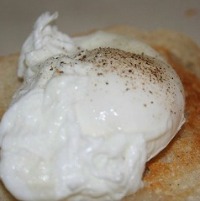 Break each egg onto a saucer or into small cups or bowls. Slip eggs carefully into simmering water by lowering the lip of each egg-cup 1/2-inch below the surface of the water. Let the eggs flow out. Immediately cover with a lid and turn off the heat. Set a timer for exactly three minutes for medium-firm yolks. Adjust the time up or down for runnier or firmer yolks. Cook 3 to 5 minutes, depending on firmness desired.
 -
Remove from water with slotted spoon. Lift each perfectly poached egg from the water with a slotted spoon, but hold it over the skillet briefly to let any water clinging to the egg drain off. Drain well before serving.
-
To serve best-quality poach eggs, the poached eggs should be served as soon as they are pulled from the water and drained. They cool down quickly and once cold, they are not as desirable for the diner.
-
Top each English muffin half with one poached egg. Spoon warm Hollandaise Sauce over eggs and garnished with a small parsley sprig or chopped chives.
-
Variation Ideas:
-
Smoked Salmon - Substitute thinly sliced smoked salmon for the ham.
-
Artichoke - Substitute cooked artichoke heart for English muffin.
-
Makes 4 serving.
-
Stir egg yolks and lemon juice vigorously in medium saucepan over very low heat. Add butter and white wine and stir constantly with whisk, until melted. Add white vinegar, salt, and pepper and continue vigorous stirring until all butter is melted and sauce is thickened (be sure butter melts slowly so eggs have time to cook and thicken sauce without curdling).
-
NOTE: If the sauce begins to separate, add 2 teaspoons of water to the sauce mixture and whisk briskly until the mixture has combined together to form a creamy sauce.
-
Keep warm until ready to serve. HINT: I put my Hollandaise Sauce in a small thermos to keep warm.
-
Quick and Easy Hollandaise Sauce: Use 1 package Knorr Hollandaise Sauce mix and follow package directions.
*Check out my web page on How To Poach Eggs with lots of hints and tips.
** The Fleur de Sel Salt is fabulous on eggs.
*** If you use salted butter, delete the salt from the recipe.
Poaching eggs for a crowd:
To poach eggs for a crowd, cook eggs ahead of time, slightly under cooking them. Slide them into a large bowl of cold water. When ready to be served, immerse in barely simmering water for 1 to 2 minutes.
Holding poached eggs for a short period of time:
If you are making eggs only a short while ahead, slide all of them, as they are cooked, into a large bowl of hot (not boiling) water. Do not worry about them sticking together. Top with more hot water from time to time to keep them warm. The eggs will be soft, warm, and ready to eat when you are ready to serve them.
One Response to “Eggs Benedict History and Recipe”
Teresa
How long does hollandaise sauce last