History of High Tea – History English Afternoon Tea – Tea Etiquette
Find out where some of the longest lasting tea traditions originated from in Afternoon Tea History.
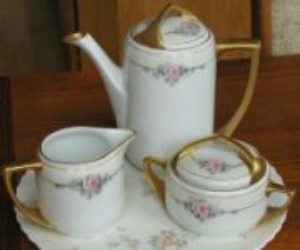
High Tea is often a misnomer. Most people refer to afternoon tea as high tea because they think it sounds regal and lofty, when in all actuality, high tea, or “meat tea” is dinner. High tea, in Britain, at any rate, tends to be on the heavier side. American hotels and tea rooms, on the other hand, continue to misunderstand and offer tidbits of fancy pastries and cakes on delicate china when they offer a “high tea.”
Afternoon tea (because it was usually taken in the late afternoon) is also called “low tea” because it was usually taken in a sitting room or withdrawing room where low tables (like a coffee table) were placed near sofas or chairs generally in a large withdrawing room. There are three basic types of Afternoon or Low Tea:
Cream Tea – Tea, scones, jam and cream
Light Tea – Tea, scones and sweets
Full Tea – Tea, savories, scones, sweets and dessert
In England, the traditional time for tea was four or five o’clock and no one stayed after seven o’clock. Most tea rooms today serve tea from three to five o’clock. The menu has also changed from tea, bread, butter and cakes, to include three particular courses served specifically in this order:
Savories – Tiny sandwiches or appetizers
Scones – Served with jam and Devonshire or clotted cream
Pastries – Cakes, cookies, shortbread and sweets
History of Tea Time
Prior to the introduction of tea into Britain, the English had two main meals, breakfast and dinner. Breakfast was ale, bread, and beef. During the middle of the eighteenth century, dinner for the upper and middle classes had shifted from noontime to an evening meal that was served at a fashionable late hour. Dinner was a long, massive meal at the end of the day.
17th Century:
Afternoon tea may have been started by the French. According to the monthly newsletter called TeaMuse, in the writings of Madame de Sign(1626 to 1696), one of history’s greatest letter writers on life in 17th Century France:
It is a little known fact, but after its introduction to Europe in the 17th century tea was tremendously popular in France. It first arrived in Paris in 1636 (22 years before it appeared in England) and quickly became popular among the aristocracy. . . Tea was so popular in Paris that Madame de Sign who chronicled the doings of the Sun King and his cronies in a famous series of gossipy letters to her daughter, often found herself mentioning tea. “Saw the Princesse de Tarente [de Signwrote]… who takes 12 cups of tea every day… which, she says, cures all her ills. She assured me that Monsieur de Landgrave drank 40 cups every morning. ‘But Madame, perhaps it is really only 30 or so.’ ‘No, 40. He was dying, and it brought him back to life before our eyes.’ . . . Madame de Signalso reported that it was a Frenchwoman, the Marquise de la Sablie, who initiated the fashion of adding milk to tea. “Madame de la Sablie took her tea with milk, as she told me the other day, because it was to her taste.” By the way, the English delighted in this “French touch” and immediately adopted it.
1600 – Queen Elizabeth l (1533-1603) granted permission for the charter of the British East India Company (1600-1858), also known as the John Company, on December 31, 1600 to establish trade routes, ports, and trading relationships with the FarEast, Southeast Asia, and India Trade in spices was its original focus, but later traded in cottons, silks, indigo, saltpeter, and tea. Due to political and other factors, the tea trade did not begin until the late 1670s.
1662 – King Charles II (1630-1685) while in exile, married the Portuguese Infanta Catherine de Braganza (1638–1705). Catherine’s dowry was the largest ever registered in world history. Portugal gave to England two million golden crusados, Tangier and Morocco in North Africa, Bombay in India, and also permission for the British to use all the ports in the Portuguese colonies in Africa, Asia and the Americas thus giving England their first direct trading rights to tea.
As Charles had grown up in the Dutch capital, both he and his Portuguese bride were confirmed tea drinkers. When the monarchy was re-established, they brought this foreign tea tradition to England with them. Her influence made tea more popular amongst the wealthier classes of society, as whatever the royals did, everyone else wanted to copy. Soon tea mania spread swept across England, and it became the beverage of choice in English high society, replacing ale as the national drink.
The reign of Charles II was crucial in laying the foundations for the growth of the British tea trade. The East India Company was highly favored by Charles II. Charles confirmed its monopoly, and also extended it to give the Company unprecedented powers to occupy by military force places with which they wished to trade (so long as the people there were not Christians).
1663 – The poet and politician Edmund Waller (1606-1687) wrote a poem in honor of Queen Catherine for her birthday crediting her with making tea a fashionable drink among courtiers:
Venus her Myrtle, Phoebus has his bays;
Tea both excels, which she vouchsafes to praise.
The best of Queens, the best of herbs, we owe
To that bold nation which the way did show
To the fair region where the sun doth rise,
Whose rich productions we so justly prize.
The Muse’s friend, tea does our fancy aid,
Regress those vapours which the head invade,
And keep the palace of the soul serene,
Fit on her birthday to salute the Queen
18th Century:
By 1700, tea was on sale by more than 500 coffee houses in London. Tea drinking became even more popular when Queen Anne (1665–1714) chose tea over ale as her regular breakfast drink. Anne’s character was once portrayed as a tea-drinking, social nonentity with lesbian tendencies.
During the second half of the Victorian Period, known as the Industrial Revolution, working families would return home tired and exhausted. The table would be set with any manner of meats, bread, butter, pickles, cheese and of course tea. None of the dainty finger sandwiches, scones and pastries of afternoon tea would have been on the menu. Because it was eaten at a high, dining table rather than the low tea tables, it was termed “high” tea.
19th Century:
According to legend, one of Queen Victoria’s (1819-1901) ladies-in-waiting, Anna Maria Stanhope (1783-1857), known as the Duchess of Bedford, is credited as the creator of afternoon teatime. Because the noon meal had become skimpier, the Duchess suffered from “a sinking feeling” at about four o’clock in the afternoon.
At first the Duchess had her servants sneak her a pot of tea and a few breadstuffs. Adopting the European tea service format, she invited friends to join her for an additional afternoon meal at five o’clock in her rooms at Belvoir Castle. The menu centered around small cakes, bread and butter sandwiches, assorted sweets, and, of course, tea. This summer practice proved so popular, the Duchess continued it when she returned to London, sending cards to her friends asking them to join her for “tea and a walking the fields.” The practice of inviting friends to come for tea in the afternoon was quickly picked up by other social hostesses.
Tea Etiquette:
For a more detailed Tea Etiquette, check out Etiquette Faux Pas and Other Misconceptions About Afternoon Tea.
Holding a Tea Cup:
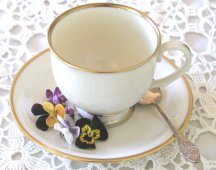
In order for one not to spill the hot liquid onto oneself, the proper way to hold the vessel of a cup with no handle is to place one’s thumb at the six o’clock position and one’s index and middle fingers at the twelve o’clock position, while gently raising one’s pinkie up for balance.
Tea cups with a handle are held by placing one’s fingers to the front and back of the handle with one’s pinkie up again allows balance.
Never wave or hold your tea cup in the air. When not in use, place the tea cup back in the tea saucer.
If you are at a buffet tea hold the tea saucer in your lap with your left hand and hold the tea cup in your right hand. When not in use, place the tea cup back in the tea saucer and hold in your lap. The only time a saucer is raised together with the teacup is when one is at a standing reception.
Pinkies Up:
Originally, all porcelain teacups were made in China, starting around 620 A.D. These small cups had no handles. In order for one not to spill the hot liquid onto oneself, the proper way to hold the vessel was to place one’s thumb at the six o’clock position and one’s index and middle fingers at the twelve o’clock position, while gently raising one’s pinkie up for balance.
Pinkie up does mean straight up in the air, but slightly tilted. It is not an affectation, but a graceful way to avoid spills. Never loop your fingers through the handle, nor grasp the vessel bowl with the palm of your hand.
Using Teaspoons:
Do not stir your tea, with your teaspoon, in sweeping circular motions.
Place your tea spoon at the six o’clock position and softly fold the liquid towards the twelve o’clock position two or three times.
Either place the iced teaspoon on the side of another plate or ask the server or hostess to remove the spoon from the table. Never leave the spoon in the glass especially when actually drinking your tea.
Serving Tea:
Milk is served with tea, not cream. Cream is too heavy and masks the taste of the tea. Although some pour their milk in the cup first, it is probably better to pour the milk in the tea after it is in the cup in order to get the correct amount.
Remove the tea bag from the cup and place it on a side saucer or in a slop bowl. Do not use the string to wrap around or squeeze the tea bag.
When serving lemon with tea, lemon slices are preferable, not wedges. Either provide a small fork or lemon fork for your guests, or have the tea server can neatly place a slice in the tea cup after the tea has been poured. Be sure never to add lemon with milk since the lemon’s citric acid will cause the proteins in the milk to curdle.
Drinking Tea:
Do not use your tea to wash down food. Sip, don’t slurp, your tea and swallow before eating.
Lots of menus and recipes for your Afternoon Tea or High Tea:
Afternoon Tea Renaissance – The Plaza’s Palm Court
Ellen Easton’s interesting article on tea time at the newly renovated Plaza Hotel in New York city.
A Rose Garden Tea with the Queen
Maintaining a tradition that began in 1860 with Queen Victoria, every year Queen Elizabeth II opens the private gardens at Buckingham Palace to host three afternoon tea parties, each attended by 8,000 guests respectively.
Etiquette Faux Pas and Other Misconceptions About Afternoon Tea
Due to the new popularity of Afternoon Tea, many people have jumped on the bandwagon, including hotels, caterers, party planners, and protocol and etiquette “experts.” While their enthusiasm is well intended, unfortunately a great deal of misinformation is being perpetuated by these “experts”.
Tea Sandwich Recipes
Also learn how to make tea sandwich ahead of time and hints and tip on making tea sandwiches.
The Afternoon Tea Gowns of the La Belle Epoque (1880-1914), known as “The Beautiful Era.”
Understanding Tea Time Service – Afternoon Tea is one of the most special times of the day. An occasion one looks forward to with great anticipation and high expectations for a perfect experience. But have you ever considered what your perfect experience entails to produce?
Check out all of Ellen Easton’s tea articles and tea recipes called Tea Travels™.
4 Responses to “Afternoon and High Tea History”
Elizabeth Chewter
” Serving tea…remove the teabag from the cup” No no no!!!If you’re talking afternoon tea (most of us Brits don’t distinguish between 3 different kinds of afternoon tea), then you’ll be having a pot of tea, not individual tea bags in cups; that’s a modern convenience and not part of afternoon tea. You’ll warm the pot with very hot water, empty it out, put in 2 or 3 ordinary tea bags (no strings!) or loose tea, then pour in boiling (not just hot but boiling) water. Then put on the lid and cover with a tea cosy. Some people don’t warm the pot or use a tea cosy. And then you leave it to ‘brew’, not ‘steep’. One other thing, with ‘cream tea’ you’ll typically have not just any cream but clotted cream. Never light fluffy whipped cream or, God forbid, squirty cream out of a can. Hope this helps.
Lisa
Tea is never made in a cup! And with tea bags!!!!!!
Drew Millet
Can you explain how a two tier French tea table was set and used during the Belle Époque? My assumption is that the silver tray and teapot, sugar, milk and lemon would be placed on the top tier with the lower level reserved for guests to set their cups and tea plates. This seems inconvenient for the hostess, who would have to stand. Recently saw a Francois Linke table where the second tier was glass, which is practical for pouring, but a large silver tray would be redundant. Did the French use porcelain tea sets without trays or are my assumptions all wrong? Your insight would be appreciated.
Nancy
Here is an article from our Tea expert, Ellen Easton. Afternoon Teas – Food Service Styles, hope the helps.
Nancy