
Also called frankfurters, frank, weenie, wienie, wiener, dog, and red hot. A hot dog is a cooked sausage that consists of a combination of beef and pork or all beef, which is cured, smoked, and cooked.
Hot dogs are among America’s favorite foods. Every year, Americans consume on average 60 hot dogs! Hot dogs are primarily regarded as a fun, summertime food, and most are eaten between Memorial Day and Labor Day.
Seasonings may include coriander, garlic, ground mustard, nutmeg, salt, sugar, and white pepper. They are fully cooked but are usually served hot. Sizes range from big dinner frankfurters to tiny cocktail size.
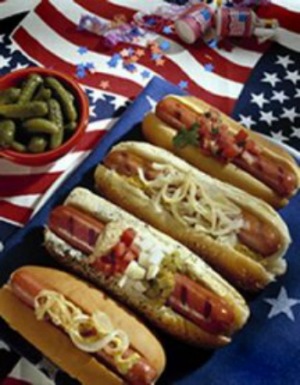
Photo by © 2002 NHD SC, Courtesy of National Hot Dog and Sausage Council Council
History and Legends of Hot Dogs
9th Century B.C.
850 – Sausage is one of the oldest forms of processed food, having been mentioned in Homer’s Odyssey (an ancient Greek tale of adventure and heroism). Following is the line from the book:
“As when a man besides a great fire has filled a sausage with fat and blood and turns it this way and that and is very eager to get it quickly roasted. . .”
1st Century A.D.
64 – Emperor Nero Claudius Caesar’s (54-68) cook, Gaius, is often credited with discovering the first sausage. It was the custom of the time to starve the pigs one week before cooking and eating them. According to legend, one pig was brought out well roasted, but it was noticed that somehow it had not been cleaned. Cook Gaius ran a knife into its belly to see if the pig was fit to eat. To his surprise, out popped the intestines and they were all puffed up and hollow. It was reported that he said, “I have discovered something of great importance.” Gaius stuffed the intestines with ground venison and ground beef mixed with cooked ground wheat and spices. He ties them into sections and the wiener was born.
7th Century
Stephen C. Carlson, a Bible Scholar, from his Sketches in Biblical Studies web site, sent me the following on sausages. Stephen says, “One piece of trivia I came across is that apparently the first person to mention a string of sausages is Leontius of Neapolis, Cyprus, in the 7th century, in his book, The Life and Miracles of Symeon the Fool, English translation by Derek Krueger.”
But he behaved otherwise before the crowd. For sometimes when Sunday came, he took a string of sausages and wore them as a (deacon’s) stole. In his left hand he held a pot of mustard, and he dipped (the sausages in the mustard) and ate them from morning on. And he smeared mustard on the mouths of some of those who came to joke with him. Wherefore also a certain rustic, who had leucoma in his two eyes, came to make fun of him. Symeon anointed his eyes with mustard. The man was nearly burned to death, and Symeon said to him, “Go wash, idiot, with vinegar and garlic, and you will be healed immediately.” As it seemed a better thing to do, he ran immediately to a doctor instead and was completely blinded. Finally, in a mad rage he swore in Syriac, “By the God of Heaven, even if my two eyes should suddenly leap (from their sockets), I will do whatever the Fool told me.” And he washed himself as Symeon told him. Immediately his eyes were healed, clear as when he was born, so that he honored God. Then the Fool came upon him and said to him, “Behold, you are healed, idiot! Never again steal your neighbor’s goats.”
15th Century
1484 – It is said that the frankfurter was developed in Frankfurt, Germany (five years before Christopher Columbus set sail for the new world). In 1987, the city of Frankfurt celebrated the 500th birthday of the hot dog. In the 1850s, the Germans made thick, soft, and fatty sausages from which we get the fame “franks.”
17th Century
1690s – Another legend is that the popular sausage (known as “dachshund” or “little-dog” sausage) was created in the late 1600s by Johann Georghehner, a butcher living in Coburg, Germany. It is said that he later traveled to Frankfurt to promote his new product.
19th Century
1805 – The people of Vienna (Wien), Austria point to the term “wiener” to prove their claim as the birthplace of the hot dog. It is said that the master sausage maker who made the first wiener got his early training in Frankfurt, Germany. He called his sausage the “wiener-frankfurter.” But it was generally known as “wienerwurst.” The wiener comes from Wien (the German name of Vienna) and wurst means sausage in German.
In 1987, the city of Frankfurt celebrated the 500th birthday of the hot dog in that city. It is said that the frankfurter was developed there in 1487, five years before Christopher Columbus set sail for the new world. The people of Vienna (Wien), Austria, point to the term “wiener” to prove their claim as the birthplace of the hot dog.
1852 – The butcher’s guild in Frankfurt, Germany introduced a spiced and smoked sausage which was packed in a thin casing and they called it a “frankfurter” after their hometown. The sausage had a slightly curved shape supposedly due to the coaxing of a butcher who had a popular dachshund. The frankfurter was also known as a “dachshund sausage” and this name came with it to America.
Also in doubt is who first served the first hot dog! Wieners and frankfurters don’t become hot dogs until someone puts them in a roll or a bun. There are several stories or legends as to how this first happened. As the cuisine of Germany relies heavily upon sausages of all shapes and sizes, it stands to reason that the German people would bring these sausages with them to America. German immigrants appear to have sold hot dogs, along with milk rolls and sauerkraut, from pushcarts in New York City’s Bowery during the 1860s.
1880 – A German peddler, Antonoine Feuchtwanger, sold hot sausages in the streets of St. Louis, Missouri. He would supply white gloves with each purchase so that his customers would not burn their hands while eating the sausage. He saw his profits going down because the customers kept taking the gloves and walking off with them. His wife suggested that he put the sausages in a split bun instead. He reportedly asked his brother-in-law, a baker, for help. The baker improvised long soft rolls that fit the meat, thus inventing the hot dog bun. When he did that, the hot dog was born. He called them red hots.
1886 – H. L. Mencken (1880-1956), newspaperman, book reviewer, and political commentator and writer, wrote:
“I devoured hot-dogs in Baltimore ‘way back in 1886, and they were then very far from newfangled….The contained precisely the same rubber, indigestible pseudo-sausages that millions of Americans now eat, and they leaked the same flabby, puerile mustard. Their single point of difference lay in the fact that their covers were honest German Wecke made of wheat-flour baked to crispiness, and not the soggy rolls prevailing today, of ground acorns, plaster-of-Paris, flecks of bath-sponge, and atmospheric air all compact.
Feltman’s Restaurant and Pavilion – Coney Island, New York:
1867 – Charles Feltman (1841-1910), a German baker, opened up the first Coney Island hot dog stand in Brooklyn, New York. Some historical accounts say he was a butcher, but according to his great grandson, he was a baker.
According to his great grandson, Charles Robert Feltman:
In order to sell his bakery goods to the men who were building Brooklyn he offered them a hot lunch of a sausage on a bun, thus the beginning of the hot dog.His bakery was located at the corner of 6th Ave and 10th St in Brooklyn. He sold 3,684 sausages in a roll during his first year in business. He is also credited with the idea of the warm bun. I believe the fiction of him being a butcher was started by a competitor.
According to the article Coney Island: Food & Dining by Jeffrey Stanton:
In 1867 Charles Feltman owned a pie-wagon that delivered his freshly baked pies to the inns and lager-beer saloons that lined Coney Island’s beaches. His clients also wanted hot sandwiches to serve to their customers. But his wagon was small and he knew that it would be hard to manage making a variety of sandwiches in a confined space. He thought that perhaps something simple like a hot sausage served on a roll might be the solution. He presented his problem to Donovan, the wheel-wright on East New York and Howard Street in Brooklyn, who had built his pie-wagon. The man saw no problem in building a tin-lined chest to keep the rolls fresh and rigging a small charcoal stove inside to boil sausages.
When the wheel-wright finished the installation they fired up the stove for a test run. Donovan thought that the sausage sandwich was a strange idea but he was willing to try it as Feltman boiled the succulent pork sausage and placed between a roll. The wheel-wright tasted the it and liked it. Thus the hot-dog was born.
Early 1900s – The hard-working Feltman built a mini-empire at Surf Ave. and 10 street that covered a full city block and consisted of 9 restaurants, a hotel, beer gardens, restaurants, food stands, a bathhouse, a pavillion, a Tyrolean village, and various rides to amuse his customers. The Depression in the 1930’s began the decline of Feltman’s business. Visitors to Coney Island could barely afford the subway ride yet alone a sit down meal at Feltman’s. At his death in 1910, he left a business worth over one million dollars which all started with selling hot dogs. By the 1920s Feltman’s Ocean Pavilion was serving five million customers a year and was billed as the world’s largest restaurant.
1952 – When the restaurant folded in 1954, the Albert family partnership bought the property and leased it out as Feltmans Astro Park. By the time it opened to the public, in the summer of 1962, it had become the space-age Astroland Park.
Nathan’s – Coney Island, New York:
1915 – Nathan Handwerker (1892-1974), a Jewish immigrant from Poland, went to work for Feltman. Handwerker’s job was slicing hot dog rolls and delivering the franks to the guys who toiled at the grilling stations. It is said that he young lived on free hot dogs and slept on the kitchen floor to save his $11 per week salary. At the end of the year, he’d saved $300 and opened a competing stand–5 cents a hot dog instead of 10 cents. That was the beginning of Nathan’s.
1916 – Nathan Handwerker with his wife Ida, started Nathan’s Famous, Inc., which now calls itself the world’s greatest hot dog purveyor. He opened his stand in Coney Island near the corner of Surf and Stillwell Avenues and called it Nathan’s. Handwerker sold his hot dogs for five cents each. He used two spice suppliers to keep his hot dog recipe secret. To counteract the rumors of his cut-price hot dogs being less than palatable, he offered free hot dogs to the doctors and nurses at Coney Island Hospital. When questioned in later years about his love for his own food (hot dogs), Nathan bragged, “I’ll gladly wrassle anyone who’s been living on caviar and champagne for thirty-nine years.”
It is said that a local singing waiter, Eddie Cantor (1892-1964), comic actor and singer, and his prominent piano accompanist, Jimmy Durante (1893-1980), comedian, piano player, and singer, resented the fact that the prospering Charles Feltman had raised the price on his “franks” to a dime. They suggested to Nathan Handwerker that instead of working for Feltman, that he go into competition with him, selling franks for half the price. Some historians suggest that Nathan Handwerker borrowed $320 from entertainers Eddie Cantor and Jimmy Durante to start the business.
To assist in serving his customers, Nathan hired a redheaded teenager, Clara Bowtiinelli (1905-1965), who later was discovered while working there and became the famous actress Clara Bow, the “It Girl” of the 1920’s silent films.
The annual Nathan’s Famous Fourth of July Hot Dog Eating Contest on Coney Island has been held at the original Coney Island hot dog stand every Independence Day since 1916.
World’s Fair and Expositions:
1893 – The 1893 Chicago World’s Fair, also called the Columbian Exposition, brought thousands of visitors who consumed large quantities of sausage sold by vendors. People liked this food that was easy to eat, convenient, and inexpensive.
1901 – Visitors to the 1901 Pan-American Exposition in Buffalo, New York could buy frankfurters. According to the article, Pan American Food web site:
A frankfurter at Alt Nurnberg cost $.45 ($9.00 in today’s money); whether a bun was included is not known!
Baseball Parks:
1893 – It is claimed that sausages became the standard fare at baseball parks. Some historians claim that Chris Von der Ahe (1851-1913), owner of a St. Louis Bar and the St. Louis Browns major league baseball team, introduced sausages to go with his already popular beer. He was a colorful character himself. A large man who wore loud, checkered clothing, Chris sat in a special box behind third base with a whistle and binoculars. He used the whistle to get the attention of players, for someone to get him a beer, or for special cops he employed for personal use and to keep tabs on his players. He bought the Browns in order to put himself in the limelight and to advertise his saloon business. Historians, to this day, have not found any research to back up the claim that hot dogs were sold at Sportsman’s Park.
1902 – Another story is that the term “hog dog” was coined in 1902 during a Giants baseball game at the New York Polo grounds. On a cold April day, concessionaire Harry Mozley Stevens (1855-1934) was losing money trying to sell ice cream and ice-cold sodas. He sent his salesmen out to buy up all the dachshund sausages they could find, and an equal number of rolls. In less than an hour, his vendors were hawking hot dogs from portable hot water tanks while yelling, “They’re red hot! Get your dachshund sausages while they’re red hot!”
2003 – Gerald Cohen, professor of professor of foreign languages at University of Missouri, spent many years trying to refute the story on Harry Stevens. In his 2003 book, Dictionary of 1913 Baseball and Other Lingo, he quotes a 1926 article that quoted Harry Stevens telling a new story:
I have been given credit for introducing the hot dog to America. Well, I don’t deserve it. In fact, at first I couldn’t see the idea. It was my son, Frank, who first got the idea and wanted to try it on one of the early six-day bicycle crowds at Madison Square Garden. I told Frank that the bike fans preferred ham and cheese. He insisted that we try it out for a few days, and at last I consented. His insistence has all Americans eating hot dogs.
In the press box, sports cartoonist, T.A. “Tad” Dorgan (1877-1929), a newspaper cartoonist for the New York Evening Journal, was nearing his deadline and desperate for an idea. Hearing the vendors, he hastily drew a cartoon of a frankfurter with a tail, legs, and a head, so that it looked like a dachshund. Not sure how to spell the word “dachshund” he simply wrote “hot dog!” The cartoon was a sensation and the term hot dog was born. According to the 1996 Maine Antique Digest:
Famous cartoon artists’ original drawings, many dedicated to the founding father Harry M. Stevens or made especially for him, sold out. Leland’s chairman Joshua Evans spent $1100 for a “frankfurter” courtroom scene cartoon by the famed cartoonist “Tad” Dorgan. Tad coined the immortal phrase “hot dog” when Stevens put the first ball game frank into a roll and rolled out a new tradition. The Stevens family kept the original Tad hot dog cartoon among a small group of memorabilia they hope will be part of their museum effort.
Barry Popik states in his column, Hot Dog (Polo Grounds myth & original monograph):
TAD wasn’t even employed by the New York Evening Journal in 1902. In 1993, Leonard Zwilling (an editor of the Dictionary of American Regional English) published a TAD lexicon. Zwilling found that the earliest TAD “hot dog” published in the New Madison Square Garden. Not the Polo Grounds. . . TAD was certainly a great cartoonist and slang popularizer/coiner – perhaps America’s greatest. But “hot dog” was in use over ten years before he first used the term in print.
1903 – It is also said that on June 3, 1903, Adolf Gehring was selling food at a ball game in St. Louis, Missouri. On this particular day, Adolf had a good day and sold out all his food and drinks. He went to a baker to buy some bread, but they had nothing left but some long dinner rolls which he bought. He then went to a butcher shop and bought all the sausages and wieners that the butcher had. With a portable wood stove, he cooked up the pork sausages and wieners and placed them in the rolls he had split. He started walking through the crowd offering his meat sandwiches as he called them. One man hollered at him, “Give me one of those damn hot dogs.” The phrase caught on and everyone in the crowd was soon hollering for hot dogs.”
Universities:
1894 or 1895 – Sausage vendors would sell their wares outside the student dorms at major eastern universities, and their carts became known as “dog wagons.” The name was a sarcastic comment on the source and quality of the meat. This slang term came from the popular belief that dog meat was used in making sausage. Many university magazines, such as Yale, Harvard, Princeton, and Cornell, all show that the term “hot dog” was well know before 1900.
The October 5, 1895 edition of the Yale Record included a poem about “The Kennel Club,” a popular campus lunch wagon which sold sausages in buns:
ECHOES FROM THE LUNCH WAGON
“‘Tis dogs’ delight to bark and bite,”
Thus does the adage run.
But I delight to bite the dog
When placed inside a bun.
Two weeks later, the Yale Record printed a fanciful bit of fiction about the lunch wagon’s being stolen, along with its owner, who awoke to find himself and his cart amidst a bunch of chapel attendees. The owner turned the circumstances to his advantage, doing a bustling business with those who “contentedly munched hot dogs during the whole service.”
Presidents of the United States:
1939 – Franklin D. Roosevelt (1882-1945), 32nd President of the United States, and his wife, Eleanor (1884-1962), wanting to introduce something truly American to the visiting King George VI (1895-1952) of England and his queen, served the royal guests Nathan’s hot dogs at a picnic at their estate in Hyde Park, New York on June 11, 1939. T he press made a great deal about the hotdogs, and the picnic menu made the front page of the New York Times:
MENU FOR PICNIC AT HYDE PARK
Sunday, June 11, 1939
Virginia Ham
Hot Dogs (if weather permits)
Smoked Turkey
Cranberry Jelly
Green Salad
Rolls
Strawberry Shortcake
Coffee, Beer, Soft Drinks
The King was so pleased with “this delightful hot-dog sandwich” that he asked Mrs. Roosevelt for another one.
Much fuss had been made in advance of this picnic. Almost a month before the King and Queen of England ate their first hot dogs, Eleanor Roosevelt expressed concern about the upcoming event in her newspaper column called “My Day,” dated May 25, 1939 (a syndicated newspaper column published from 1935 to 1962):
Oh dear, oh dear, so many people are worried that the ‘dignity of our country will be imperiled by inviting Royalty to a picnic, particularly a hot dog picnic! My mother-in-law has sent me a letter which begs that she control me in some way. In order to spare my feelings, she has written on the back a little message: “Only one of many such.” She did not know, poor darling, that I have “many such” right here in Washington. Let me assure you, dear readers, that if it is hot there will be no hot dogs, and even if it is cool there will be plenty of other food, and the elder members of the family and the more important guests will be served with due formality.
Hot Dog Quotes and Trivia:
“Many people think all frankfurters are the same. Nothing could be more wrong. Too often the frankfurter in the market display case is a dreary hunk of pressed meat. There is not much you can do to give it flavor. Hunt out German shops, Greek or Kosher delicatessens for the well-seasoned franks.”
by James Beard, famous culinary writer and cook
“I would like to buy one of your hot dogs. They smell rather tasty. I was wondering if I could buy just one . . . May I select my own?” Ignatius asked, peering down over the top of the pot . . .”I shall pretend that I am in a smart restaurant and that this is the lobster pond.”
From the novel “A Confederacy of Dunces” by John Kennedy Toole (1937-1969)
“The noblest of all dogs is the hot-dog; it feeds the hand that bites it.”
by Lawrence J. Peter
“Mary had a little dog. It played a naughty trick; Just think – it bite poor Mary so, the mustard was too thick.”
from The Yale Humor Magazine, March 5, 1904
SOURCES:
A Confederacy of Dunces, by John Kennedy Toole Random House, 1995.
Amusing the Zillion.
Bull Cook and Authentic Historical Recipes and Practices, by George Leonard Herter & Berthe E. Herter, Herter’s Inc., 1967.
Dachsunds, Dog Wagons and Other Important Elements of Hot Dog History, Hot Dog City, National Hot Dog and Sausage Council.
Dictionary of 1913 Baseball and Other Lingo, by Gerald Cohen, Rolla, Missouri. University of Missouri-Rolla.
Feltman’s & the Hot Dog, Coney Island – Food & Dining, by Jeffrey Stanton.
Foods and Drinks at the Pan-American Exposition,Food Firsts and Technological Marvels, The Libraries, University at Buffalo.
Coney Island History Project, Hall of Fame: Famous Figures in Coney Island.
History Of The Hot Dog, National Hot Dog and Sausage Council.
Hot Dog, by Robert Fischer, published by Jullan Messner, 1980.
Hot Dog (Polo Grounds myth & original monograph), July 15, 2004, The Big Apple, by Barry Popik.
Hot Dogs – Who Cooked That Up, by J. J. Schnebel.
Hot Dog! Harry M. Stevens Sports Memorabilia Sold at Leland’s, by Dorothy S. Gelatt, Maine Antique Digest, 1996.
Hypotyposeis, Sketches in Biblical Studies, Did the Church Ban Sausages? @ Baraita, by Stephen C. Carlson.
National Hotdog & Sausage Council.
Panati’s Extraordinary Origins Of Everyday Things, by Charles Panati, Harper & Row, 1987.
The Hot Dog Companion, by David Graulich, Lebhar-Friedman Books, 1999.
The Life of Symeon the Fool, Leontius’ Life and the Late Antique City, by Leontius of Neapolis, translated by Derek Kreuger, University of California Press, Berkeley, 1995.
The Night 2000 Men Came To Dinner, by Douglas G. Meldrum, Charles Schribner’s Sons, 1994.
The Royal Visit: June 7-12th, 1939, Franklin D. Roosevelt Presidental Library and Museum.
Urban Legends Reference Pages, by Barbara and David P. Mikkelson.
One Response to “History and Legends of Hot Dogs”
Ian Kingsley
When were hotdogs introduced into Britain?