
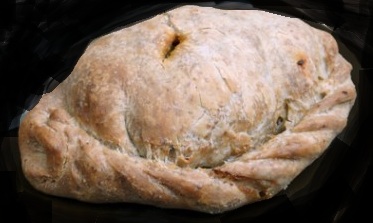
The solid ridge of pastry, hand crimped along the top of the pasty, was so designed that the miner or traveler could grasp the pastie for eating and then throw the crust away. By doing this, he did not run the risk of germs and contamination from dirty hands. The crusts were n0t wasted though, as many miners were believers in ghosts or “knockers” that inhabited the mines, and left these crusts to keep the ghosts content. There is some truth to this rumor, because the early Cornish tin mines had large amounts of arsenic, by not eating the corner which the miners held, they kept themselves from consuming large amounts of arsenic.
One end of the pasty would usually contain a sweet filling which the wives would mark or initial so the miner would not eat his dessert first, while the other end would contain meat and vegetables. The true Cornish way to eat a pasty is to hold it in your hands, and begin to eat it from the top down to the opposite end of the initialed part. That way its rightful owner could consume any left over portion later.
Pasties are one of the most ancient methods of cooking and of carrying cooked food. It is said that the early Irish Catholic Priests created them in order to transport food as they walked about the countryside preaching and aiding the people. The dish is mentioned in Shakespeare’s Merry Wives of Windsor (1598).
The earliest known reference to the pasty contribute it to the Cornish. From 1150 to 1190, Chretien de Troyes, French poet, wrote several Arthurian romances for the Countess of Champagne. In one of them, Eric and Enide, it mentions pasties:
Next Guivret opened a chest and took out two pasties. “My friend,” says he, “now try a little of these cold pasties and you shall drink wine mixed with water….” – Both Guivret and Eric came from various parts of what today is considered Cornwall.
Irish people that migrated to northern England took the art of pastie making with them. Soon every miner in northern England took pasties down into the mine for his noon lunch. Pasties were also called oggies by the miners of Cornwell, England. English sailors even took pastie making as far as the shores of Russia (known as piraski or piragies.
The Cornish people who immigrated to Michigan’s Upper Peninsula in the United States, in the middle of the 19th century, to work in the mines made them. The miners reheated the pasties on shovels held over the candles worn on their hats. In Michigan, May 24th has been declared Michigan Pasty Day.
In the Upper Peninsula of Michigan the pasty has gone from an ethnic food to a regional specialty.
In 1968, Governor George Romney declared May 24th as Michigan Pasty Day.
This pasty recipe is courtesy of Kim Miller of Newberg, Oregon. A native of Traverse city, Michigan, Kim says that she does not know which family member this recipe originally came from, but that it has been passed down and shared by three generations of women in her family since the late 1930s.
- 1 cube beef bullion
- 1/2 cup hot water
- 5 1/2 cups potatoes, diced
- 2 medium carrots, shredded
- 1 medium onion, finely diced
- 1/2 cup rutabaga, finely diced*
- 1 pound lean ground beef
- 1/2 pound lean ground pork
- 1 teaspoon black pepper
- 1 1/2 teaspoons salt
- Tomato ketchup
- 4 1/2 cups flour (all-purpose)
- 1 teaspoon salt
- 1 cup solid vegetable shortening or lard
- 1 1/3 cups water, chilled
-
Preheat oven to 425 degrees F.
-
Make Pasty Crust (see recipe below).
-
In a large bowl, dissolve beef bouillon cube in hot water. Add potatoes, carrots, onion, rutabaga, ground beef, ground pork, pepper, and salt; gently stir until well mixed.
-
Place 1 1/2 cups of vegetable filling in the center of each rolled dough rectangle; bring short (6-inch) sides together and seal by crimping edges together. Makes 3 or 4 small slits in the top of the pasty to allow steam to escape during cooking.
-
Place pasties onto a large ungreased baking sheet. Bake 45 to 55 minutes or until golden brown; remove from oven.
-
Can be served warm, but real Michiganities eat their pasties cold with tomato ketchup. They make a great sack lunch and freeze well.
-
Makes 6 pasties.
-
In a large bowl, sift together flour and salt. With a pastry blender or two knives, cut vegetable shortening into flour mixture until particles are the size of small peas. Sprinkle in water, a little at a time, tossing with fork until all flour is moistened and pastry dough almost cleans side of bowl. Form dough into a ball and cut dough into 6 sections.
-
On a lightly floured surface with a floured rolling pin, roll out each section into 6 x 8-inch rectangles. Fill and bake as directed in recipe.
* Turnips may be substituted.
Comments from readers:
Thanks for the history of the Cornish Pasty! My family came over from Cornwall as copper/ore miners to the Ishpeming area. I learned from my mother, who learned from her mother. I hadn’t made Cornish Pasty in years, but ran across a recipe I’d transcribed as I helped her make hers years ago, so gave it whirl. They were great! – Susan Boase, Portland, OR (1/28/15)
Thank you for publishing the Michigan Cornish Pasty recipe. I’ll be trying it this weekend. My husband is a Michigander who fell in love with pasties when he was in college at Michigan Tech in the U.P. Until now, the only Michigan version of the recipe we could find was the one from the university’s cook. It called for something like 500 pounds of flour and entire crops of the root vegetables! They serve it at homecomings, class reunions, and the school’s 125th anniversary celebration. Yoopers are kind of crazy when it comes to pasties and every Tech alum is a Yooper at heart.
There’s a statement in the recipe: “Can be served warm, but real Michiganities eat their pasties cold with tomato ketchup.” Apparently Ms. Miller has been away from Michigan too long because all the Michigan natives I know call themselves Michiganders. Wikipedia also lists Michiganian, but I’ve never heard anyone use that term. I often tease my husband by telling him that by extension of the nickname, Michigan women should be called Michigeese. – A Michigander’s Goose (1/23/15)
15 Responses to “Cornish Pasty History and Recipe”
Warren Swaine
I have no doubt that that will be a tasty pasty, and the back story is accurate. I’m happy to allow it as a Michigan variant but it isn’t a Cornish pasty! I was born in Cornwall and my Dad showed me how to make an “oggie” when I was about 9.
Pork – No! Carrot – No! Ground beef – No!
A proper Cornish pasty is made with dry uncooked ingredients. Skirt (in the UK this is called chuck steak) cut into approx 1/4″ pieces not minced. Potato, swede (or turnip) and onion the same size. Pastry is filled with these and generously peppered. Other than that, you can follow this recipe.
Hope this helps.
Mary Bronson
Thank you. I read the recipe with my eyes wide. I learned from my grandma, who was from Cornwall. We always used chuck, potatoes, rutabaga, and onion. Mom used to add a teaspoon of water. I have 2 or 3 when I go up th the UP of Michigan. God Bless.
Liz Hornbaker
When I went camping for the first time in the UP, I discovered the pasty. Although the locals were amused (laughing uproariously) by my mispronunciation of the word, I purchased one. I loved it and consumed them every time I went camping. I have fond memories of both pasties and camping in the Upper Peninsula.
R Smith
Will try your pasty but will make smaller pastys but not change the recipe! Want to tastw them again and have not had any for quite a while!
Rodney R
I’m sure every family that makes pasties has their own ingredients. I learned from my mother, born in the Keweenaw, raised in the copper mining town of Phoenix, and she from her mother (Croatian). Contains only diced chuck, potatoes and onion, a bit of salt and pepper as well as a daube of butter on top of the mix. Always served hot, NEVER with ketchup. My grandfather and uncles had them delivered by my grandmother in a pail, covered with a cloth. My mother tried adding other vegetables (carrot, rutabaga, or turnip), but my brother and I always asked her not to, as the simple ingredients were wonderful as-is.
Gloria
You are right. My husband is a YOOPER & all the family and other yoopers ONLY use chuck steak or roast and potatoes, cut into small pieces, plus diced onions, salt, pepper and parsley, a pat or two of butter, then baked. They are served hot. Now many DO add ketchup as they eat them, but I don’t.
JANET JARWOOD
This is not a cornish pastie, for a start they do not have carrots of any shape or form and the meat used is skirt beef not mince/ground beef and never pork. What the hell is rutabaga. Tomato ketchup, never. Bullion. Never. A pastie is just skirt potato swede(you dont even mention the swede)and onion. salt and pepper. You can not call your concoction a cornish pastie
Whats Cooking America
Keep in mind every family will have their own version of meat and vegetables they like to stuff in their pasty. This recipe came from a contributor and it has been in their family for generations.
Cornball
Cornish pastry, I tink you would add some meat,onions and carrots if you like,pepper and salt,the UK is pretty bland and definitely cheap with ingredients.
Cook for 40 minutes in flour she’ll and enjoy the bland taste.
Lois Blackburn
In case there is any confusion, rutabega is swede. Rutabegas are large turnips. America-rutabega. UK-swede.
Michael Kizer
Mom was born /raised in the U.P. Her family was Czech, had polacks , finns, and jews as neighbors. She remembers eating ‘Pasties’. She added carrots just to add another vegetable to our diet. The beef used is what was in the freezer/ on sale that week. It might be dry, ketchup was handy, and some people seem to like rutabagas and turnips, personally I Can’t imagine. The church sold 3 for 5 dollars on Sunday. Can’t be beat.
Paul
Rutabagas/Swedes aren’t large turnips. They are a cross between cabbage and turnip. Much milder flavour than a turnip. Sometimes they are called yellow turnips around here (Port Elgin, ON).
MaryJo
OMGosh this brought back memories. When I lived in Michigan I worked in the building upstairs from Cousin Jenny’s Pasties in Traverse City. I would stop in the morning & get what they called a Bobby for breakfast. It would have ham, bacon, sausage, etc.. It was a smaller version of the pasty. I checked & they do have a website & better yet you can order them by the dozen. Can’t wait. I’m SO excited. cousinjenniespasties.com
MaryJo
Oooops. It’s cousinjennyspasties.com
James
Never put carrot in a cornish pasty. It is a sin! A pasty contains beef Skirt, sliced onions, thinly sliced potato and thinly sliced swede/turnip. Then you season it with salt and pepper. It creates it own juices while cooking which usually takes about an hour. Trust me on this one 😉😀👍