
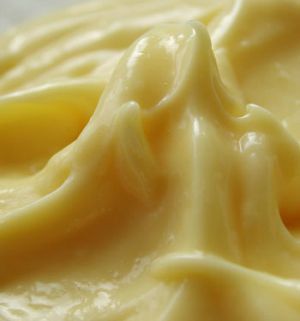
 The word “sauce” is a French word that means a relish to make our food more appetizing. Sauces are liquid or semi-liquid foods devised to make other foods look, smell, and taste better, and hence be more easily digested and more beneficial.
Because of the lack of refrigeration in the early days of cooking, meat, poultry, fish, and seafood didn’t last long. Sauces and gravies were used to mask the flavor of tainted foods.
200 A.D. – The Romans used sauces to disguise the taste of the food. Possibly to conceal doubtful freshness. According to the article Food & Cooking in Roman Britain by Marian Woodman:
The main course, or primae mensai varied both in the number and elaboration of dishes. Roast and boiled meat, poultry, game or other meat delicacies would be served. No dish was complete without its highly flavoured and seasoned sauce. Contrary to present day preference, the main object seemed to be to disguise the natural taste of food – possibly to conceal doubtful freshness, possibly to demonstrate the variety of costly spices available to the host. Sometimes so many ingredients were used in a sauce it was impossible to single out any one flavour. One Roman cook bitterly complained that some of his fellow cooks ‘When they season their dinners they don’t use condiments for seasoning, but screech owls, which eat out the intestines of the guests alive’. Apicius wrote at the end of one of his recipes for a particularly flavoursome sauce, ‘No one at table will know what he is eating’. These sauces were usually thickened with wheat flour or crumbled pastry. Honey was often incorporated into a ‘sweet-sour’ dish or sauce.
Highly flavoured sauces often containing as many as a dozen ingredients were extensively used to mask the natural flavours of Roman food. The most commonly used seasoning was liquamen, the nearest equivalent today being a very strong fish stock, with anchovies as its main ingredient. This was so popular that it was factory-produced in many towns in the Roman empire.
1651 – A little heard of sauce today, but very popular in the 17th century is Sauce Robert. It is similar to the present day Espagnole Sauce. Both Sauce Rober and Espangnole are basically a brown roux (a combination of fat and flour to create a thickening agent).
In le Grand Cuisinier (1583) there is a mention of a sauce Barbe Robert, sauce already found in le Viandier under the name “taillemasl” (fried onions, verjus, vinegar, mustard) for roasted rabbit, fry fish and fry egg.
Franis Rabelais (Circa 1483-1553)in le Quart-Livre, mention: “Robert, the one who invented the sauce Robert indispensable for roast, rabbits, duck, pork, poached eggs…”
There are Five Foundation Sauces or Basic Sauces
Grandes Sauces or Sayces Meres
Two of them have a record of two hundred years behind them; they are the “bechamelle” and the “mayonnaise”. They have lasted so long, not only because they are very good, but also because they are so adaptable and provide a fine basis for a considerable number of other sauces.
The other three, which also date back to the 18th century, are the “veloute,” the “brune,” and the “blonde.” These five sauces still provide the basis for making of many modern sauces, but no longer of most of them.
Modern sauces may be divided into two classes: the “Careme” and “Escoffier” classes. Among the faithful, in the great kitchen of the world, Escoffier is to Careme what the New Testament is to the Old. See “Mother Sauces” for descriptions of the five basic sauces.
Aioli (eye-YO-lee) – Aioli is a thick garlic sauce used in the cooking of Provence, France, and of Catalonia in Spain. It is often compared to mayonnaise in its texture, but it is not actual mayonnaise. It is though by culinary historians that Aioli is a Roman sauce, the one the Romans called “aleatum” made of garlic and oil.
History: The first apparent written mention of a sauce resembling aioli was by Pliny the Elder (23-79 A.D.), the Roman procurator in Tarragona (a city located in the south of Catalonia on the north-east of Spain.) He writes about garlic (Latin term: aleatum) in his first century book Naturalis Historia. Information below by Peter Hertzmann from his la carte website:
Natural History (Naturalis Historia) is an encyclopedia published around AD 77–79 by Pliny the Elder (23-79 AD). It is one of the largest single works to have survived from the Roman Empire to the modern day and purports to cover all ancient knowledge.
Whether garlic was introduced to France by the Romans, brought back to France during the crusades, or a native of French soil is not known for certain. (I think it was introduced by the Romans.) Pliny the Elder discusses garlic at some length in his work Naturalis Historia, published in the year 77. He states that it “is generally supposed, in the country more particularly, to be a good specific for numerous maladies.”
Later, in a chapter entitled “Garlic: Sixty-One Remedies,” Pliny writes, “Garlic has very powerful properties, and is of great utility to persons on changes of water or locality. The very smell of it drives away serpents and scorpions, and, according to what some persons say, it is a cure for wounds made by every kind of wild beast, whether taken with the drink or food, or applied topically…. Pliny does not discuss the use of garlic as food, he does comment extensively, however, on how to best grow garlic.
Bearnaise sauce (bair-naz) – It is a variation of hollandaise sauce. White wine or vinegar, diced shallots, tarragon, and peppercorns are cooked together and reduced and sieved and then added to hollandaise sauce. The spice tarragon is what gives it a distinctive taste. The sauce is served with beef and some shellfish.
History: Chef Jules Colette at the Paris restaurant called Le Pavillon Henri IV in the 19th century invented Brnaise sauce in Paris, France. It was named Brnaise in Henry’s honor as he was born in Bearn, France (a region in the Pyreness mountain range in southwest France). It is said that every chef at the restaurant tried to claim the recipe as his own.
Bechamel Sauce (bay-shah-mel) – As the housewife in the 17th Century did not have the luxury of modern refrigeration, they were wary of using milk in their recipes. Peddlers were known to sell watered down or rancid produce. Basically, only the rich or royalty could use milk in their sauces.
In France, it is one of the four basic sauces called “meres” or “mother sauces” from which all other sauces derive. It is also know as “white sauce.” It is a smooth, white sauce made from a roux made with flour, boiled milk, and butter. It is usually served with white meats, eggs, and vegetables. It forms the basis of many other sauces.
History: There are four theories on the origin of Bhamel Sauce:
The Italian version of who created this sauce is that it was created in the 14th century and was introduced by the Italian chefs of Catherine de Medici (1519-1589), the Italian-born Queen of France. In 1533, as part of an Italian-French dynastic alliance, Catherine was married to Henri, Duke of Orleans (the future King Henri II of France. It is because of the Italian cooks and pastry makers who followed her to France that the French came to know the taste of Italian cooking that they introduced to the French court. Antonin Careme (1784-1833), celebrated chef and author, wrote in 1822: “The cooks of the second half of the 1700’s came to know the taste of Italian cooking that Catherine de’Medici introduced to the French court.”
Bechamel Sauce was invented by Duke Philippe De Mornay (1549-1623), Governor of Saumur, and Lord of the Plessis Marly in the 1600s. Bechamel Sauce is a variation of the basic white sauce of Mornay. He is also credited with being the creator of Mornay Sauce, Sauce Chasseur, Sauce Lyonnaise, and Sauce Porto.
Marquis Louis de Bechamel (1603–1703), a 17th century financier who held the honorary post of chief steward of King Louis XIV’s (1643-1715) household, is also said to have invented Bechamel Sauce when trying to come up with a new way of serving and eating dried cod. There are no historical records to verify that he was a gourmet, a cook, or the inventor of Bechamel Sauce. The 17th century Duke d’Escars supposedly is credited with stating: “That fellow Bechameil has all the luck! I was serving breast of chicken a la creme more than 20 years before he was born, but I have never had the chance of giving my name to even the most modest sauce.”
It is more likely that Chef Francois Pierre de la Varenne (1615-1678) created Bechamel Sauce. He was a court chef during King Louis XIV’s (1643-1715) reign, during the same time that Bechamel was there. He is often cited as being the founder of haute cuisine (which would define classic French cuisine). La Varenne wrote Le Cuisinier Francois (The True French Cook), which included Bechamel Sauce. It is thought that he dedicated it to Bechamel as a compliment. La Varenne recipes used roux made from flour and butter (or other animal fat) instead of using bread as a thickener for sauces.
Chasseur Sauce – Chasseur is French for hunter. It is a hunter-style brown sauce consisting of mushrooms, shallots, and white wine (sometimes tomatoes and parsley). It is most often served with game and other meats. Chasseur, or “Hunter Style” was meant for badly shot game or tough old birds. The birds were always cut up to remove lead shot or torn parts, and often cooked all day on the back of the range if they were old or tough. Originally the veggies used were ones hunters would find while they hunted. This can be scaled up.
History: It is thought that Chasseur sauce was invented by Duke Philippe De Mornay (1549-1623), Governor of Saumur, and Lord of the Plessis Marly in the 1600s. He was a great protestant writer and called the protestant pope. It is said that he also invented Mornay Sauce, Sauce Bechamel, Sauce Lyonnaise, and Sauce Porto.
Coulis (koo-LEE) –
(1) A French culinary term. It is a type of a sauce, usually a thick one, which derives it body (either entirely or in part), from pureed fruits or vegetables. A sauce of cooked down tomatoes can be a tomato coulis as can a puree of strained blackberries.
(2) Today coulis also means a thick soup made with crayfish, lobster, prawns, and other crustaceans – the word being used where bisque has formerly been used.
History: In old English cookbooks, the world “cullis” is found but this has fallen into disuse and “coulis” has taken its place. At one time, coulis were sauces and also the juices which flowed from roasting meat. Some cooks called liquids purees coulis, but only those prepared with chicken, game, fish, crustaceans, and some vegetables.
Hollandaise Sauce (HOL-uhn-dayz) – Hollandaise mean Holland-style or from Holland. Uses butter and egg yolks as binding. It is served hot with vegetables, fish, and eggs (like egg benedict). It will be a pale lemon color, opaque, but with a luster not appearing oily. The basic sauce and its variations should have a buttery-smooth texture, almost frothy, and an aroma of good butter. Making this emulsified sauce requires a good deal of practice — it is not for the faint of heart. Bearnaise sauce, which is “related” to hollandaise sauce, is most often served with steak.
History – Most historians agree that it was originally called Sauce Isigny after a town in Normandy, Isigny-sur-Mer, known for its butter. Today, Normandy is called the cream capital of France. During World War I, butter production came to a halt in France and had to be imported from Holland. The name was changed to hollandaise to indicate the source of the butter and was never changed back.
17th Century – Sauce Hollandaise, as we now know it, is the modern descendant of earlier forms of a sauce believed to have been brought to France by the Heugenots. It appears to have actually been a Flemish or Dutch sauce thickened with eggs, like a savory custard, with a little butter beaten in to smooth the texture.
1651 – Francois Pierre de La Varenne (1618-1678), in his cookbook, Le cuisine franis (The True French Cook) has a recipe for a similar sauce in his recipe for Asparagus in Fragrant Sauce:
“Choose the largest, scrape the bottoms and wash, then cook in water, salt well, and don’t let them cook too much. When cooked, put them to drain, make a sauce with good fresh butter, a little vinegar, salt, and nutmeg, and an egg yolk to bind the sauce; take care that it doesn’t curdle; and serve the asparagus garnished as you like.”
Marinara (mah-ree-NAH-rah) – Means “sailor” in Italian (sailor style of tomato sauce). A spicy, quickly cooked pasta sauce of Italian origins but far more popular in American restaurants featuring southern Italian cuisines than in most of Italy.
Mayonnaise (MAY-uh-nayz) – Mayonnaise is an emulsion consisting of oil, egg, vinegar, condiments, and spices.
History: When first invented, it was called Mahonnaise. According to the Oxford English Dictionary, the sauce got its present name of mayonnaise purely by accident through a printing error in an early 1841 cookbook. There are many conflicting stories on the origin of mayonnaise:
Most authorities believe the first batch of this mixture of egg yolks, oil and seasonings was whipped up to celebrate the 1756 French capture of Mahon, a city on the Spanish Isle of Minorca, by forces under Louis-Francois-Armad de Vignerot du Plessis, duc de Richelieu (1696-1788). The Duke, or more likely, his personal chef, is credited with inventing mayonnaise, as his chef created a victory feast that was to include a sauce made of cream and eggs. Realizing that there was no cream in the kitchen, the chef substituted olive oil for the cream and a new culinary creation was born. Supposedly the chef named the new sauce “Mahonnaise” in honor of the Duc’s victory. Besides enjoying a reputation as a skillful military leader, the Duke was also widely known as a bon vivant with the odd habit of inviting his guests to dine in the nude.
Early French immigrant cooks that originally lived in Fort Mahon brought the original recipe to Minnesota. An old superstition is that a woman should not attempt to make mayonnaise during menstruation time, as the mayonnaise will simply not blend together as well.
Some historians state that Marie Antoine Careme (1784-1833), celebrated French chef and author, proclaimed that mayonnaise was derived from the word magnonaise (magner means “made by hand” or “stir”). Due to the time period of when Careme was a chef, this theory doesn’t make sense, as he would surely have know the history of the name, had mayonnaise been created as recently as 1756.
The French cities Bayonne and Les Mayons also claim to be the place of birth of mayonnaise.
Les Mayons, capital of Minorque in the Balearic Islands, occupied by English and conquered by the French admiral Louis-Franis-Louis-Franis-Armand of Plessis de Richelieu. He brought back a local sauce based on lemon juice key and egg yolk, olive oil, raised of a little black pepper and marine salt, garlic or fresh grass.
Bayonne, a resort town on the Aquitaine/Basque coast in southwest France. It is thought that mayonnaise could be an alteration and corruption of bayonnaise sauce. Nowdays, bayonnaise refers to a mayonnaise flavored with the Espelette chiles.
The sauce may have remained unnamed until after the Battle of Arques in 1589. It may then have been christened “Mayennaise” in ‘honor’ of Charles de Lorraine, duc de Mayenne (1554-1611), supposedly because he took the time to finish his meal of chicken with cold sauce before being defeated in battle by Henri IV (1553-1610).
Other historians claim it received its name from the Old French words “moyeunaise” or “moyeu,” meaning, “egg yok.”
1910 – Nina Hellman, a German immigrant from New York City, made a dressing that her husband, Richard Hellman, used on the sandwiches and salads he served in his New York delicatessen. He started selling the spread in “wooden boats” that were used for weighing butter. Initially he sold two versions of the recipe, and to differentiate between the two, he put a blue ribbon around one. In 1912, there was such a great demand for the “ribbon” version, that Hellmann designed a “Blue Ribbon” label, which he placed on larger glass jars. He did so well that he started a distribution business, purchased a fleet of trucks, and in 1912 built a manufacturing plant. Also Best Foods, Inc. in California did the same. Hellman and Best Foods later merged and account for about 45% of all bottled mayonnaise sole in the United States.
Newburg Sauce – An American sauce that was created at the famous Delmonico Restaurant in New York City by their French chef, M. Pascal. This elegant sauce is composed of butter, cream, egg yolks, sherry, and seasonings. It is usually served over buttered toast points. The sauce is also used with other foods, in which case the dish is usually given the name “Newburg.”
History: The sauce was originally named after a Mr. Wenburg, a frequent guest at the Delmonico restaurant. Mr. Wenburg and the boss of the Delmoico had an argument, thus causing Wenburg to insist that the sauce be renamed. The first three letters were changed to “New” instead of “Wen” to create the name “Newberg.”
Mother Sauces – Also called Grand Sauces. These are the five most basic sauces that every cook should master. Antonin Careme, founding father of French “grande cuisine,” came up with the methodology in the early 1800’s by which hundreds of sauces would be categorized under five Mother Sauces, and there are infinite possibilities for variations, since the sauces are all based on a few basic formulas. Sauces are one of the fundamentals of cooking. Know the basics and you’ll be able to prepare a multitude of recipes like a professional. Learn how to make the basic five sauces and their most common derivatives. The five Mother Sauces are:
Bechamel Sauce (white)
Veloute Sauce (blond)
Brown (demi-glace) or Espagnole Sauce
Hollandaise Sauce (butter)
Tomato Sauce (red)
Remoulade (ray-muh-LAHD) – A chilled flavored mayonnaise used in French cuisine. It includes mayonnaise, anchovies or anchovy paste, mustard, capers, and chopped pickles that are served as a dressing for cold meats, poultry or seafood.
Veloute Sauce (veh-loo-TAY) – Also called sauce blanche grasse or fat white sauce, rich white sauce. One of the five “mother sauces.” It is a stock-based white sauce that can be made from chicken, veal, or fish stock thickened with white roux. ee Mother Sauces for more information.
Allemande Sauce – Veal veloute with egg yolk and cream liaison.
Supreme Sauce – Chicken veloute reduced with heavy cream
Vin Blanc Sauce – Fish veloute with shallots, butter, and fines herbs.
Sources:
2001 Food Secrets Revealed, by Dr. Myles H. Bader, published by Northstar Publishing, 1997.
A Concise Encyclopediea of Gastronomy, by Andre L. Simon, published by Harcourt, Brace and Company, New York, 1952.
Bull Cook and authentic Historical Recipes and Practices, by George Leonard Herter and Berthe E. Herter, , published by Herter’s Inc., 1960.
Food & Cooking in Roman Britain’ by Marian Woodman. The Romans in Britian, Roman Cooking Part 3.
Key Terms In Cuisine, by Dr. John Skull, published by Elbrook Press, Australia, 1991.
Ladyfingers & Nun’s Tummies, by Martha Barnette, published by Times Books, 1997.
Larousse Gastronomique – The Encyclopedia of Food, Wine & Cooker, by Prosper Montagne, published by Crown Publishers Inc., 1961
Menu Mystique, by Norman Odya Krohn, published by Jonathan David Publishers, Inc, New York, 1983.
Royal Cookbook (Favorite Court Recipes from the World’s Royal Families, by Editors of Parent’s Magazine, published by Parent’s Magazine Press, New York, MCMLXXI.
The Dictionary of American Food & Drink, by John F. Mariani, published by Ticknor & Fields, 1983.
The Food Chronology, by James Trager, published by Henry Holt & Company, 1995.
The Horizon Cookbook – Illustraated History of Eating and Drinking through the Ages, William Harlan Hale and the Editors of Horizon Magazine, published by American Heritage Publishing Co., Inc., 1968.