
Article by Linda Stradley of What’s Cooking America.
Health claims on food packages can be confusing, and it is sometimes hard to reconcile the information of the front of the package with what’s on the nutrition facts panel on the back of the package.
Have you ever been confused by the information on the labels on the food you buy to eat? Especially when you are trying to cut calories, fat, and carbohydrates.
Do you read the labels on the food you buy for yourself and your family? If you don’t, it is time to educate yourself and start. What are those food labels really saying? A food label is like a recipe – It tells you what is in the food you eat. You do want to know what you are putting into your body? In order to plan a healthy diet, you must know how to read a food label.
This article will help you make quick, informed choices that that can help contribute to healthy eating through more informed label reading.
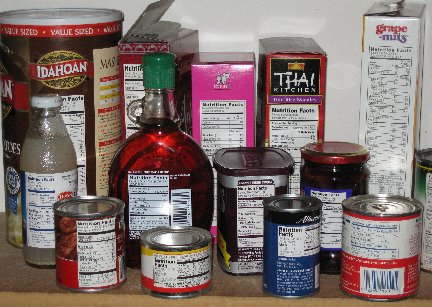
 When trying to figure out what the food you are thinking of buying actually contains, ignore the front of the package hype! It is just that – marketing hype. Manufacturers can not actually lie on labeling, but they can stretch the true when trying to get your attention to buy their product.
Every packaged food must include a list of ingredients. The ingredient in largest quantity is listed first, while the one in smallest quantity is listed last.
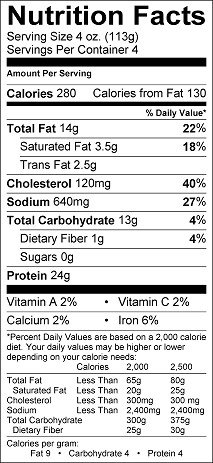
Recommended serving size/Calories per serving. The first items, at the top of the label, you will notice are Serving Size and Servings Per Container. Serving Size is a standard measure of food. Servings Per Container represents the number of servings found in the food package. Serving size can be expressed in kitchen terms – cups, spoons, slices, ounces, and also in grams. Serving size tells how much food makes up a single serving. All data on the label is based on the serving size stated.
Amount Per Serving – Shows the number of calories found in a single food serving. Multiply this number by the serving size and it should equal, or come close to, the total volume of the package.
Sample Food Label on left: Always remember that the calories listed are based on one (1) individual serving from the container. 4 servings x 280 calories = 1,230 total calories in the container/box/bottle on the sample food label.
Calories from fat – Food labels show Calories from Fat so you can limit the amount of fat you eat for a healthier diet. The rule of thumb is that no more than 30% of your daily calories should come from fat. Higher fat foods should be eaten in smaller portions.
% Daily Value -This section tells you what percentage of the total recommended daily amount of each nutrient (fats, carbs, proteins, major vitamins, and minerals) is in each serving, based on a 2,000 calorie per day diet.
Total Fat– This equals the number of grams of fat per serving of the food. A heart-healthy diet limits foods containing saturated fats, trans fats, cholesterol, and sodium.
Saturated Fat – A fat that is solid at room temperature and comes chiefly from animal food products and some plants. Some examples of saturated fat include foods such as beef, lamb, pork, lard, butter, cream, whole milk and high fat cheese. Plant sources include coconut oil, cocoa butter, palm oil and palm kernel oil. Saturated fat causes high LDL cholesterol levels — a risk for cardiovascular disease.
Trans Fat – Also known as also known as trans fatty acid. Trans fat is a specific type of fat formed when liquid fats are made into solid fats by the addition of hydrogen atoms, in a process strangely enough known as hydrogenation. Hydrogenation solidifies liquid oils and increases the shelf life and the flavor stability of oils and foods that contain them. Trans fat is found in vegetable shortenings and in some margarines, crackers, cookies, snack foods and other foods. Small amounts of trans fats are found naturally in certain animal based foods. Trans fat is what is considered unhealthy fat.
Cholesterol – This line tells you how many milligrams of cholesterol and what percent this is of the recommended daily value.
Sodium/salt -The latest recommendation for sodium is less than 2,400 mg of sodium per day, or about a teaspoon of table salt.
Total carbohydrates – Tells you how many grams of carbohydrates are in each serving and the percentage of the Daily Value this represents. This number includes starches, complex carbohydrates, dietary fiber, added sugar sweeteners, and non-digestible additives.
Fiber – Fiber is an indigestible carbohydrate and aids in elimination. At least 15 grams of fiber per day is recommended.
Protein – Many foods contain some protein but meat, fish, poultry and dairy foods are highest. Protein needs average between 50-100 grams per day.
Percent Daily Values -This section gives some estimated nutrients per 2000 and 2500 calories.
The FDA also regulates the use of certain words or phrases on food packaging. Before May 8, 1994, a food product claiming to be “light” could just be light in color, texture or taste. But now such creative, and often misleading, labeling jargon is regulated. Terms used on the new food labels must adhere to the following FDA definitions:
Light– Means that the food has half the fat, one-third the calories or half the salt of its regular counterpart. It can still be used to describe other properties like color or texture as long as the label makes the distinction clear (for example, “light brown sugar” or “light and fluffy”).
Fat-Free or Sugar-Free – Indicates that none of the substance cited (or only a negligible amount) is in the product. For instance, a calorie-free product must have fewer than five calories per serving, while fat-free and cholesterol-free foods should have less than half a gram per serving. Related words, such as “without,” “no” and “zero,” must meet the same standards. For example, suppose a food is labeled 95 percent “fat-free.” This means that five percent of the total weight of the food is fat, (which may not seem like much), yet a single gram of fat contains nine calories compared to four calories in a gram of protein or carbohydrates.
Fresh – Means unprocessed, uncooked, unfrozen (for example, fresh or freshly-squeezed orange juice). Washing and coating of fruits and vegetables are allowed. If a food has been quickly frozen, it can be described as fresh-frozen, which is commonly done with fresh fish.
Healthy – Means the food may contain no more than 3 grams of fat (including one gram of saturated fat) and 60 milligrams of cholesterol per serving.
High – As in high-fiber, means the product has 20 percent or more of the daily value for the nutrient cited.
Good Source – Indicates that one serving of the food contains 10 to 19 percent of the daily value for a particular nutrient.
Lean – Can be used to describe the fat content of meat, poultry and seafood. To be called “lean,” a serving of the product must have less than 10 grams of fat, 4.5 grams or less of saturated fat, and less than 95 milligrams of cholesterol. “Extra lean” has also been defined to mean less than 5 grams of fat, less than 2 grams of saturated fat and less than 95 milligrams of cholesterol.
Less and fewer – Can be used to describe foods that have a nutrient or calorie content which is reduced by at least 25 percent.
Low Fat – May be used on products that do not exceed the dietary guidelines for fat, saturated fat, cholesterol, sodium or calories. The criteria they must meet are:
Low-fat: 3 grams or less per serving
Low-saturated fat: 1 gram or less per serving
Low-sodium: 140 milligrams or less per serving
Low-cholesterol: 20 milligrams or less of cholesterol and 2 grams or less of saturated fat per serving
Low-calorie: 40 calories or less per serving
Natural flavors– The Federal Food, Drug, and Cosmetic Act defines “natural flavors” as: “the essential oil, oleoresin, essence or extractive, protein hydrolysate, distillate, or any product of roasting, heating, or enzymolysis, which contains a flavoring constituent derived from a spice, fruit, fruit juice, vegetable, vegetable juice, edible yeast, herb, bark, bud, root, leaf, or similar plant material; meat, seafood, poultry, eggs, dairy products, or fermentation products thereof whose significant function in food is flavoring rather than nutritional. This broad definition simply means that “natural flavors” are extracts from these non-synthetic foods.
Reduced – Means that a nutritionally altered product contains at least 25 percent less of a nutrient or of calories than the regular product.
Did You Know – In the nineteenth century, food labels barely identified what was inside a box or container. People who lived at that time just had to eat the food and hope for the best!
First, the Federal Food and Drug Act allowed the federal government to regulate the safety and quality of food. By 1924, the FDA no longer allowed untrue health claims and statements on food labels that might mislead people. After that, the net weight of the food produced and names and addresses of the food manufacturer or distributor had to be printed on labels as well. Ingredient lists also became common on labels.
Additional food articles to help you on your diet:
Categories:
Cooking Lessons - Cooking 101