
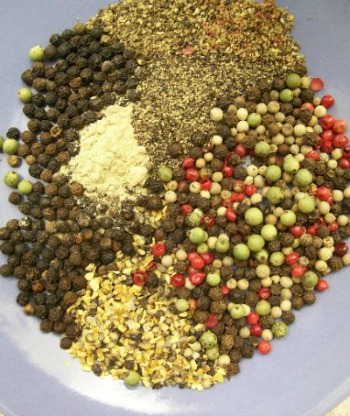
Along with salt, pepper is on nearly every table. Historically significant, pepper is the most common spice in use. Nutritionally beneficial and medicinally positive, pepper offers a unique flavor and a variety of uses. It is the third most common ingredient behind water and salt. There are a variety of peppercorns commonly used.
This master spice is versatile in all forms. It offers up a vibrant flavor suitable for any dish. Historically, it has led an illustrious and full life giving fortune and paying ransoms. Pepper is used daily by most people and offers health benefits along with adding its unique flavor. Reach for that pepper shaker or grinder and enjoy all the benefits it has to offer!
Types of Pepper
Peppercorns (piper nigrum) ground for use on the table and in cooking originally only came from India, but is now also cultivated in Indonesia, Malaysia, China, Sri Lanka, Madagascar, and South America. India is still the major producer of this spice with over half of the product coming from there.
A perennial bush, which often grows wild, is produced in mounds with trellises similar to grape vines. These mounds are usually about 8-feet tall but the bush itself can grow up to 33 feet in the proper climate. The bush has a round and smooth jointed stem; dark green leaves which are smooth, broad, and have seven nerves in them; and small white flowers. The flowers become the berries which are harvested. The flowers grow in clusters of up to 150. Grown from cuttings, the bush bears fruit at three to four years until about fifteen years. Typically the pepper bush grows within about 20 degrees of the equator some believe the closer to the equator the hotter the peppercorn.
From this bush, three types of peppercorn are harvested: black, green, and white. The difference in the peppercorns come from when the berry of the bush is harvested and how it is processed.
Black Peppercorns:
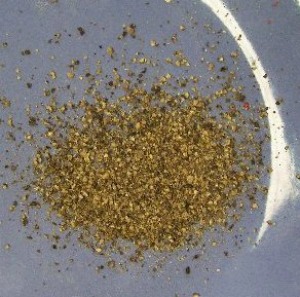 Black peppercorns are the dried berry and the most pungent and strongest in flavor of the three. The berries are picked just before they are ripe and are typically sun dried. As they dry, an enzyme is released which darkens the hull of the berry to anywhere from dark brown to jet black. Within the hull is a lighter seed which causes a variance in the color of the ground pepper.
Black pepper comes in many forms; whole, cracked, and ground. The ground pepper has varying degrees of coarseness from fine to coarse.
Some of the uses are as follows:
in whole form for pickling and stocks
cracked for meats and salads
ground for everything else
Tellicherry Peppers:
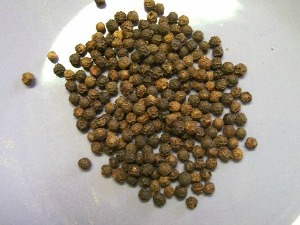 Currently the Tellicherry pepper is the most popular. It is named after the port and region it is gathered from. It is the oldest source of black pepper, though Alleppey and Pandjung are also long time ports for the export of this spice. The Tellicherry peppercorn is larger and darker than others. It has a more complex flavor which is why it is more popular.
Tellicherry and Malabar come from the same region in Southwest India. The Tellicherry is picked slightly closer to being ripe and is considered to be slightly better than the Malabar. Malabar has a green hue with a strong flavor.
Green Peppercorns:
Green peppercorns are the green berry picked long before they are ripe, which can be freeze-dried to preserve the smooth texture and bright color. While the green peppercorn gives a strong tart punch of flavor to begin with, it does not linger long in the mouth. These can also be pickled for shipment. The berries for the green and black peppercorns are actually picked at about the same time but the green are not allowed to dry causing which prevents that enzyme from activating. Green peppers only come packed in brine, water, or freeze-dried.
Some of the uses are as follows:
meat sauces
poultry
vegetables
seafood
White Peppercorns:
 The United States is one of the largest consumers of black pepper and has a much higher demand for the black pepper compared to white pepper. However, Europeans prefer the white pepper over the black.
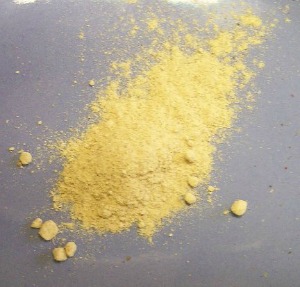
This peppercorn is the mature berries that are given a short water bath in order to remove the husks before the remaining seed is sun-dried. The removal of the husk prevents the dark color forming during the drying process. As the berry ripens, it becomes a bright red color. During the drying process, it becomes white. A second way for the white pepper to be harvested is to harvest the green berry, soak it for several days before rubbing off the outer layer. The remaining seed is then either dried for use whole or ground. This pepper has a long drawn out flavor which lingers.
White pepper has two forms: whole and ground. Generally white is preferred over black for any dish where the pepper might show like some of the following uses:
white sauces
cream soups
fish
poultry
grilled meats
Red Peppercorns:
These are rare and difficult to find, particularly in the United States. They are the red berries ripened on the vine. Instead of picking the berries, they are harvested with part of the vine. These are best used within a very short period of time. The red peppercorn has a sweet and mellow flavor in contrast to the pungent strong flavor of the black. Since these are rare in the United States, most recipes calling for red pepper are referring to ground cayenne or red chile’s.
Pink Peppercorns:
A rare find, this is created from the red berries of the piper nigrum and are preserved in a brine. These are too soft to grind so are often put into a recipe whole. The best dishes to use these in are egg dishes and salads.
Blends and Combinations:
Blending the three types of pepper doesn’t really enhance the flavors; however, there are two blends which can work nicely. Black and green combined add a bit more bite to a dish. Black and white combined makes the flavor linger longer. If pink peppercorns (see below), as opposed to the pink peppercorns (piper nigrum family) is added to a combination, its flavor is easily overpowered.
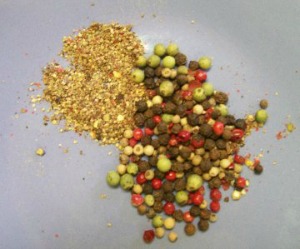
Medley Peppercorns:
Blends of different kinds of peppercorns are typically called medleys.
Lemon Pepper:
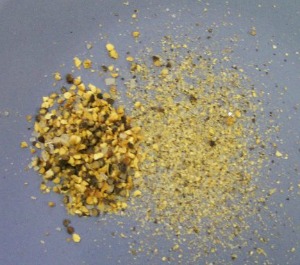
Peppercorns can also be blended with other products like garlic, coriander, lemon, shallot, and chipotle.
Many people have had lemon pepper chicken or fish, the main spice in those dishes come from a combination of lemon and pepper.
False Peppers:
There are several varieties of peppercorns which are do not belong to thepiper nigrum family. These come from a several different types of plants. The flavors of these are different from the piper nigrum plant so should not be used as a substitute. Some are as follows:
Long pepper (piper longum) originates in central Africa but is now in India, Africa, and Eastern China. This is harvested in summer. The bud fruit is about an inch long and consists of lots of tiny black and gray seeds. The taste is like a mild pepper and ginger combination. This was commonly used during the Middle Ages. This one can substitute for common pepper and is best used in sweet hot recipes accenting the ginger flavor. Some suggestions for use are on fruit (particularly fresh) or in coleslaw, this prevents the flavor from being cooked away.
Pink peppercorns (shinus molle) is grown in Madagascar, Mexico and Australia. The pale pink berries are harvested in the summer. Initially this has a pepper flavor but ends tasting sweet. It is good for vegetables and seafoods and is not a good replacement for regular pepper. This can cause an allergic reaction in children so follow the recipe precisely. The schinus terebinthifolius species is also used as a pink pepper. The plant looks similar to a holly tree and is grows in parts of the US like the shinus molle. There is an additional pink peppercorn which comes from the Baies rose plant (euonymus phellomanus) which is also from Madagascar. Pink peppercorns (shinus molle) is grown in Madagascar, Mexico, and Australia.
Sichuan or Szechuan pepper is found commonly in China and used in many Chinese and Japanese dishes, but also adds a zing to chicken noodle soup. The pepper derives from the berries of a prickly Ash tree native to China. These are more spicy than the regular pepper.
Negro Pepper (xylopia aethiopica) is grown in Ghana and Malawe. This one is harvested in the fall and when dried has dark brown seed pods. Like the piper nigrum, it is fruit which is dried in the sun. Also similar to piper nigrum, this has a strong flavor but it leaves a bitter after taste so is not a good substitute for regular pepper.
Pepperleaf (piper sanctum) is cultivated in Peru and Argentina. The leaves are harvested year round. The green leaf is plucked from a bush which is in the pepper family. It is very similar to cilantro and best used fresh. It has a little bite but mellows to a sweeter flavor.
History of Pepper
Like salt, this spice has a long and illustrious past. It has been popular for more than 4000 years; cultivation of pepper began about 1000 BC.
Pepper was actually the first spice used in Europe and helped to motivate the Spanish, English, and Dutch to find trade routes to India. It helped develop the relations among East, West, and Middle East countries. This spice was a luxury and only used by the upper class up until the early 1800s before average citizens could afford to use this spice. This spice is so valuable that even in some parts of Asia, poorer families hold peppercorns as a type of savings.
The spice dates back much further than these somewhat modern trade routes though. It was highly prized in ancient Greece, being given as an offering to the Gods, used for paying taxes, and even in paying ransoms. Some of the ransoms were paid to the Ottoman Tribes. Rome also utilized pepper for taxes. The famous Roman Centurions received peppercorns as part of their pay.
The Middle Ages saw the price of pepper equal that of gold. The upper class often kept stores of it and accepted it as payment for rent and other debts. One pound of peppercorns was worth three weeks of work during this time frame.
Pepper is known as the king or master spice because even today it makes up about a quarter of the spice trade. Historically, it was a popular spice to use because it flavored bland food and covered up any signs of spoilage.
Additional Uses
Aside from culinary deliciousness, pepper has other uses. It is toxic to several insects so is an effective insecticide. You can sprinkle pepper around non-garden areas to keep insects out. Mix teaspoon of freshly ground pepper to one quart of warm water and spray it on plants to kill ants, potato bugs, and silverfish.
Pepper has also been used as a brandy flavor and in perfumes.
The best way to determine the flavor of peppercorns is to smell them. To cleanse you nose and sense of smell try smelling coffee beans in between each sample.
Cooking Tips
Almost every recipe calls for a sprinkle or dash of pepper. For the novice, this can be a difficult measurement. Should you shake your pepper shaker once or twice? Should the grinder be turned five or six times? With the small measurements, it really doesn’t matter. However, if you are concerned about the intake of pepper, then five turns on your typical pepper grinder is about an 1/8 of a teaspoon.
Other helpful cooking tips include:
- Put a few peppercorns in your pepper shaker to add flavor and prevent clogging.
- If cooking a recipe with a lot of pepper, be cautious of the cooking steam for it may cause irritation.
- Use in the preparation of venison as it is complementary to its deep flavor.
- Add pepper at the end of the cooking process to reduce the loss of flavor.
- Combine olive oil, lemon juice, salt, and cracked pepper to make a salad dressing.
Health and Medicinal
In a Christmas Carol, Scrooge is trying to sneeze, sniffing from a sniff box containing pepper. This intimates one of the multiple health uses of pepper. This master spice has nutritional value and many medicinal uses. These uses have been put into practice since the time of Hippocrates.
The peppercorns are rich in vitamin A and K, as well as a good source of dietary fiberand contain the following:
calcium
magnesium
potassium
manganese
phosphorous
beta carotene
capsaicin which is supposed to block the cancer forming compounds in smoked and cured meats and fish.
Pepper is also an antioxidant and antibacterial agent. In addition to the nutritional elements, pepper is supposed to help with the following ailments:
Abdominal pain, heart burn, inadequate stomach juices, indigestion, and other stomach problems. Pepper stimulates the taste buds which signals the body to produce hydrochloric acid which helps to break down foods not being digested by stimulating by stimulate
intestinal pain, constipation
arthritis, stiffness
cold
diabetes
diarrhea
dysentary
flu
fluid retention
mental exhaustion; provides mild amount of energy
nicotine craving
obesity by stimulating the breakdown of fat cells; this comes from the outer layer of the peppercorn.
pain
poor memory and poor spirits
respiratory phlegm and mucus by stimulating membranes in the nose to secrete a lubricant
runny nose
sprains
tumors
ulcers
weakness caused by cholera, coma, or vertigo
Additionally, pepper is an aromatic stimulant, good for the urinary organs. If you gargle with pepper, it relaxes the uvula and paralyzes the tongue. Since pepper aids so much with the digestive system, its use can also correct flatulence and nausea. By making a salve with pepper, this spice can be used externally for hives and other skin ailments.
Due to the differences in grades and coarseness, the dose and application may vary so be cautious when using it for medicinal purposes. Apparently a handful of pepper has killed several small children so be extremely cautious when giving doses to children. It is also advised for pregnant and breast feeding women to use only a moderate amount of pepper.
There are some drugs that do not mix well with pepper so check with your doctor if you are taking any of the following:
Coumadin
Inderal
Advil
Naprosyn
Tylenol
Neodur
Smoking cessation aids
Tips for care and use of pepper
How old is your pepper in your pepper shaker? Are you buying ground pepper or using a handy grinder? Commercially available are several brands of peppercorns in their own handy grinders. These make it easy to purchase the whole peppercorn and have a fresher and more zesty spice.
Here are some tips for ensuring good flavor from your peppercorns:
buy whole peppercorns and grind yourself
cook with organically grown pepper
keep in a tightly sealed glass container in a cool, dark, dry location
ground pepper holds its flavor only about three months, whole peppercorns hold their flavor almost indefinitely
freezing peppercorns will enhance its flavor
refrigerate any peppercorns in a brine after they have been opened.8 These last about a week.
Whole peppercorns can be added to marinades, liquid for poaching, fish, and liquid for boiling a variety of meats. Follow these guidelines:
Marinades – 10-12 whole peppercorns
Poaching liquid – 4-6 whole peppercorns
Fish – 1-2 whole peppercorns
Liquid for boiling meat – 8 to 10 whole peppercorns
Sources:
Haughty Cusick, Heidi, The International Pantry Cookbook, Chronicle Books, 1998, pg 60.
Hill, Tony, The Contemporary Encyclopedia of Herbs and Spices Seasons for the Global Kitchen, Wiley John Wiley & Sons, Inc, 2004 pgs 253-261.
Avila, Juan R and Charles Fetrow, The Complete Guide to Herbal Medicines, Pocket Books, 2000 pgs 418 – 420.
Dipion, vicki Edgson and Ian Marber Dipion, The Food Doctor, Collins and Brown, 1999, pgs 25, 45, 96, 129.
Grieve, M, A Modern Herbal Vol II I – Z, Dover Publications Inc, 1971, pgs 627-628.
Day, Avanelle and Lillie Stuckey, The Spice Cookbook, David White Company, 1964, pg 49-51.
The Spice House.
Article by Eileen Troemel – Eileen Troemel resides in Janesville, Wisconsin. By day she work as a clerical worker and at night she spends her spare time writing. Writing is her way of expressing her feelings about her world and life. Raised on a farm, she has a love for nature and is inspired by the beauty and power she finds there.
Categories:
Herbs, Spices and Seasoning Hints & Tips
2 Responses to “Pepper – The Master Spice”
Michelle Findley
Is the same of fresh cracked pepper the same as store bought ground pepper? If a recipe calls for 1 tsp fresh, is it equal to 1 tsp ground pepper?
Linda Stradley
Fresh cracked pepper is coarser than ground pepper. It is what you achieve when grinding whole peppers in your pepper mill.