
Techniques for Restoring an old Cast Iron Skillet
ATTENTION – PLEASE READ:
All new cast iron pots and skillets have a protective coating on them which must be removed. American companies use a special food-safe wax; imports are covered with a water-soluble shellac. In either case, scrub the item with a scouring pad, using soap and the hottest tap water you can stand.
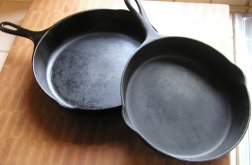 Question:
I just purchased a cast iron skillet which was not seasoned. I scrubbed and scrubbed to get the protective coating off as the manufacture states. I think it is paraffin – I hope anyway. Do know what they use to protect the Iron? And If I can’t get it off will it have any bad effects? – Frank (12/14/05)
Answer:
I called the manufacture and I was told that wax is used in the molding process. They state that you do not really need to wash it off. They recommend to wipe it down with peanut oil and place it in the barbecue because it will smoke a little.
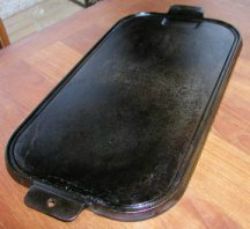 Question:
I recently purchased a cast iron grille pan that was pre-seasoned at the factory. I washed it with hot water and sprayed it with oil prior to the first use. The problem is that when I now clean the pan I keep getting black stuff off the pan. My brush that I use is black now. What is causing this? When I oil it after washing and wipe the excess off, the paper towel is black. Please help. Thank you. Barb (11/01/05)
Answer:
I have never used a pre-seasoned cast iron pan. From what I understand, even pre-seasoned pans will eventually need to be re-seasoned. Here is what I would do:
Both the natural, classic finish and pre-seasoned pans are seasoned in the same way. First wash with hot, soapy water and a stiff, nonmetallic scouring pad or brush. Then rinse and dry completely. NOTE: Never soak or let soapy water sit in the pan for any length of time.
Apply a thin coat of melted, plain vegetable shortening such as Crisco to the entire surface, both inside and out. Cooking oil or sprays should not be used for seasoning because they will eventually make the surface sticky. (Both, however, can be used for cooking.) Coat the handle, edges and corners of the pan, and if it has a cast iron lid, coat that, too. Wipe out excess shortening with a paper towel.
Preheat your oven to 350 degrees F. Line the lower oven rack with aluminum foil to catch any drippings. Place the cast iron pot upside-down on the middle rack and bake 2 hours for the new, natural-finish pans, and 1 hour for older pans with either finish.
Turn the oven off and let the pan cool before removing it from the oven. Wipe again with a paper towel. Once seasoned, a new, natural-finish pan will acquire a brownish-gray color. With time and use, and re-seasoning, it will become shiny and black. Seasoning is an ongoing process, and a well-seasoned pot has a surface that will release food easily. A rule of thumb to consider – If the crust on your fried fish or chicken begins to stick and burn, it’s time to re-season.
How to clean:
The right seasoning also will repel rust, but if the pan begins to show traces, or if it takes on a metallic smell or taste, wash it with soap and hot water. Scrub off rust with an abrasive, nonmetallic pad or stiff brush (never a metallic scouring pad such as SOS) and then re-season.
Allen-Grier suggests cleaning pots after cooking with a stiff brush and hot water only. Never wash cast iron pans in the dishwasher or scour with abrasive detergents. In fact, purists do not use soap of any kind on their cast iron pans. Salt is rubbed on the surface to clean the pan; it’s then rinsed and dried immediately.
If that makes you uncomfortable, clean the pan immediately after use with a little mild dish washing liquid and hot water. If, soap is used, however, the pan will need to be re-seasoned more often.
Never soak or let soapy water sit in the pan for any length of time. After cleaning, rinse and dry immediately with a kitchen towel. Set your pan back on your burner on medium heat until it is completely dry (air-drying eventually will cause the pan to rust). Then apply a light coating of vegetable oil to cookware, wiping out the excess.
Check out all my web pages on cast iron pots, kettles, and Dutch ovens:
Main Page:
The Irreplaceable Cast Iron Skillet
Question & Answer Pages:
Ceramic Top (Flat Top) Electric Range and Cast Iron Pots
Hot Fire for Curing & Cleaning
Iron and Carcinogens in Cast Iron
Self-Cleaning Oven for Cleaning & Seasoning
Warped or Cracked Cast Iron Pots